- What Is a Tax Code and Why It Matters
- Why Does Your Tax Code Matters?
- Why Has My Tax Code Changed?
- What Do UK Tax Code Letters and Numbers Mean?
- How a Tax Code Change Affects Your Pay ?
- How to Check If Your Tax Code Is Correct?
- Signs Your Tax Code Might Be Wrong
- What to Do If Your Tax Code Is Wrong?
- How to Change Your Tax Code (If Needed)
- Special Cases: Directors, Freelancers & Multiple Jobs
- FAQs: Frequently Asked Questions
- Conclusion
One of the most searched questions related to tax is “Why has my tax code changed?”
The tax code is a number given by HMRC, It shows how much tax‑free income you’re entitled to each year, and updates it when your circumstances change. This can include things like a new job, a change in salary, taxable benefits from your employer, or corrections to tax you owe or have overpaid.
A change in your tax code can directly affect your net income, still many taxpayers don’t understand the reason why the tax code has changed, whether it is correct or not.
For many people, the issue isn’t just about the code; it’s about the uncertainty it causes. Are you paying too much? Underpaying? Or is this an early warning sign to a larger problem later on?
Understanding your tax code is more than just ensuring compliance; it is also about protecting your income. In this blog, we will discuss the reasons for tax code changes, their actual impact, and how you can respond confidently.
What Is a Tax Code and Why It Matters
Your tax code is a short collection of numbers and letters supplied by HM Revenue and Customs that informs your employer or pension provider on how much Income Tax to deduct from your pay.
If you look at the tax code for the first time, you will find it confusing. The tax code is a combination of numbers and letters, it carries a meaning.
- Numbers indicate how much tax-free income (Personal Allowance) you can make in one year.
- Letters represent your circumstances (for example, whether you qualify for the basic allowance or have adjustments).
For example, the most common UK tax code 1257L means you can earn £12,570 tax-free in a tax year before paying Income Tax.
Why Does Your Tax Code Matters?
Your tax code has a direct impact on your income. If everything is okay, you will automatically pay the correct amount of tax via PAYE. However, if it is incorrect, it may result in:
- Overpaying tax – reducing your monthly income unnecessarily
- Underpaying tax – which could result in an unexpected bill later
- Cash flow issues – especially if changes happen without you noticing
Tax codes are not fixed permanently. They can change depending on your income, benefits, job changes, or previous tax adjustments, which is why many individuals wonder, “Why Has My Tax Code Changed?”
Why Has My Tax Code Changed?
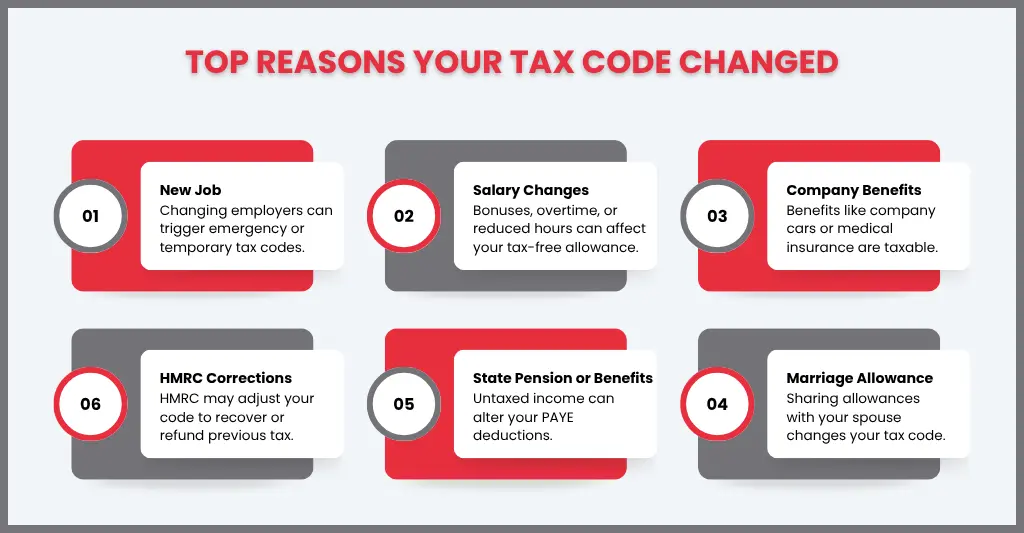
If you are thinking of this question why your tax code has changed, there can be some of the following reasons behind it.
Let’s break down the most common reasons:
Change in Employment
Starting a new job, changing employers, or working numerous jobs might all result in a tax code change. When you change jobs, HMRC may not immediately receive your complete income information. This can lead to:
- A temporary emergency tax code.
- Adjustments after your income is validated.
If you have recently switched jobs, this is typically the first place to look.
Changes in Income
A rise or drop in your income can affect how much tax you owe, and your tax code adjusts accordingly.
This could include:
- Salary increases or bonuses
- Overtime or variable pay
- Reduced hours or unpaid leave
Even small changes can lead to HMRC recalculating your tax-free allowance.
Benefits from Employer
If you receive benefits through your employer, they are often taxable, and reflected in your tax code.
Common examples include:
- Company car or fuel allowance
- Private medical insurance
- Interest-free or low-interest loans
These benefits reduce your tax-free allowance, which can lower your take-home pay.
HMRC Adjustments or Corrections
HMRC occasionally modifies your tax code to correct unpaid or overpaid taxes from past years.
For example:
- If you underpaid tax last year, HMRC may spread the repayment across your current tax code
- If you overpaid, your code may be adjusted to refund it gradually
These adjustments can happen even if nothing has changed in your current job.
State Benefits or Pension Changes
If you receive state benefits or a pension, your tax code may be adjusted to include this income.
This can apply to:
- State Pension
- Jobseeker’s Allowance
- Other taxable benefits
Because some of these payments are made without tax deducted, HMRC modifies your tax code to collect the proper amount elsewhere.
Marriage Allowance or Personal Allowance Changes
If you apply for Marriage Allowance or your Personal Allowance changes, your tax code will reflect this.
For instance:
- Transferring part of your allowance to a spouse
- Losing allowance due to higher income
- Annual updates to tax thresholds
These changes can slightly increase or decrease how much tax you pay.
What Do UK Tax Code Letters and Numbers Mean?
When you check your tax code, you will normally see a few digits followed by one or more letters, such as 1257L or 0T, with each section indicating how much tax HMRC should deduct from your salary. The numbers in your tax code indicate your tax-free income for the year, while the letters describe your tax situation, such as if you receive the standard Personal Allowance, use Scottish or Welsh tax bands, or have untaxed income collected through PAYE.
What Do the Letters Mean?
The letters explain your tax situation and how your allowance is applied.
Here are some common UK tax code letters:
- L – You are entitled to the standard Personal Allowance
- BR – All your income is taxed at the basic rate (usually used for a second job)
- D0 – All income taxed at higher rate (40%)
- D1 – All income taxed at additional rate (45%)
- K – You have extra taxable income or owe tax (your allowance is reduced below zero)
- M / N – Marriage Allowance adjustments (received or transferred)
- T – Your code includes other calculations or adjustments
- 0T – No Personal Allowance applied (often temporary or emergency)
How a Tax Code Change Affects Your Pay ?
A tax code change is not just a minor change in a series of numbers. It directly affects how much tax is deducted from your salary every time you are paid. And because it is applied through PAYE by HM Revenue and Customs, even little changes can have a significant influence on your monthly earnings.
Your Take-Home Pay Changes Immediately: Your tax code affects your tax-free amount. When that allowance changes, your taxable income changes, which has a direct impact on your net compensation.
- Higher allowance → Less tax → More take-home pay
- Lower allowance → More tax → Less take-home pay
Adjustments Are Spread Across the Year: When HM Revenue and Customs changes your tax code, they normally do not take or refund the entire sum in one go.
Instead, they spread the change across your remaining payslips for the tax year, making the impact feel gradual rather than sudden.
You May Be Paying Back Old Tax (Without Realising It): If your previous year tax was underpaid, HMRC often collects it silently through your tax code.
How it works:
- Your tax-free allowance is reduced
- More tax is deducted each month
- The underpaid amount is recovered over time
Example:
If you owe £600 from last year, HMRC may reduce your personal allowance so you repay around £50 per month instead of asking for a lump sum.
You may get a refund: When your tax code changes, it doesn’t always mean bad news. If you have overpaid taxes, HM Revenue and Customs may change your tax code to refund the money to you. Instead of delivering a lump-sum refund, HMRC normally raises your tax-free allowance, resulting in less tax being deducted from your wage in the future. As a result, your take-home pay will increase somewhat each month. Because this occurs gradually, many people are unaware they are receiving a return.
Benefits in Kind Can Quietly Reduce Your Salary: Benefits from your employer, such as a company vehicle or private medical insurance, are considered taxable income. Instead of taxing them separately, HMRC deducts the amount from your tax-free allowance. This causes a higher amount of tax to be deducted from your salary each month. As a result, even if your gross compensation remains unchanged, your net pay may fall.
How to Check If Your Tax Code Is Correct?
If you ever notice a change in your tax code, the first question might be “why has my tax code changed?”. But the next step should be making sure the tax code is correct or it will cost you money.
The good news? Checking your tax code is simpler than most people think.
Check Your Payslip or P60
Start with the basics. Your tax code is usually shown on:
- Your monthly payslip
- Your P60 (year-end summary)
- Your P45 (if you’ve recently changed jobs)
Make a note of the code and check if it looks familiar or if it has recently changed.
Use Your Personal Tax Account
The easiest way to verify your tax code is through an online account with HMRC.
There, you can:
- View your current tax code
- See how it has been calculated
- Check income and benefits HMRC has recorded
This is often where you will spot if something doesn’t match your actual situation.
Review Your Income and Job Details
Ask yourself a few key questions:
- Have you started a new job or changed employers?
- Do you have more than one source of income?
- Has your salary, bonus, or overtime changed?
If HMRC’s records don’t reflect your current situation, your tax code may be incorrect.
Check for Benefits or Adjustments
Look for any benefits that might be included in your tax code, such as:
- Company car
- Private medical insurance
- Other perks from your employer
Also check if there are adjustments for:
- Underpaid tax from previous years
- Estimated income that doesn’t match reality
Even small mismatches here can affect your code.
Compare With Standard Tax Code
Most people’s standard tax code is 1257L (based on the Personal Allowance of £12,570. If your code differs significantly, it is important to understand why. Differences do not always mean that something is wrong, but they do indicate that you should check.
Contact HMRC If Something Looks Off
If you have doubt or you are unclear about any change in the tax code, what is the reason behind it. Then you should contact HMRC through call or your online HMRC account.
Signs Your Tax Code Might Be Wrong
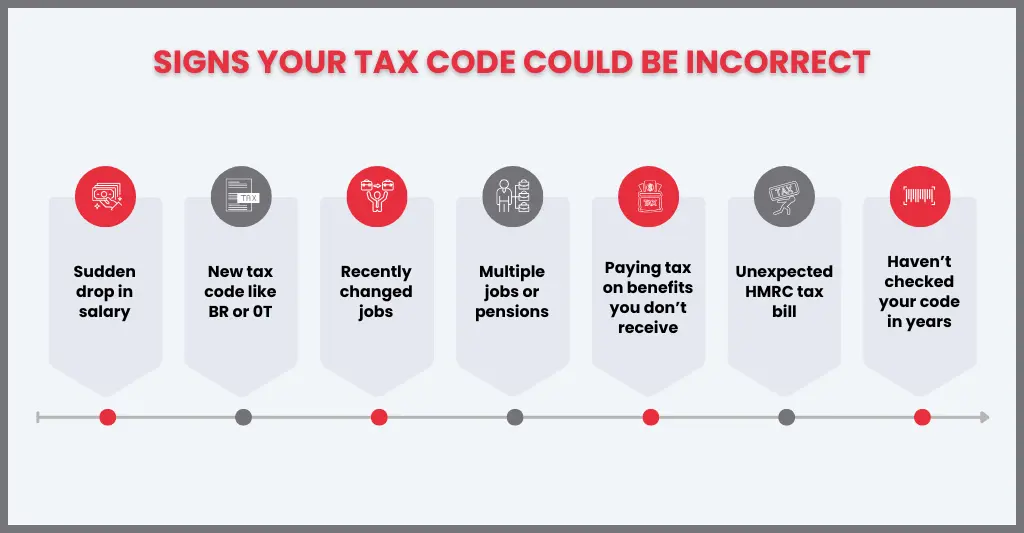
These might be the reason if you notice your tax code is not the same as the previous.
- Sudden change in take-home pay – Your salary drops or increases without any clear reason
- Unusual tax codes – Codes like BR, 0T, or K appear on your payslip
- Recently changed jobs – You may be on an emergency tax code
- Multiple income sources – Tax may not be split correctly across jobs or pensions
- Incorrect benefits included – You’re being taxed for perks you don’t receive
- Unexpected tax bill – Could mean your tax code was wrong earlier
- Haven’t checked in a while – Your code may be based on outdated info from HM Revenue and Customs
If any of these apply, you should review your tax code because minor inaccuracies can result in overpayment or underpayment.
What to Do If Your Tax Code Is Wrong?
If you believe your tax code is incorrect, do not dismiss it; even little inaccuracies can have a long-term impact on your pay. Here’s what you should do.
Check the Details First: Check your tax code on your payslip or on your HM Revenue and Customs account. Verify your income, work description, and perks.
Gather the Right Information
Before taking action, keep these details ready:
- Employer name(s)
- Estimated annual income
- Details of any benefits (car, insurance, etc.)
- Previous tax documents (P45/P60)
Contact HMRC: If something doesn’t seem correct, contact HMRC directly. You can:
- Update data with your Personal Tax Account.
- Dial their helpline.
- They can adjust your tax code using the most recent information.
Inform Your Employer (If Needed): When your tax code is updated, your employer will often apply the new code automatically. However, check your next payslip to ensure the modification has been applied.
Claim Back Any Overpaid Tax
If you have been overpaying, you will usually get a refund:
- Through your updated payslip
- Or as a direct payment from HMRC
How to Change Your Tax Code (If Needed)
You cannot directly modify your tax code, but you can have it modified through HM Revenue and Customs.
Here’s the quick process:
- Check your details in your Personal Tax Account
- Update any incorrect info (income, job, benefits)
- Contact HMRC if something still looks wrong
- Wait for the updated code to be sent to your employer
- Check your next payslip to confirm it’s applied
Special Cases: Directors, Freelancers & Multiple Jobs
If you do not work in a traditional salaried position, tax rules can get more confusing. Certain scenarios necessitate extra caution to guarantee you’re paying the correct amount of tax.
Directors: Directors frequently have irregular pay schedules and dividends, which can complicate ordinary tax regulations. HMRC typically calculates a specific annualised code for the entire year, but changes in dividends, bonuses, or salaries might still alter your take-home pay.
Freelancers & Self-Employed Income: If you are partially self-employed or make extra income outside of PAYE, HMRC may change your code to collect tax on projected earnings. If your self-assessment tax has not yet been taken into account, this may result in greater PAYE deductions.
Multiple Jobs: Having many jobs can also affect your tax code. Your main work consumes your standard allowance. Secondary jobs may use a BR code, indicating that all income is taxed at the basic rate. This guarantees that tax is collected appropriately, but it may result in temporary overpayments or underpayments if HMRC does not have precise total income information.
FAQs: Frequently Asked Questions
Why would my tax code suddenly change?
Your tax code may change as a result of a new employment, changes in income, employer benefits, HMRC modifications, or personal allowance changes. It is HMRC’s method of ensuring that the appropriate tax is deducted from your pay.
Why is my tax code lower than 1257L?
A tax code less than 1257L indicates that your tax-free allowance has been reduced. This may happen if HMRC is collecting unpaid tax from a previous year, you get taxable benefits, or your personal circumstances (such as income or allowances) have changed.
How can I check if my tax code is correct?
You can find your tax code on your payslip, P60, or P45, or by accessing your HMRC Personal Tax Account. Compare it to your present income, perks, and allowances to confirm it is appropriate for your position.
What are the new tax rules for 2026?
For 2026, the UK Personal Allowance remains at £12,570, while income tax rates (20%, 40%, and 45%) remain constant. Some allowances, such as the dividend and savings allowances, remain untouched, and Making Tax Digital applies to self-employed and landlords as well. Due to fiscal pressure, freezing thresholds may have an impact on higher earners.
Why has my tax code changed from 1250l to 1185l?
A decrease in your tax code from 1250L to 1185L indicates that your tax-free allowance has been lowered. This may occur if HMRC is correcting for underpaid tax from the previous year, including taxable benefits, or reflecting changes in your income or personal circumstances. It results in somewhat more tax being withheld from your paycheck each month.
Which tax year does the £12,570 Personal Allowance apply to, and what does it mean for higher earners?
The £12,570 Personal Allowance currently applies to the 2025/26 and 2026/27 tax years in the UK. Income‑tax bands (20%, 40%, and 45%) remain unchanged, but frozen thresholds mean more people are pushed into higher‑rate tax as their income rises. This can indirectly affect your tax code, especially if your salary or benefits increase over time.
Do these rules apply to Scottish taxpayers as well?
Yes, but Scottish taxpayers are issued S‑prefixed tax codes (for example S1257L) and taxed at Scottish Income Tax bands, which differ from the rest of the UK. The format of the code still shows your tax‑free allowance, but the rates applied depend on where HMRC classifies you as a Scottish taxpayer.
Where can I check my tax code and official HMRC guidance?
You can check your tax code on your payslip, P60, or P45, or through your HMRC Personal Tax Account on the GOV.UK website. HMRC also provides free guidance on how tax codes are calculated and what to do if you think your code is wrong.
Conclusion
Understanding your tax code is much more important than most people realise. If you ever think of this question, “Why Has My Tax Code Changed?” The essential lesson is that changes typically reflect modifications to your income, benefits, or HMRC adjustments, but they can sometimes result from errors or outdated information.
An incorrect tax code might reduce your take-home pay, disturb your budget, or result in unexpected tax bills. That’s why it’s important to:
- Check your tax code regularly
- Review your income, benefits, and job details
- Update HMRC if something doesn’t match
- Monitor your payslip after any changes
Staying proactive ensures that you pay the appropriate amount of tax, not too much, not too little, while preventing surprises later in the year. Taking a few minutes today to check your tax code can help you save money, decrease stress, and gain confidence in your finances.
Still worried about your tax code?
If you’re unsure whether your tax code has changed legitimately – or if you’ve been over‑ or underpaying tax – it’s always sensible to get professional help. Cox Hinkins can review your tax code, check for hidden PAYE errors, and help you reclaim any overpaid tax or spread adjustments in a way that protects your cash flow.
Get in touch with Cox Hinkins today to book a tax‑code review or a free initial consultation with one of our chartered accountants.