In the UK, managing payroll involves more than just paying workers on time; firms must also adhere to HMRC’s strict PAYE requirements. If you miss PAYE deadlines, your company may face fines, interest, and needless compliance stress.
HMRC deducts income tax and national insurance directly from an employee’s salary using the PAYE (Pay As You Earn) system. It is your responsibility as an employer to check the appropriate amount is deducted, handle payroll, and ensure that HMRC is paid on time.
In this blog we are going to outline the PAYE deadlines & look at why they are so important for UK employers. We will cover the Full Payment Submission (FPS), the Employer Payment Summary (EPS), when PAYE tax & national insurance are due, plus the key yearly PAYE deadlines we’re expecting in 2026. You will also get to know how the whole quarterly PAYE payments system works, what happens if you miss a deadline and some practical tips for keeping your business organised & compliant throughout the tax year.
What Are PAYE Deadlines?
Employers have deadlines for submitting payroll data and paying HMRC their National Insurance and Income Tax obligations.
Employers are required by the PAYE system to promptly record employee pay and deductions through payroll submissions such as FPS and EPS. HMRC may impose penalties and interest if certain deadlines are missed.
PAYE deadlines usually include:
- Sending payroll reports such as Full Payment Submissions (FPS)
- Submitting Employer Payment Summaries (EPS) when required
- Paying PAYE tax and National Insurance contributions to HMRC
- Completing annual payroll reporting obligations
To avoid fines, interest, and compliance problems it is important to be updated about the all PAYE deadlines.
Key PAYE Deadlines Employers Must Know in 2026
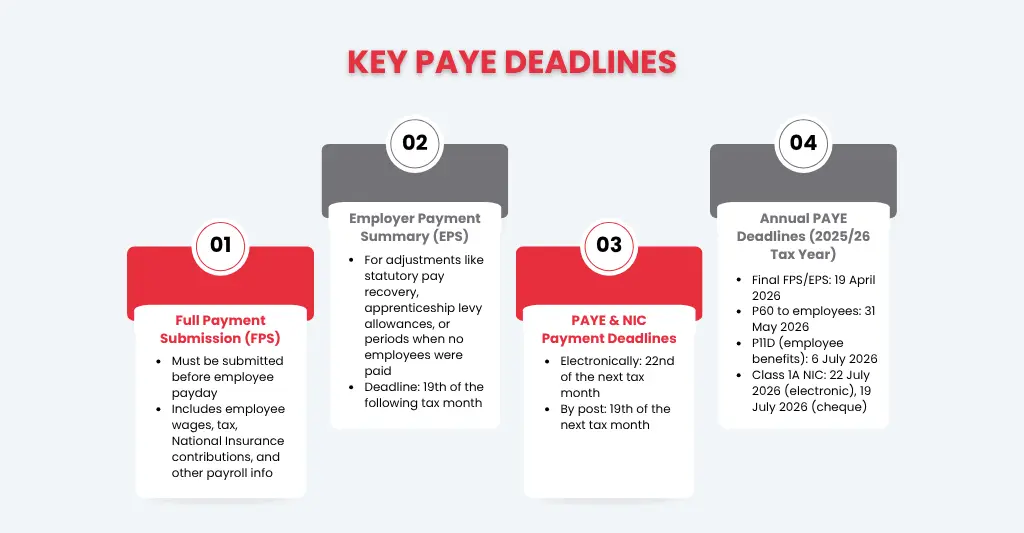
Error-free payroll management requires knowledge of the key PAYE dates set by HMRC. These are the main PAYE dates for 2026 that employers should be aware of.
Full Payment Submission (FPS)
Before an employee’s payday an FPS must be submitted to HMRC. FPS includes details of employee wages, tax deductions, National Insurance contributions as well as other payroll information.
Employer Payment Summary (EPS)
When you must report modifications to HMRC, such as mandatory pay recovery, apprenticeship levy allowances, or times when no employees were paid, you submit an EPS. In general, it must be submitted by the 19th of the following tax month.
PAYE Tax and NIC Payment Deadlines
Employers are required to pay HMRC the PAYE tax and National Insurance contributions that are withheld from workers:
- By the 22nd of the next tax month if paying electronically
- By the 19th if paying by post
Instead of making monthly payments, small businesses would be able to make quarterly PAYE payments.
Annual PAYE Deadlines
- Final FPS or EPS submission for the tax year: by 19 April 2026
- Providing P60 forms to employees: by 31 May 2026
- Reporting employee benefits through P11D forms: by 6 July 2026
- Paying Class 1A National Insurance: by 22 July 2026 if paying electronically (19 July if paying by cheque)
How Do You Pay PAYE Quarterly?
Small employers can pay PAYE quarterly rather than monthly if their average monthly PAYE and National Insurance liability are less than £1,500. This lessens the need for payment management and enhances cash flow.
Quarterly PAYE payment deadlines are:
- 22 July
- 22 October
- 22 January
- 22 April
If paying by post, payments must reach HMRC by the 19th of the month.
Employers are still required by HMRC’s Real Time Information (RTI) regulations to provide payroll reports, such as Full Payment Submission (FPS), on or before each payday even with quarterly payments.
PAYE can be paid through:
- Online banking
- Direct Debit
- Faster Payments
- Debit or corporate credit card
Consequences of Missing PAYE Deadlines
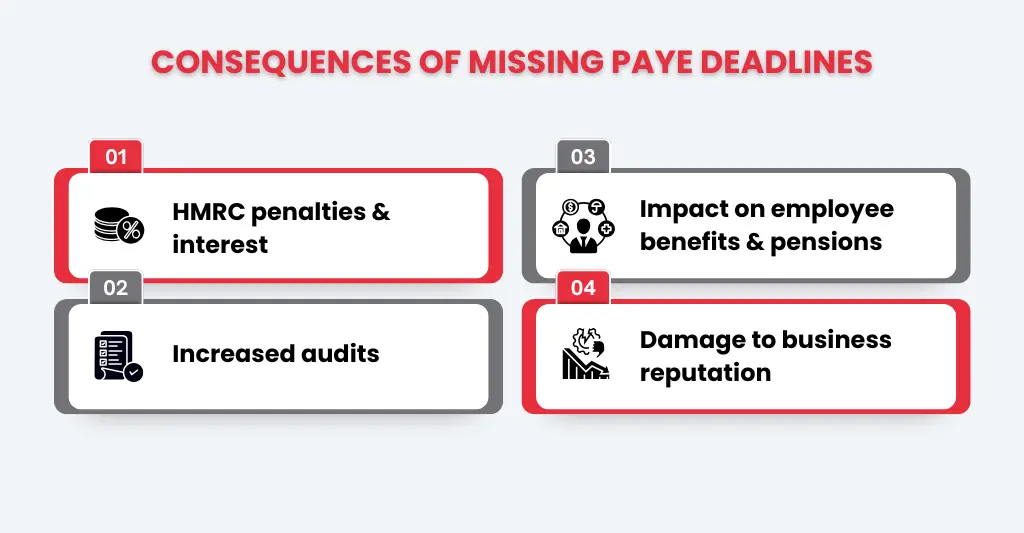
If you miss any deadline you have to face its consequences there can’t be any safe option. Similarly, there are some consequences that you may face for missing PAYE deadlines.
Here’s what can happen:
Penalties from HMRC: Late submission of employees FPS and EPS can automatically incur penalties. As long as you delay the submission the penalties will keep on increasing and add up especially for larger payrolls.
Interest Charges: HMRC increases your total liability by charging interest on unpaid PAYE tax or National Insurance contributions.
Increased Scrutiny: If HMRC notices you are repeatedly missing the deadlines, then it may land you in trouble for investigations and audit through HMRC.
Employee Impact: Payroll reporting delays may have an impact on statutory payments, employee benefits, and pensions, which could result in complaints or dissatisfaction.
Damage to Business Reputation: Persistent non-compliance can damage your reputation with HMRC, investors, and staff. It can also make it more difficult for you to get funding or expand your company.
How to Stay on Track With PAYE Deadlines
If you don’t want to miss the PAYE deadlines here are some tips you can use to be on track and keep a good image in the eyes of HMRC.
Use HMRC-Compatible Payroll Software: On every payday, companies must electronically submit payroll data to HMRC’s Real Time Information (RTI) system. Using HMRC-recognised payroll software ensures:
- Accurate calculation of Income Tax and National Insurance
- Timely FPS and EPS submissions
- Automatic reminders for deadlines
Popular software like Sage, Xero, QuickBooks, or BrightPay can integrate with HMRC systems for seamless reporting.
Set Clear Calendar Reminders:
Key 2026 PAYE dates to track include:
- FPS submissions: on or before every payday
- EPS submissions: by the 19th of each month if adjustments are needed
- PAYE and NIC payments: by the 22nd of the month (19th if paying by post)
- Annual submissions: P60s by 31 May, P11Ds by 6 July, Class 1A NIC by 22 July
Plan Payroll in Advance: Prepare payroll at least a few days before each payday this will give you time to correct errors. Make sure benefits, pensions and statutory deductions are accurately recorded.
Outsource payroll: Whether you are a small business or large one outsourcing payroll to the trained accounting team can make the difference. Outsourced team can give:
- Compliance guarantee with all RTI and PAYE deadlines
- Reduce administrative workload of inhouse staff
- Get expert guidance in handling complex payroll scenarios like statutory payments, benefits, or director-only payroll.
Maintain Accurate Employee Records: Keep employee data up-to-date, including:
- Wages and bonuses
- Tax codes and National Insurance numbers
- Pension contributions and statutory benefits
Accurate records make FPS, EPS, P60, and P11D submissions straightforward and reduce the chance of HMRC penalties.
PAYE Arrears and Appeals
Employers may occasionally argue with HMRC’s penalty determinations or fall behind on PAYE payments. To reduce the financial impact and maintain compliance, it is crucial to understand how to handle arrears and appeals.
PAYE Arrears: When employers don’t pay income tax or National Insurance on time that time PAYE arrears occur. What happen if arrears accumulate:
- HMRC may charge interest on overdue amounts
- If longer time payment is unpaid, the penalties will increase
- HMRC can take enforcement action, including deductions from your business bank account.
It’s crucial to get in touch with HMRC right away if you are unable to pay the entire amount at once. They may agree to a Time to Pay (TTP) plan, which would let you pay off arrears in manageable installments.
Appealing PAYE Penalties: If employers feel HMRC has issued a wrong penalty to them they can make an appeal for it.
- Technical errors in payroll submissions
- Exceptional circumstances beyond the employer’s control (e.g., illness or IT failure)
- Prompt correction of mistakes after discovery
Make sure your appeal is submitted within 30 days of receiving the penalty notice, mostly via HMRC online portal or by post. But supporting evidence should clearly state why the penalty should be reduced or cancelled.
Frequently Asked Questions
What happens if I miss a PAYE deadline?
Missing a PAYE deadline is a big mistake, as HMRC can charge penalties and interest on late payments or submissions. Repeated delays can trigger audits or strict action against your company.
Can I pay PAYE quarterly instead of monthly?
Sure. Small businesses can typically make quarterly payments if their average monthly PAYE and National Insurance liability is less than £1,500. Payroll reports, such as FPS, are still required to be turned in on each payday. The deadlines for quarterly payments are July 22, October 22, January 22, and April 22 (or the 19th if paying by mail).
What records do I need to keep for PAYE compliance?
If anytime in future HMRC investigation happens they can ask for payroll records as a proof of PAYE compliance. So, you need to maintain records at least for 3 years from the end of the tax year. Your records must include the following documents:
Employee details: name, address, National Insurance number, and tax code
Pay information: wages, bonuses, overtime, and deductions
Tax and National Insurance contributions deducted
Statutory payments: sick pay, maternity/paternity pay, and other benefits
Pension contributions and any workplace schemes
Records of FPS and EPS submissions to HMRC
Maintaining these records ensures accurate reporting, helps with audits, and protects your business from HMRC penalties.
How do I correct mistakes in my PAYE submissions?
As a human, making errors is a common thing. But there are some ways how you can rectify them:
Submit an amended FPS: Most errors in employee pay, tax, or National Insurance can be corrected by sending a new FPS with the correct information.
Submit an EPS if needed: If the error involves adjustments like statutory payments or recoveries, use an EPS to correct it.
Notify HMRC if necessary: For complex errors or missed payments, contact HMRC to explain the mistake and avoid penalties.
Document the correction: Keep a record of the original submission, the error, and the correction for compliance and audit purposes.
Are there special PAYE deadlines for new employers?
Before receiving their first payment, new employers must register with HMRC. The deadlines for FPS submissions and PAYE/NIC payments are the same as for other employers. If the average monthly liability is less than £1,500, quarterly payment rules may effect.
Conclusion
Paying your HMRC PAYE bill on time and adhering to HMRC PAYE deadlines are essential components of managing payroll in the UK. Avoiding expensive fines, safeguarding your company’s reputation, and maintaining the accuracy of your employees’ tax records all depend on doing it correctly.
You can maintain the seamless operation of your payroll and be completely compliant with HMRC regulations by understanding the important dates, putting up dependable methods or software, and getting expert assistance when necessary.
Speak with an accountant or payroll specialist if you have questions about your PAYE obligations or are having trouble fulfilling them. Staying on top of these deadlines will save you time, money, and stress in the long run.