Employees and businesses may feel overwhelmed as the tax year comes to an end. P60s may appear to be just another piece of paperwork, but they must be completed correctly and on time. Employees’ P60 is the official record of their income, taxes paid, and National Insurance contributions, and it can have an impact on everything from collecting refunds to applying for loans or assistance. It is a critical compliance requirement for organisations, and failing to meet the deadline can result in dissatisfied employees, HMRC fines starting at £300 plus £60 per day late, or undue stress at the end of the year.
This blog is intended to take the mystery out of P60 deadlines. We will explain what a P60 is, who needs it, and which deadlines you can’t afford to miss. In addition, we will provide practical ideas to help the process run smoothly, eliminate errors, and guarantee that everyone, from your payroll team to your employees, is confident that the year-end paperwork is completed appropriately.
What is a P60?
A P60 is an official document provided by your company at the end of the tax year (on April 5th in the UK). It summarises your total pay, tax paid, and National Insurance contributions for the year. Consider it your annual financial snapshot, it reveals exactly how much you earned and how much went to HMRC.
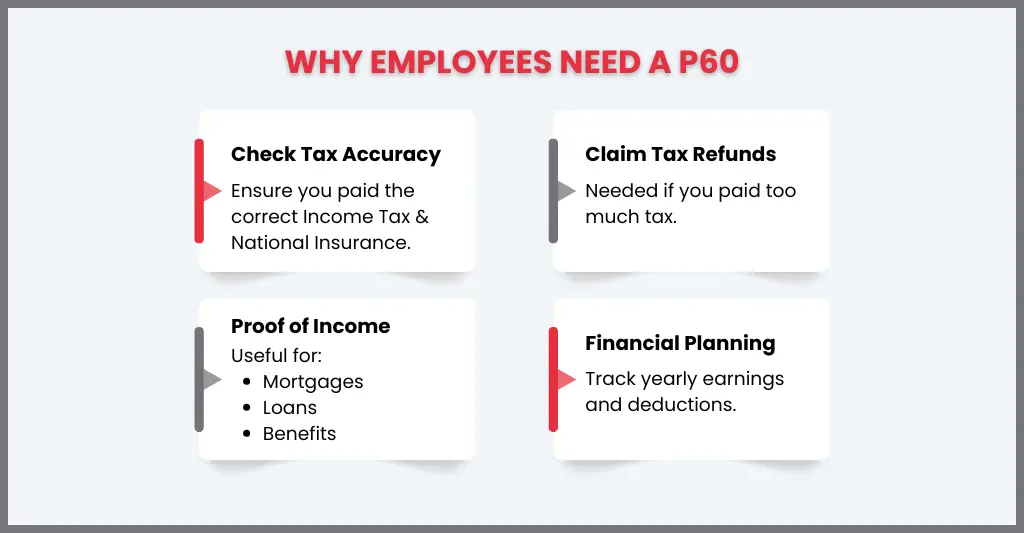
Employees need the P60 to check their taxes, seek refunds, and provide proof of income for loans, mortgages, or benefits. Employers are legally required to issue P60s on time and appropriately. by paper or securely electronic means (with proof of delivery retained). Each P60 should be distributed to relevant employees by 31 May following the tax year end.
In short, the P60 keeps everyone on track: employees know their tax position, and employers stay compliant with HMRC via Real Time Information (RTI) alignment.
Why the P60 is Important for Employees
The P60 is not just a form, it is your official record of earnings and taxes paid for the respective year. Here’s why it matters:
- Check Your Tax Accuracy: Make sure you have paid the right amount of income tax and National Insurance.
- Claim Refunds: P60 will give your tax refund back if it’s deducted more than necessary.
- Proof of Income: Mortgage providers, lenders, or government agencies may ask for your P60 as evidence of your earnings.
- Plan Your Finances: Knowing your exact pay and deductions helps you plan a budget for the year ahead.
P60 vs P45 vs Payslip (Quick Comparison)
There are a number of forms related to tax and payroll, so getting confused is easy. Here’s a quick breakdown of the following:
| Document | When you get it | Purpose | Key use |
| P60 | End of tax year( by 31May) | Summarises total pay, tax, and National Insurance for the year | Proof of income, tax refunds, loan/mortgage applications |
| P45 | When leaving a job | Details pay and tax up to leaving date | Giving to a new employer or claiming tax refunds |
| Payslip | Every payday | Shows current pay, deductions, and net pay | Tracking monthly earnings and deductions |
P60 Deadline 2026: Key Payroll Dates You Must Not Miss
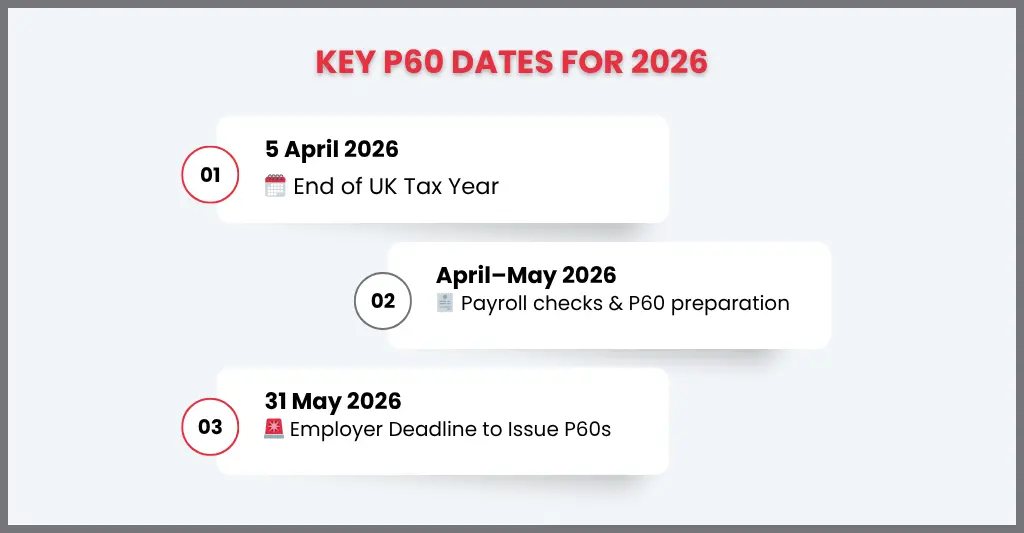
Keeping note of P60 deadlines is essential for both employees and managers. Missing these deadlines might result in fines, payroll issues, or delays in tax refunds. Here’s what you should know in 2026:
- End of Tax Year: 5th April 2026 – This is the date your P60 will cover, displaying your entire earnings and deductions up to this point.
- Employer Deadline for Issuing P60s: 31st May 2026 – Employers must submit P60s to all employees on payroll on 5 April 2026 (including those with earnings above NI Lower Earnings Limit, tax/NI deductions, or Student Loans)
- Submission for HMRC (Optional): P60s are primarily for employees, retain copies for at least 3 years (PAYE records ideally 6 years) for audits
Who Needs a P60 (And Who Doesn’t?)
P60 form is not meant for everyone, so you need to understand first whether it is applicable to you or not.
Who Needs a P60?
You will receive a P60 if you were on payroll on 5 April 2026. This includes
- Full-time and part-time employees on a company’s payroll
- Directors (even without salary payments)
- Employees on temporary or fixed-term contracts still active at year-end
If you fall into any of these categories, your employer is legally required to provide your P60 by May 31st.
Who Doesn’t Get a P60?
You won’t receive a P60 if:
- You left your job before 5th April (you will get a P45 instead)
- You are self-employed and not on PAYE
- You work as a freelancer or contractor and manage your own taxes
- Your income comes from sources outside payroll (like dividends or investments
Why the P60 Deadline Matters for Employers?
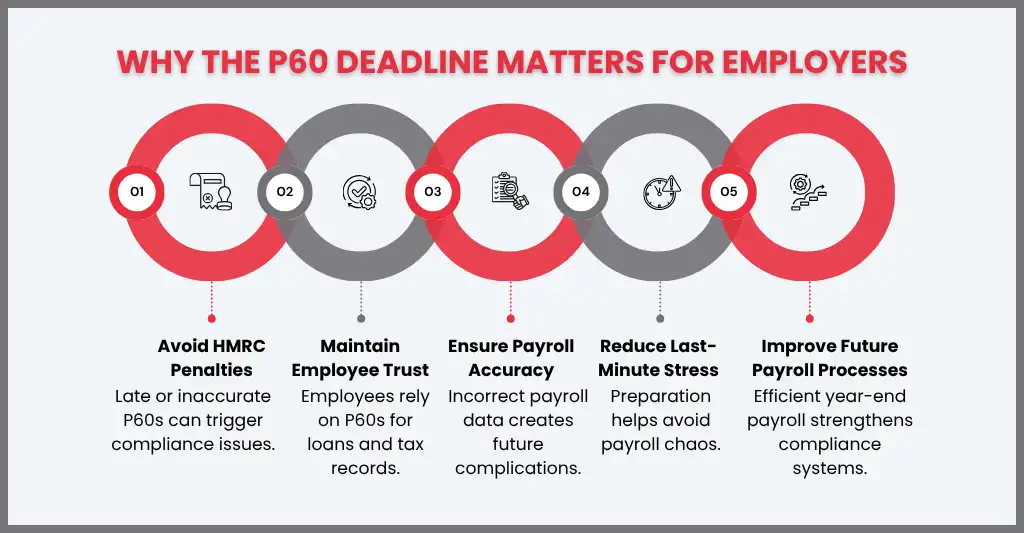
The P60 deadline is a legal requirement protecting employee tax positions and HMRC compliance. Missing it risks penalties (£300 initial + £60/day), audits, and reputational damage
- Avoid HMRC penalties: If employers don’t issue P60 forms on time it will result in compliance issues and penalties. HMRC demands timely reporting and delays can cause audits and reviews.
- Maintain employee trust: Employees rely on their P60 for important financial matters such as tax returns, loan applications, and evidence of income. Delays or inaccuracies can frustrate employees, break confidence in your payroll process, and result in recurrent inquiries.
- Ensure Accurate Year-End Reporting: P60 form reflects your payroll accuracy for the whole year. Make sure your figures are accurate in tax, pay, or National Insurance otherwise it can create complications that may take time to resolve later.
- Reduce Last-Minute Payroll Pressure: Leaving P60 till last minute can result in checks, higher chances of mistakes and unnecessary stress for your payroll team. Planning beforehand can ensure a smoother year-end process.
- Strengthen Your Payroll Process for the Future: Managing P60s efficiently sets the tone for your overall payroll system. It highlights gaps, improves processes, and ensures you are better prepared for upcoming compliance requirements.
Employer Responsibilities Before the P60 Deadline
Getting P60s right should start before the deadline. Little preparation before the deadline can save a lot of issues arising later. So, what employers need to do before issuing P60.
- Finalise your payroll records: Ensure that all payroll calculations for the tax year are complete and accurate. This includes salary, bonuses, overtime, and any adjustments made throughout the year.
- Check employee details: Make sure you are providing the right employee information to the payroll department. Even a small error in name, address, National Insurance numbers,and tax codes can cause problems for employees later.
- Reconcile tax and National Insurance: Cross check that the total for income tax and National Insurance match your payroll records and submissions. This will help you to avoid mistakes in P60.
- Review leavers and current employees: All the existing employees should receive P60 before 5th April. Also, make sure that you have issued P45 to the leavers.
- Test your payroll system or software: Before generating P60s, verify that your payroll software is producing accurate reports. A quick review can prevent errors happening with a number of employees.
- Plan how to distribute P60s: Decide how you will be providing P60 to all the employees, digitally or in paper form. Make sure the process is clear and secure for the employees.
Common Mistakes to Avoid Before the P60 Deadline
Mistakes can happen from anybody, whether the employee is new or old to tax filing. Following a checklist can prevent you from making errors, save time and reduce stress.
- Missing the deadline: At any cost try not to miss a deadline or you may have to pay a higher cost in terms of penalty. Therefore, employers should P60 before the deadline.
- Forgetting leavers: Employees who left the organisation before 5th April should receive P45 form not P60. Mixing this can confuse your records and employees.
- Incomplete payroll records: If any pay records are missing or not finalised, the P60 won’t reflect the correct totals. Always reconcile payroll before generating P60s.
- Failing to keep copies: Always maintain copies of your P60 records. This helps if HMRC audits your payroll or employees have any queries later.
FAQs: Frequently Asked Questions
What is the P60 deadline for 2026?
The P60 should be issued to employees by 31st May 2026. This is applicable to anyone who was employed on the last day of the tax year 5th April 2026. Employers should ensure payroll records are finalised and accurate before the P60 deadline to avoid errors and delays.
Can I download my P60 from HMRC?
P60 form is not issued by HMRC to employees. P60 is only provided by your employer, some employers may offer a digital version through payroll software or employee portals.
Is it illegal not to provide a P60?
Yes, employers are legally required to provide P60 form to all the existing employees who are on payroll. Failing to provide P60 by 31st May deadline can be considered as breach of payroll obligations and it may lead to compliance issues with HMRC.
Do I get a P60 if I leave my job?
No, if you quit your job before the end of the tax year (5th April), you will not receive a P60 form. Instead, your employer will provide P45 which will show your pay and tax details up to your leaving date.
How long should employers keep P60 records?
At least 3 years from tax year-end (PAYE standard). As it will be helpful at the time of payroll audits in the future.
What should I do if my P60 is incorrect?
If there are any errors in your P60, such as incorrect pay, tax calculations, or National Insurance details, then you should connect with your employer or payroll team promptly. They will correct the errors and issue an updated P60. In case the error affects your tax records you may need to contact HMRC.
Conclusion
Think of P60 as your financial summary in one single document. That shows how much you earned, what you paid in tax and how much money you have left for the rest of the year. For employees it’s a proof of income and a handy tool for tax verification or loan applications. Whereas, for employers it is a proof to show that payroll is accurate, organised and on time.
Staying on top of deadlines, double-checking details, and avoiding common mistakes is the key to completing the P60 process smoothly and stress-freely. Being prepared with the essential things before the deadline will save you time and unnecessary panic situations.
Need Help with Year-End Payroll and P60 Compliance?
Don’t risk HMRC penalties or employee frustration when the P60 deadline hits. At Cox Hinkins, our payroll experts handle the entire year-end process for you—from finalising payroll records to issuing accurate P60s by 31 May
Disclaimer: Kindly note this blog provides general information and should not be considered financial advice. We recommend consulting a qualified financial advisor for personalised guidance. We are not responsible for any actions taken based on this content.