- Tax avoidance vs tax evasion: what is legal?
- Understanding the UK Tax System in 2026/27: Key Changes and Rates
- Already announced: changes coming from April 2027 to 2029
- How to Reduce Corporation Tax in the UK?
- How to Reduce Tax on Salary in the UK?
- How to Reduce Capital Gains Tax (CGT) in the UK?
- How to Reduce Inheritance Tax (IHT) in the UK
- How High Earners Can Legally Reduce Their Tax Bills?
- Essential Tax Planning Tips and Tools for Every Taxpayer
- Frequently Asked Questions
- Conclusion
Tax season doesn’t have to be costly or stressful. In the UK, you can legally reduce your tax bill and keep more of your hard-earned money with careful planning. Each year, tax rules change, and the 2026/27 tax year (6 April 2026 to 5 April 2027) brings new opportunities and challenges for businesses, contractors, and individuals. This guide covers how to maximise allowances, use HMRC-approved tax reliefs, and organise your finances effectively. All while keeping the right business records, handling employee details, and staying compliant with HMRC reporting, which is legally required for every taxpayer.
Figures in this guide apply to England, Wales and Northern Ireland unless stated. Scotland sets its own income tax rates and bands.
In The Ultimate Guide to Legally Reduce Your Taxes in the UK in 2026/27, we will outline the best practices, point out significant changes to tax legislation, and provide you with practical steps you can take right now to save money and remain in compliance.
Tax avoidance vs tax evasion: what is legal?
The two terms are often confused, but they are very different.
- Tax avoidance means arranging your affairs to use the reliefs, allowances and exemptions the law provides, such as pension contributions, ISAs and capital allowances. Everything in this guide is legal tax planning of this kind. Artificial schemes that go against the intention of the law can still be challenged by HMRC.
- Tax evasion means deliberately hiding income or inflating expenses to pay less tax. It is a criminal offence that can lead to heavy fines, back taxes with interest and, in serious cases, prison.
Keeping records of everything you claim, and claiming only what you are entitled to, keeps you on the right side of that line.
Understanding the UK Tax System in 2026/27: Key Changes and Rates
You need to study how the UK tax system operates and what changes are made in 2026/27. After that, you can take the step of attempting to lower your tax liability. Tax rules are constantly changing over time. HMRC makes some adjustments to allowances, tax thresholds, and reliefs every year. These changes can have an immediate effect on your outstanding balance.
Key Changes for 2026/27
Income Tax Thresholds
The personal allowance (£12,570) and the income tax bands are frozen, and the freeze has been extended until 5 April 2031. As pay rises, more of your income is pulled into higher bands.
| Band | Taxable income | Tax rate |
| Personal Allowance | Up to £12,570 | 0% |
| Basic rate | £12,571 to £50,270 | 20% |
| Higher rate | £50,271 to £125,140 | 40% |
| Additional rate | Over £125,140 | 45% |
Dividend Allowance
Investors and business owners who use dividends to pay themselves have been impacted by a low tax-free dividend allowance of £500 and higher rates. From 6 April 2026, dividend tax rates for basic and higher rate taxpayers rose by 2 percentage points.
| Tax band | Dividend tax rate in 2026/27 |
| Basic rate | 10.75% |
| Higher rate | 35.75% |
| Additional rate | 39.35% |
Capital Gains Tax (CGT)
The annual exempt amount is £3,000. Gains are taxed at 18% for basic rate taxpayers (within the basic rate band) and 24% for higher and additional rate taxpayers. Gains that qualify for Business Asset Disposal Relief are taxed at 18% from 6 April 2026, up from 14% in 2025/26.
National Insurance Contributions (NICs)
Both self-employed people and employees are still impacted by changes to rates and thresholds. National Insurance thresholds remain frozen, with the freeze extended to April 2031. Every taxpayer must keep their National Insurance number updated for accurate filings.
Pension Contributions
Pension planning continues to be one of the most tax-efficient options for income tax purposes. Rules on pensions and inheritance tax, and on salary sacrifice, change from 2027 and 2029 (see below).
Making Tax Digital for Income Tax
Making Tax Digital for Income Tax started on 6 April 2026. Self-employed people and landlords with qualifying income (gross self-employment and property income combined) over £50,000 must keep digital records and send quarterly updates using compatible software. The threshold falls to £30,000 from April 2027 and £20,000 from April 2028.
Already announced: changes coming from April 2027 to 2029
These changes were announced at the Autumn Budget 2025. They do not affect your 2026/27 bill, but they matter for planning now.
- April 2027, pensions and inheritance tax: most unused pension funds and death benefits will count as part of your estate for inheritance tax.
- April 2027, savings income: tax rates on savings interest rise by 2 percentage points in every band.
- April 2027, property income: rental income gets its own rates of 22% (basic), 42% (higher) and 47% (additional) in England, Wales and Northern Ireland.
- April 2029, salary sacrifice: National Insurance will apply to salary-sacrificed pension contributions above £2,000 a year.
- To April 2031: the personal allowance, income tax bands, and the inheritance tax nil-rate bands stay frozen.
How to Reduce Corporation Tax in the UK?
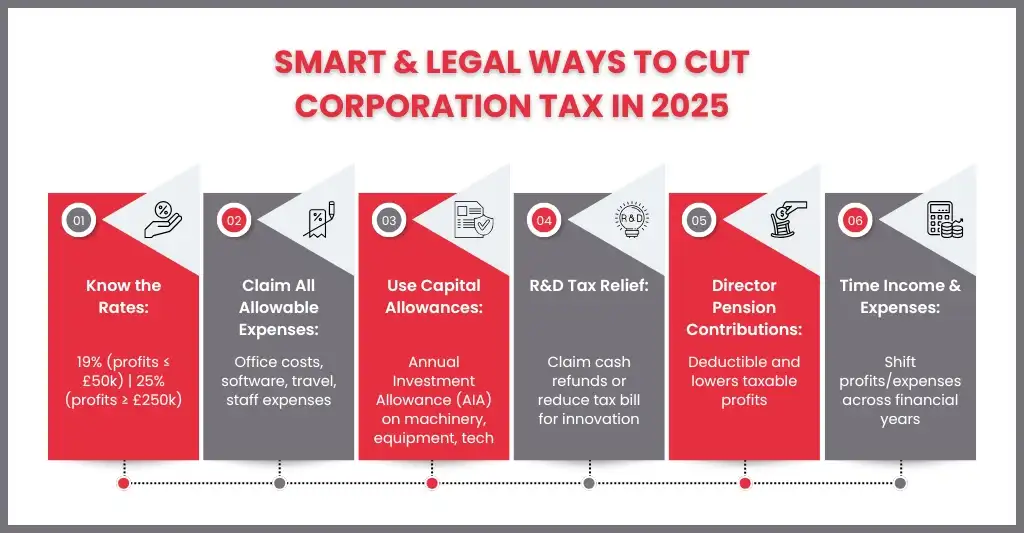
Corporation tax is a major burden for limited firms. In 2026/27, the small profits rate is 19% for profits up to £50,000, the main rate is still 25% for profits exceeding £250,000, and there is a marginal relief mechanism in between. Thankfully, there are a number of legally permitted methods to lower your corporation tax bill without breaking the law.
Claim All Allowable Business Expenses
Make sure all allowable expenses are subtracted from earnings prior to calculating taxes. Software subscriptions, travel, office expenditures, professional fees, and some employee costs can all be included in this. Always maintain clean business records for compliance.
Make the Most of Capital Allowances
Investments in machinery, technology, or equipment may be eligible for capital allowances, such as the Annual Investment Allowance (AIA), which may significantly decrease taxable profits. The AIA lets you deduct up to £1 million of qualifying spending a year. Recent changes to know about:
- Zero-emission cars and charge points: 100% first-year allowance continues until 31 March 2027 for corporation tax (5 April 2027 for income tax).
- Full expensing: companies can deduct 100% of qualifying spending on new main-rate plant and machinery in the year of purchase.
- New 40% first-year allowance: from 1 January 2026, 40% of qualifying main-rate spending can be deducted up front where full expensing is not available, for example on assets bought for leasing or by sole traders and partnerships. It excludes cars and second-hand assets.
- Lower writing down allowance: the main rate of writing down allowance fell from 18% to 14% from 1 April 2026 for companies (6 April 2026 for income tax), so relief on older main-pool balances is slower.
R&D (Research & Development) Tax Relief
If your company creates new goods, services, or procedures, you might be eligible for R&D reimbursement. For businesses that are losing money, this may result in a cash reimbursement from HMRC or a decrease in corporation tax.
Pension Contributions for Directors
Contributions to an employer’s pension plan are deductible business expenses. Contributions to a pension help directors save money over the long run while lowering taxable profits.
Consider Timing of Income and Expenses
Effectively managing taxable gains can be achieved by purposefully postponing revenue or accelerating expenses within the same financial year.
Choose the Right Business Structure
The structure you trade through changes how much tax you pay, so it is worth reviewing as your profits grow.
- Sole trader: simple to run, but all profits are taxed as your personal income, along with National Insurance.
- Limited company: profits are charged to corporation tax (19% to 25%). You choose how to pay yourself through salary and dividends, but dividends above the £500 allowance are taxed at 10.75% (basic rate) or 35.75% (higher rate).
An accountant can model which structure leaves you with the most after tax at your level of profit.
How to Reduce Tax on Salary in the UK?
Maximise Tax-Free Allowances
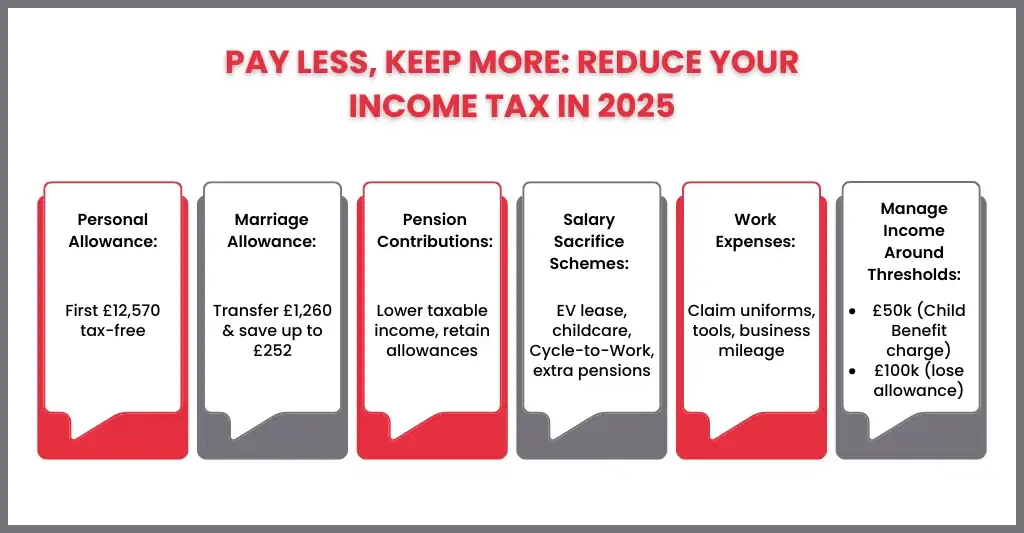
Personal Allowance: The first portion of your salary is exempt from taxes (£12,570 in 2026/27, frozen until April 2031). This allowance decreases if your income exceeds £100,000; however, there are strategies available to mitigate this (see pension contributions below).
Marriage Allowance: The lower earner may transfer up to £1,260 of their allowance to the higher earner, saving up to £252 per year, if they or their spouse earns less than the personal allowance, and the higher earner is a basic rate taxpayer.
Trading and property allowances: if you are self-employed or let out property, your first £1,000 of income from each can be tax-free (trading allowance and property allowance). You cannot also deduct expenses against the same income.
Contribute More to Your Pension
Salary Sacrifice/Pension Contributions: Your taxable income is decreased by pension contributions.
For instance, if you make £60,000 and contribute £10,000 to your pension, you will only be taxed on £50,000.
Keeping your income below certain thresholds, such as £100,000, where you begin to lose your Personal Allowance, can also be facilitated by this.
Employer pension plans: Salary sacrifice plans are provided by certain employers, which prevent both you and your employer from having to pay NICs. From April 2029, National Insurance will apply to salary-sacrificed pension contributions above £2,000 a year.
Use Salary Sacrifice Schemes: Some employers allow you to “sacrifice” a portion of your cash pay for non-cash benefits, which are either tax-free or NIC-efficient, instead of receiving your entire wage. Among the examples are:
- Cycle to Work scheme
- Electric car lease scheme (Benefit-in-Kind is very low on EVs)
- Additional pension contributions
- Childcare vouchers (if still in the old scheme)
Claim Work-Related Expenses
- Flat-rate expense allowances exist for certain jobs (e.g., nurses, mechanics, police).
- Use HMRC’s online portal to make claims.
- If you work from home, you may be able to claim for part of your household costs. Self-employed people can claim a share of costs or use HMRC’s simplified flat rates. Employees can usually claim only if their employer requires them to work from home.
Optimise Investments & Savings: ISA Allowance: You can save or invest up to £20,000 annually without paying taxes. From 6 April 2027, people under 65 can put no more than £12,000 of this into a cash ISA. Our guide to tax-free investments in the UK covers the options in more detail.
Dividend Allowance & Capital Gains Allowance: If you make money from investments as well, arrange your income to benefit from tax-free allowances (£500 dividend allowance and £3,000 CGT annual exempt amount in 2026/27).
Manage Income Around Key Tax Thresholds
- £60,000 to £80,000: The High-Income Child Benefit Charge may apply if you make more than £60,000 and you or your partner receive Child Benefit. You repay 1% of the benefit for every £200 of adjusted net income above £60,000, and all of it at £80,000. Contributions to a pension can help bring your adjusted net income down towards £60,000.
- £100,000: Above this, for every £2 earned, you lose £1 of your personal allowance. Donations to charities or pension plans may lower your adjusted net income
- £125,140: All Personal Allowance is gone.
Make Charitable Donations (Gift Aid)
Gift Aid donations raise your basic-rate tax band, resulting in a higher percentage of your income being taxed at 20% rather than 40%.
How to Reduce Capital Gains Tax (CGT) in the UK?
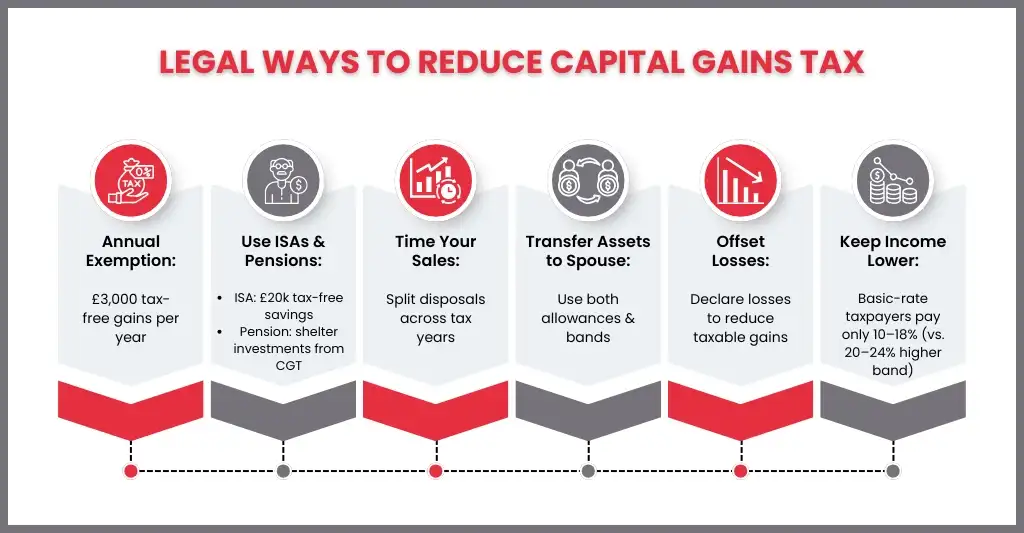
Capital Gains Tax (CGT) is due when you sell or give away assets such as shares, valuable objects, or real estate (typically not your primary residence), and your profit surpasses the yearly cap. It is legal to lower or avoid CGT with appropriate planning:
Use Your Annual CGT Allowance
- A tax-free amount known as the Annual Exempt Amount is given to each individual.
- For 2026/27, it is £3,000.
- You lose it if you don’t use it throughout a tax year, so make sure to arrange your disposals appropriately.
Time Your Asset Sales
- Use several annual allowances by spreading out disposals over several tax years.
Consider Main Residence Relief (Property)
Under Private Residence Relief, you are often excluded from CGT when you sell your primary residence. Lettings Relief now applies only where you shared your home with a tenant. Letting out a whole property you have lived in no longer qualifies for it, so check how your home has been used before you sell.
Reduce Tax Rate with Income Planning: Your tax band determines the CGT rates
- Basic rate taxpayers pay 18% on gains that fall within the basic rate band, and 24% on any part above it.
- Higher and additional rate taxpayers pay 24%.
- Gains can be moved into the lower CGT band by lowering your taxable income (via salary sacrifice, gift aid, or pension contributions).
- Business Asset Disposal Relief: qualifying gains are taxed at 18% from 6 April 2026 (14% in 2025/26).
How to Reduce Inheritance Tax (IHT) in the UK
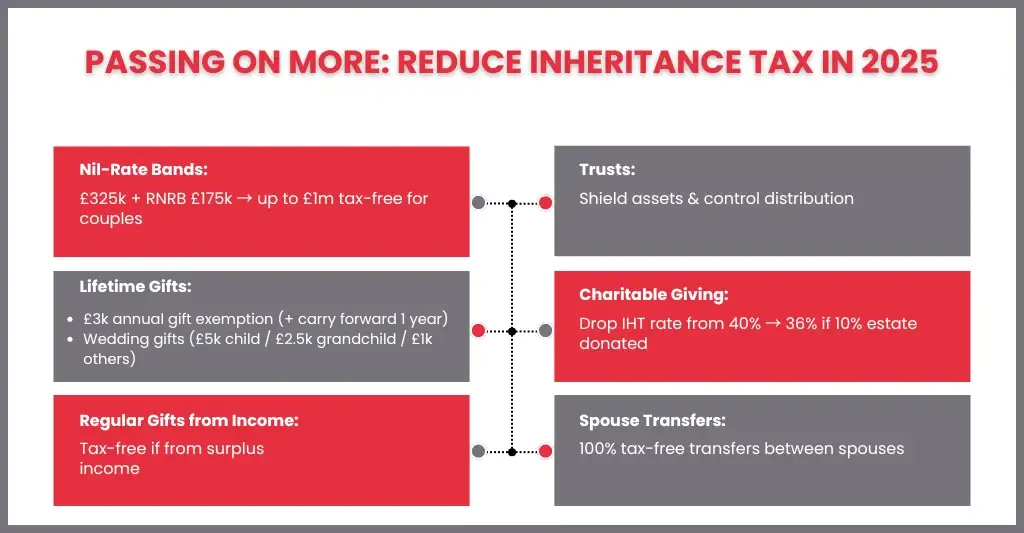
Inheritance Tax (IHT) is usually charged at 40% on estates above the nil-rate band (£325,000 per person, 2026/27). The nil-rate band has been frozen since 2009 and is now frozen until 5 April 2031. With planning, you can legally reduce or avoid IHT and pass on more wealth to your family.
Use Your Nil-Rate Band & Residence Nil-Rate Band
Each individual has a tax-free allowance of £325,000. You also receive the Residence Nil-Rate Band (RNRB) (up to £175,000) if you leave your primary residence to your direct family members. When selling a family property, married couples or civil partners can combine allowances up to £1 million tax-free. The RNRB is also frozen until April 2031, and it reduces by £1 for every £2 that your estate is worth over £2 million.
Make Gifts During Your Lifetime
- Small Gifts: Up to £250 per person per tax year is exempt.
- Annual Exemption: You can give away £3,000 per year tax-free (can carry forward 1 year).
- Wedding Gifts: Up to £5,000 to a child, £2,500 to a grandchild, £1,000 to others.
- Regular Gifts from Income: If you can show gifts are from surplus income (not savings), they are exempt.
- Larger gifts: these usually fall out of your estate if you live for seven years after making them.
Use Trusts for Estate Planning
Your taxable estate may decrease in value if you place assets into specific trusts.
Trusts can also dictate when and how assets are distributed to beneficiaries.
Complex area → ask for guidance on the appropriate structure.
Leave Assets to a Spouse or Charity
- IHT does not apply to anything given to a spouse or civil partner.
- Charity gifts are likewise exempt.
- The IHT rate on the remainder of your estate may drop from 40% to 36% if at least 10% of it is donated to charity.
Reduce the Estate Value Before Death
- Naturally, the taxable estate decreases when you spend your fortune on lifestyle, vacations, and other personal expenses.
How High Earners Can Legally Reduce Their Tax Bills?
Pension Contributions: Reduce taxable income and maintain it below the £100k Personal Allowance and £60,000 to £80,000 Child Benefit levels.
Salary Sacrifice: To save taxes and NICs, exchange your pay for perks like a pension, an electric vehicle, or a bicycle to work. The NIC saving on pension salary sacrifice is capped at £2,000 a year from April 2029.
ISAs: Make tax-free investments up to £20,000 annually.
Gift Aid: Charitable contributions increase the basic-rate band and lower taxable income.
Spousal Allowances: Distribute assets to a spouse who makes less money so they can use them.
Tax-Efficient Investments: EIS, SEIS, and VCTs provide CGT breaks and income tax relief. EIS gives 30% income tax relief on up to £1 million a year, SEIS gives 50% on up to £200,000 a year, and from 6 April 2026 VCT income tax relief fell from 30% to 20%.
Using Pensions for Estate Planning: Pensions develop tax-efficiently, but from 6 April 2027, most unused pension funds will be included in your estate for IHT. Plan ahead for how you will use or pass on your pension.
Essential Tax Planning Tips and Tools for Every Taxpayer
Every taxpayer may save money with the correct tactics, so smart tax planning isn’t only for the wealthy. Here are the main pointers and resources:
Make Full Use of Allowances
- Personal Allowance (£12,570) – tax-free income.
- ISA Allowance (£20,000 per year) – tax-free savings and investments.
- Dividend & CGT Allowances (£500 and £3,000) – use them before they reset each tax year.
Claim Work-Related Expenses
- It is possible to deduct uniform, professional costs, tools, and business transportation.
- For information on flat-rate allowances at work, visit HMRC’s online portal.
Optimise Pension Contributions
- Contributions reduce taxable income and boost retirement savings.
- Salary sacrifice can also cut NICs.
Keep Good Records
- Maintain records of your earnings, expenditures, and investments.
- Apps or software for accounting that have been approved by HMRC, such as Xero, QuickBooks, or FreeAgent.
- If you are self-employed or a landlord with qualifying income over £50,000, you must use Making Tax Digital compatible software from April 2026.
Get Professional Support When Needed
- A tax adviser or accountant can uncover reliefs you may miss.
- HMRC’s free tools: Tax Relief Checker and Personal Tax Account.
Frequently Asked Questions
Can I reduce Capital Gains Tax (CGT)?
Yes, through the use of your £3,000 yearly allowance, offsetting losses, transferring assets to a spouse, and holding assets in ISAs or pensions.
What is Inheritance Tax, and how can I cut it?
Estates over £325,000 are subject to 40% IHT (the nil-rate band is frozen until April 2031). Through pensions, trusts, lifelong gifts, and spousal/charity exemptions, you can lower it. From April 2027, unused pensions will also count towards your estate.
Are there free tools to help with tax planning?
Yes, including tax calculators, software such as FreeAgent, Xero, or QuickBooks, and HMRC’s Personal Tax Account.
How can we help reduce your tax bill in the UK in 2026/27?
We provide expert advice and strategies to maximise your allowances, claim all eligible reliefs, optimise pension contributions, and manage income efficiently, helping you legally minimise your tax liability while staying compliant.
What tax changes took effect in April 2026?
Dividend tax rates rose to 10.75% (basic rate) and 35.75% (higher rate). Business Asset Disposal Relief rose to 18%. The main writing down allowance fell from 18% to 14%, a 40% first-year allowance was introduced for main-rate assets, and Business Relief and Agricultural Relief at 100% were capped at £2.5 million. Making Tax Digital for Income Tax also began for those with qualifying income over £50,000.
What changes are coming in April 2027?
Unused pensions will count towards your estate for IHT, the cash ISA limit for under-65s falls to £12,000, and tax rates on savings and property income rise by 2 percentage points.
Conclusion
The goal of effective tax planning is to make use of the reliefs, allowances, and resources that the UK tax system already offers, not to avoid paying taxes. Little actions like maximising pension contributions, using ISAs, spreading profits, and giving thoughtfully can add up to substantial savings over time, regardless of your tax status, basic-rate taxpayer, a high-income taxpayer, or someone preparing for retirement and inheritance.
You can legally lower your tax burden, safeguard your wealth, and keep more of your hard-earned money working for you and your family by remaining organised, making plans in advance, and getting help when needed.
Disclaimer: Kindly note this blog provides general information and should not be considered financial advice. We recommend consulting a qualified financial advisor for personalised guidance. We are not responsible for any actions taken based on this content.