- Dividends vs Salary: Understanding the Core Difference
- How You Pay Yourself as a Director (2026 Overview)
- UK Tax Breakdown for 2025/26
- Salary vs Dividends: Which Pays More in 2026?
- Best Salary and Dividend Split for 2026
- When Salary Might Be Better Than Dividends
- Other Ways to Extract Profit
- Common Mistakes to Avoid
- FAQs: Frequently Asked Questions
- Conclusion
If you are a business owner in the UK, one of the most common queries you will get is, “Should I pay myself dividends or salary?” It’s not just about what feels easier, it can have a significant impact on your take-home pay, tax bill, and even how you plan for the future. Understanding the relationship between dividends vs salary is more essential than before now that the 2026 tax laws are in effect.
In this blog, we will go over the figures, discuss the advantages and cons of each option, and help you determine which technique will make you earn more money in your pocket while remaining fully compliant with HMRC. There is no complicated jargon, just clear information so you can make the right decision.
Dividends vs Salary: Understanding the Core Difference
Salary and dividends both are the ways to earn money. They operate in quite different ways, have various tax implications, and have an impact on things like National Insurance, pension payments, and even your company’s cash flow. Understanding the fundamental differences is essential to make the correct decision in 2026.
What is Salary?
A salary is a fixed recurring payment paid to you as an employee by your organisation. It is recognised as a business expense and is subject to income tax and national insurance contributions. Paying a salary provides you with a consistent income, contributes to your state benefits, and helps you to accumulate pension rights, but it can be more costly for the company due to employer NI.
What are Dividends?
Dividends are distributions provided to shareholders from the company’s profits after Corporation Tax has been paid. They are not considered as a company expense and are not subject to National Insurance, making them frequently more tax-efficient than salaries. However, dividends can only be paid if your company is profitable, and they are not eligible for state benefits or pension payments.
Quick Comparison Table
| Features | Salary | Dividends |
| Taxed as | Income tax +National insurance | Dividend Tax only |
| Employer Cost | Includes employer NI | Paid from post-tax profits. |
| Predictable Income | Yes | Depends on profit |
| Affects Benefits/Pension | Yes | No |
| Can Be Paid If Company Loss-Making | Yes | No |
How You Pay Yourself as a Director (2026 Overview)
If you own a limited company in the United Kingdom, paying yourself is not as straightforward as writing a personal check. As a director, you have options for how you earn money, and the decisions you make can have a significant impact on tax efficiency, take-home pay, and company finances.
In 2026, most directors will combine a small salary with dividends to meet tax responsibilities and personal income demands. This is how it works.
- Salary: Directors usually pay themselves a modest payment up to the National Insurance main threshold. This ensures that you are eligible for state benefits and a pension, while keeping employer NI expenses low.
- Dividends: Dividends can be distributed when your company has achieved a profit. These are taxed at a lower rate than salaries and do not require National Insurance, making them a tax-effective option to increase take-home pay.
- Combination Approach: Most UK directors employ a salary + dividends model, with a minimal salary for NI and benefit purposes and dividends for additional income. This strategy maximises efficiency under the current 2026 standards while making compliance simple.
- Timing & Planning: Dividend should be planned and paid at the beginning of the financial year to reduce cash flow surprises and sudden tax bills. Accurate corporate records should be maintained about dividend and it must be paid from profits.
Understanding what options work and which don’t work can help you pay yourself in the most tax-efficient way. While keeping your company compliant with HMRC laws.
UK Tax Breakdown for 2025/26
Understanding the tax picture for 2025/26 is important to know how to pay yourself as a director. The important tax rates, allowances, and thresholds affecting salary, dividends, National Insurance, and Corporation Tax in the UK for the 2025/26 tax year are listed here.
Income Tax Personal Allowance
- £12,570 – Income you can earn before paying Income Tax.
- Personal Allowance reduces by £1 for every £2 of income over £100,000.
Income Tax Rates (England, Wales & Northern Ireland)
| Tax band | Taxable income range | Rate |
| Basic rate | £12,571 – £50,270 | 20% |
| Higher Rate | £50,271 – £125,140 | 40% |
| Additional Rate | Over £125,140 | 45% |
National Insurance Contributions (NICs)
Class 1 (Employee – for directors/employees)
- Primary Threshold: £12,570 — no employee NICs up to this point.
- Main Rate: 12% on earnings between £12,571 and £50,270.
- 2% on earnings above £50,270.
Class 1 (Employer NICs)
- Employer Threshold: £9,100
- Rate: 13.8% on earnings above the threshold.
Dividend Allowance & Dividend Tax Rates
- £1,000 dividend allowance – tax-free dividend income.
- Dividend Tax Rates:
- 8.75% – Basic rate band
- 33.75% – Higher rate band
- 39.35% – Additional rate band
Dividends are paid from post‑tax profits (after Corporation Tax) and don’t attract NICs.
Corporation Tax (CT)
- 25% – Main rate for most companies (small profits rate may apply if profits are low). Companies with profits between £50,000 – £250,000 may pay less than 25% due to marginal relief.
- Corporation Tax is paid on company profits before dividends are declared.
Other Relevant Thresholds
- Personal Savings Allowance:
- £1,000 for basic rate taxpayers
- £500 for higher rate taxpayers
- Capital Gains Tax Annual Exemption: £6,000 (2025/26)
Salary vs Dividends: Which Pays More in 2026?
The tax efficiency of dividends compared to salary payments will likely remain a factor for most limited company directors in the UK during 2026, as dividends are taxed differently and also do not incur the same level of National Insurance contributions as salary payments. However, the gap between the two forms of payment is no longer as large as it was previously due to the fact that from April 6 2026 to April 5 2027, dividend tax rates will increase to 10.75% for basic-rate taxpayers, 35.75% for higher-rate taxpayers and 39.35% for additional-rate taxpayers.
A salary provides consistent income and can assist protect your right to benefits related to payroll records; but, it is liable to Income Tax and National Insurance, and the company may be required to pay employer’s National Insurance on it. According to HMRC, directors are classified as workers for National Insurance reasons and must pay NICs on salaries and bonuses that exceed the applicable limits.
On the other hand, dividends are usually more tax -efficient because they do not attract employee National Insurance, but they can be paid from post-tax company profits. This indicates that your firm pays Corporation Tax on its profits first, and then you pay dividend tax if your dividends exceed the applicable allowances.
Best Salary and Dividend Split for 2026
In 2026, the most tax-efficient approach for limited company directors is usually a balanced mix of salary and dividends. This allows you to take advantage of the personal allowance and National Insurance thresholds while paying lower dividend tax rates.
Key Considerations:
Salary:
- Pay a salary up to the National Insurance primary threshold (£12,570 in 2026/27) to avoid employee NICs.
- Salary counts towards state benefits, pension qualifying years, and allows corporation tax relief for the company.
- Subject to Income Tax and employee NIC, with employer NIC also payable if above thresholds.
Dividends:
- Dividends are paid from post-tax profits and are not subject to National Insurance.
- Dividend tax rates for 2026/27:
- Basic rate: 10.75%
- Higher rate: 35.75%
- Additional rate: 39.35%
- Dividend allowance remains £500, on top of your personal allowance
When Salary Might Be Better Than Dividends
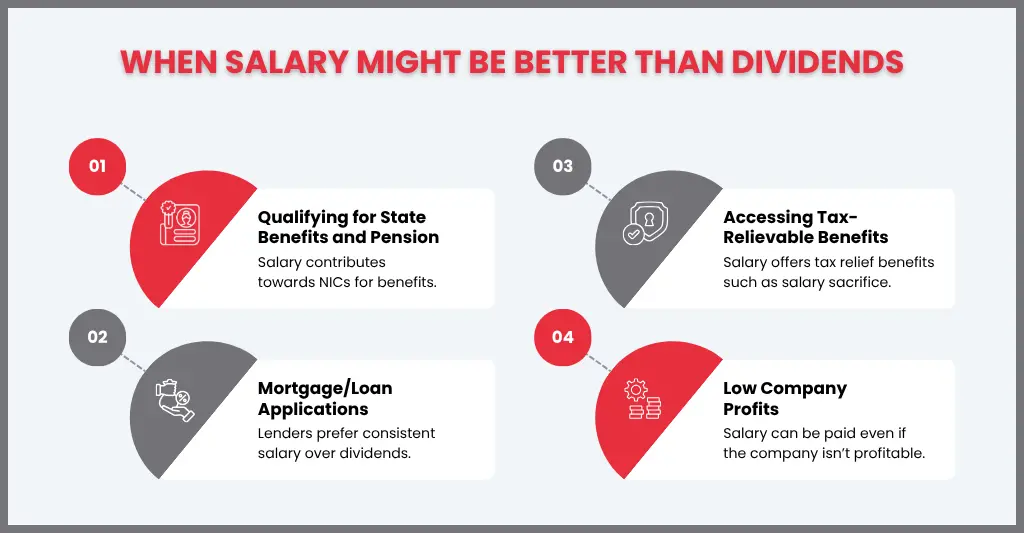
Generally, dividends are considered a tax-efficient option due to lack of National Insurance. Still there are various scenarios in which a higher salary or full salary is considered as a superior choice. Let’s understand about those scenario below:
- Qualifying for State Benefits and Pensions: Salary contributes toward National Insurance contributions, which increase eligibility for the State Pension and other benefits. Dividends do not count as NICs, therefore relying solely on dividends can reduce the possibility of future pension entitlements.
- Mortgage or Loan Applications: While evaluating the affordability of a mortgage or personal loan, lenders consider those applicants who have consistent salary income. Dividends are frequently perceived as less predictable, which may reduce borrowing capacity.
- Accessing Tax-Relievable Benefits: Some tax benefits like workplace pensions or salary sacrifice schemes, are only applicable on salary not dividends. Salary may allow additional tax relief such as reducing overall personal or company tax.
- Low Company Profits or Losses: If the company’s post – tax profit is insufficient, then the dividends may not be possible. A salary paid through PAYE can still provide a stable income, even if profit is less.
- Avoiding Dividend Overdrawn Situations: Taking big dividends in the absence of sufficient business profitability might result in loans to directors and possibly tax fines. Salary overcomes these concerns because it is a consistent expense for the organisation.
Other Ways to Extract Profit
Directors have several other options to access company profits apart from salary and dividends. Each has its own tax consequences and compliance needs.
- Director’s Loan Account: Directors can obtain funds from the company through a director’s loan account. However, to avoid tax penalties, loans must be reported and repaid on time. If the loan is interest-free or has low interest, there may be a benefit-in-kind tax charge. Additionally, if the loan remains overdrawn for more than 9 months after the year-end, the company may face additional Corporation Tax charges.
- Benefits in Kind: Non-cash incentives include business automobiles, private medical insurance, and interest-free loans. Taxed differently than salaries or dividends, and must be reported on P11D forms. Can be tax-efficient if properly constructed, although poor reporting may result in HMRC penalties.
- Pension Contributions: The corporation may make employer contributions to a pension plan on your behalf. Contributions minimise Corporation Tax and are not taxed personally until withdrawn during retirement. A very tax-efficient method for extracting revenues while increasing future retirement savings.
Common Mistakes to Avoid
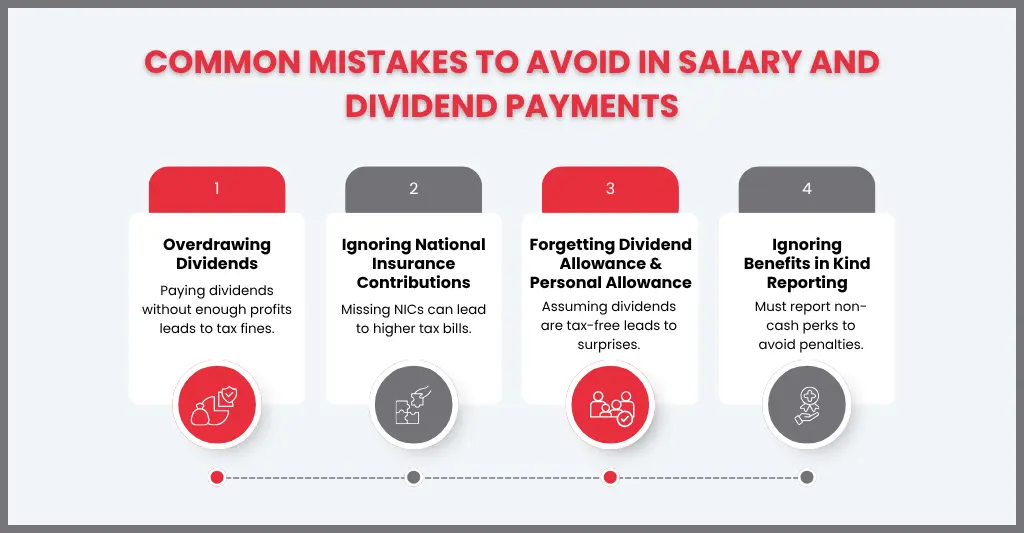
Withdrawing money out of a limited company needs careful planning. Directors frequently make mistakes that result in extra taxes, penalties, or compliance concerns.
- Overdrawing dividends: Paying dividends in the absence of sufficient post-tax profits results in a director’s loan. This may result in tax charges and HMRC investigation.
- Ignoring National Insurance Contributions: Employee and employer NICs apply to salaries above certain thresholds. Not accounting for NICs might result in higher tax bills or underpayments.
- Forgetting Dividend Allowance and Personal Allowance: Dividends above the £500 dividend allowance and your personal allowance are taxed. Assuming that all dividends are tax-free is incorrect and may result in unplanned tax payments.
- Ignoring Benefits in Kind Reporting: Non-monetary perks provided by a company must be reported on P11D forms. Failure to report them can result in penalties and back taxes.
FAQs: Frequently Asked Questions
Are dividends taxed at 40%?
Dividends are taxed based on your Income Tax band, not a flat 40%. For the 2026/27 tax year in the UK:
Basic rate taxpayers: 10.75%
Higher rate taxpayers: 35.75%
Additional rate taxpayers: 39.35%
What is the best salary for a director in 2026?
The most tax-efficient salary for a UK director in 2026 is typically £12,570 per year, which matches the Personal Allowance. At this level, no income tax is owed, and employee national insurance is disallowed while remaining eligible for state benefits. Directors typically combine their low compensation with dividends to maximize take-home pay.
Are you taxed twice on dividends?
Dividends are not taxed twice. The company pays Corporation Tax on its profits first, and then distributes dividends to shareholders from the remaining profits. Shareholders only pay personal dividend tax on sums more than the £500 dividend allowance. Dividends are not subject to National Insurance, so you don’t have to pay tax twice on the same income.
Can I take only dividends and no salary?
Yes, however dividends must be paid from post-tax profits and do not qualify for National Insurance, so you may miss out on state benefits or pension credits. To maximise tax efficiency and compliance, most directors pay a little salary plus profits.
What happens if I pay dividends without profit?
Paying dividends without sufficient post-tax profits results in a director’s loan. This can result in tax levies, HMRC penalties, and compliance concerns. Dividends should always be backed by firm earnings before they are declared.
Is dividend better than salary in the UK?
Dividends are frequently more tax-efficient as they are not subject to National Insurance, whereas salaries are. However, salary is included into state benefits, pensions, and mortgage applications, so most directors combine a small salary with dividends to maximise take-home pay while staying compliant.
Conclusion
Choosing how to pay yourself as a corporate director in 2026 necessitates balancing tax efficiency, compliance, and personal financial objectives. A modest salary up to the Personal Allowance reduces Income Tax and National Insurance, however dividends are a tax-efficient means to access profits over that salary.
To avoid HMRC penalties, directors should also evaluate alternate means of profit extraction, such as pension contributions, benefits in kind, or director’s loans, and keep sufficient paperwork to avoid future consequences from HMRC.
Finally, the most effective plan is a combination of salary and dividends, adjusted to your company’s profits and your specific requirements. Careful planning increases take-home pay, protects state benefits, and ensures long-term financial security.
Disclaimer: Kindly note this blog provides general information and should not be considered financial advice. We recommend consulting a qualified financial advisor for personalised guidance. We are not responsible for any actions taken based on this content.