
- Does service charge go up every year?
- Why does service charge go up? The main cost drivers
- What is a reasonable increase in service charge?
- Is there a legal cap on service charge increases in England and Wales?
- What LAFRA 2024 means for your service charge in 2026
- When should you question a service charge increase?
- What can you do about it?
- FAQs: Frequently Asked Questions
- Conclusion
Quick answer: No — service charges don’t automatically increase every year. Landlords in England & Wales can only recover reasonable, lease-authorised costs and must provide service charge accounts with supporting invoices on request.
“What am I actually paying for?” “Can my landlord increase these charges every year?” As Rachel looked over her most recent service charge statement, these were the questions that were on her mind. The charge was far higher than the previous year, although neither the building nor the facilities had undergone any visible changes.
Although the landlord cannot automatically increase the service charge every year, it should be reasonable, transparent, and in line with your lease.
Rachel’s story is by no means exceptional. Similar inquiries and claims for 2026 service charges are being made by leaseholders around the United Kingdom. Service charges are rising for many properties due to continuous building safety regulations, rising insurance premiums on higher-risk buildings, and escalating maintenance expenditures. What rights do leaseholders have, and what increases are justified? (If you’re a tenant rather than a leaseholder, the rules differ — see our guide on whether tenants pay service charges in the UK).
This article will discuss the reasons behind service charge increases, the primary expenses that contribute to these increases, what constitutes a reasonable service charge increase, and whether there is a legal cap on the amount that charges can increase. So does your service charge go up every year, or is something else going on? Let’s break it down.
Does service charge go up every year?
No, annual increases in service charges are not required. They only rise in response to an increase in building maintenance expenses, such as utility bills, cleaning, insurance, and repairs.
If expenses don’t change, the charges may occasionally remain the same. If there is an increase, it should be justified and grounded on the building’s actual costs. In order to understand why the amount has changed, leaseholders can also request a cost breakdown.
Why does service charge go up? The main cost drivers
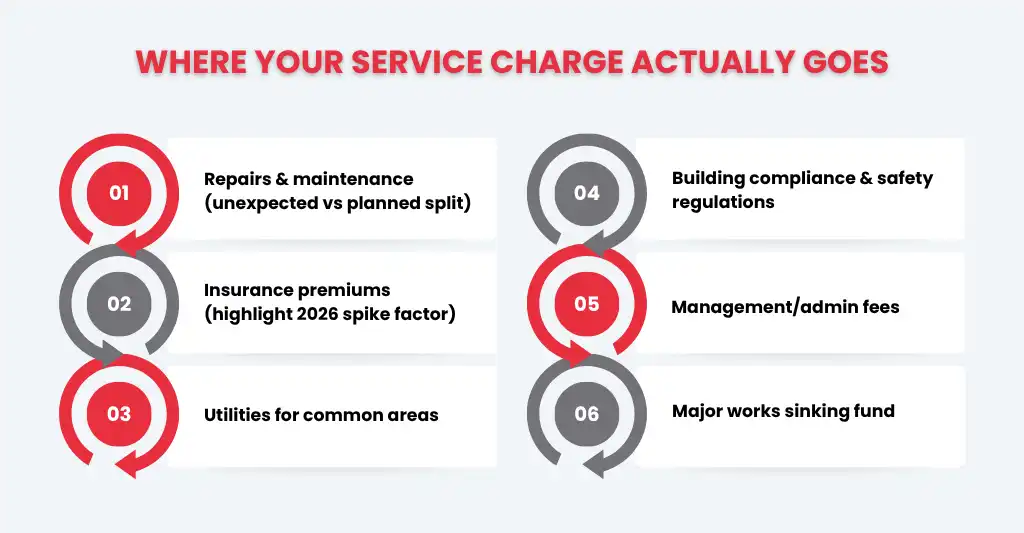
When the cost of operating, maintaining, and managing a facility rises, so do service charges. These expenses are not fixed and can fluctuate annually based on the state of the economy, the needs of the property, and legal requirements. Leaseholders can better understand why their fees may increase by being aware of the key factors.
| Cost driver | Why it changes |
|---|---|
| Inflation & supplier costs | Cleaning, maintenance, and contractor rates typically rise year on year |
| Repairs & maintenance | Unplanned plumbing, lift, or structural issues add to annual costs |
| Insurance premiums | Buildings with cladding or fire safety issues have seen sharp, building-specific rises |
| Major works | Roof repairs, repainting, or common area upgrades increase costs in the relevant year |
| Utilities | Electricity, water, and heating for shared spaces fluctuate with market prices |
| Compliance & safety | New building safety regulations can add inspection and remediation costs |
| Management fees | Accounting and property management service costs can rise |
Inflation and rising supplier costs: Due to inflation, cleaning, maintenance, and contractor rates frequently rise annually.
Repairs and maintenance: Unexpected repairs, plumbing issues, lift maintenance, or structural work can increase annual costs.
Insurance premiums: Overall UK property insurance prices have been broadly stable, but buildings with cladding or other fire safety issues have faced much sharper, building-specific premium increases — in some cases 15–20%+ in a single year — which feeds directly into service charges. Source: ABI Property Insurance Premium Tracker, 2025/26.
Major works and refurbishments: Higher fees may result from planned projects like common area improvements, roof repairs, or repainting.
Utilities for common areas: Electricity, water, and heating costs for shared spaces fluctuate and often rise over time.
Compliance and safety regulations: For management firms and landlords, new building safety regulations and inspections may result in additional costs.
Management and administrative fees: Accounting procedures and property management services may also become more expensive.
What is a reasonable increase in service charge?
Actual building costs and the management and calculation of the Service charge Accounting Process determine a fair rise in service fee. Increases must always be transparent and justified, but there is no set percentage limit.
- A fair increase takes into account actual shifts in utility, insurance, maintenance, and repair expenses.
- In general, modest yearly increases in proportion to inflation are regarded as typical.
- Only when there are specific justifications, such as significant repairs or compliance upgrades, may larger increases be justified.
- All expenses should be meticulously tracked and equitably distributed to leaseholders through the Service Charge Accounting Process.
- All charges must be supported by accurate financial records and invoices.
- A clear explanation of how the service charge was determined should be provided to leaseholders.
- Any increase must be both legally “reasonable” under UK law and in line with the terms of the lease.
- Leaseholders have the right to contest or ask for explanations if expenses appear abnormally excessive.
Is there a legal cap on service charge increases in England and Wales?
No, there isn’t a cap on service charge increases in England and Wales at this time. This position is specific to England and Wales — leaseholders in Scotland and Northern Ireland fall under separate statutory frameworks. However, there are a number of legal protections for leaseholders.
No fixed percentage limit: There is no legislation limiting service price rises to a certain annual percentage.
Charges must be reasonable: The only expenses that managing agents and landlords are able to recover are those that are justified.
Costs must relate to actual expenses: Genuine expenses like property management, insurance, repairs, and routine maintenance should be reflected in increases.
Right to transparency: Leaseholders can review supporting documentation and ask for a breakdown of service charge expenses.
Lease terms apply: The terms outlined in the lease agreement must be followed when charging service fees.
Major works consultation: Before performing certain large-scale projects that could incur substantial fees, landlords are typically obliged to communicate with leaseholders.
According to research: One of the most commonly disputed components of leasehold ownership is still service charges. Legal advisory groups observe that disagreements frequently center on the fairness of fees, a lack of transparency, and the caliber of management; leaseholders are entitled to contest costs through the First-tier Tribunal (Property Chamber).
What LAFRA 2024 means for your service charge in 2026
The purpose of the Leasehold and Freehold Reform Act (LAFRA) 2024 is to enhance leaseholder rights and increase transparency. Although it does not directly cap service charge increases, it does establish procedures that facilitate leaseholder’s understanding, review, and challenge of costs that seem excessive. Accurate Specialist Service Charge Accounts will become more crucial in showing how service charge money is gathered and used for both property managers and leaseholders. For a fuller breakdown of what’s changing in service charge accounting compliance this year, see our guide to New Rules for Service Charge Accounting 2026.
Important: many of LAFRA 2024’s service charge transparency provisions are still being phased in through secondary legislation and consultation (the Government’s “Strengthening leaseholder protections over charges and services” consultation closed in September 2025), rather than already fully in force. The points below describe the direction of travel under the Act rather than the rights that leaseholders can exercise today in every case.
Greater transparency: Clearer information regarding the calculation and application of service costs should be provided to leaseholders.
Increased accountability: Increased examination of service charge spending and management practices will be directed towards freeholders and managing agents.
Focus on reasonableness: Service fees must continue to represent actual expenses and offer leaseholders value even after LAFRA 2024.
Stronger rights to challenge charges: It might be simpler for leaseholders to argue against expenses they feel are unreasonable or unjustified.
Better protection for leaseholders: The goal of the reforms is to establish a more equitable balance between building managers and leaseholders.
Improved access to financial information: The Act facilitates leaseholders’ access to service charge records and associated documentation.
When should you question a service charge increase?
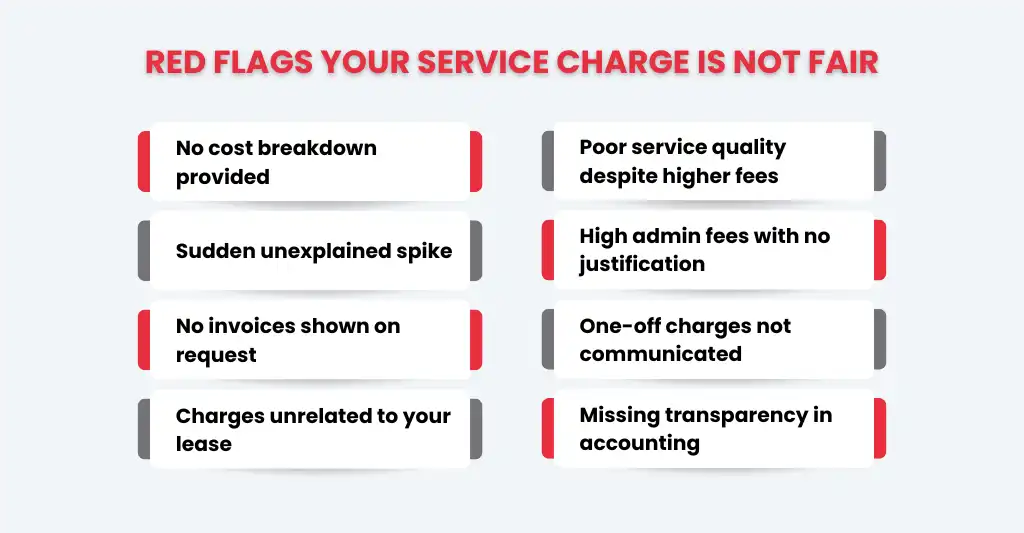
“Does Your Service Charge Go Up Every Year?” is a common question from tenants. While cost increases may be common, not all increases should be taken at face value. It’s crucial to find out why your service fee bill has gone up so much and make sure the expenses are justified.
Here are some common red flags that may warrant further investigation:
- A significant rise for which neither the managing agent nor the landlord has explained.
- No cost breakdown demonstrates how the service charge was determined.
- Fees for services that don’t seem to be changing or whose quality has significantly decreased.
- High management or administrative costs that don’t appear reasonable given the services rendered.
- Yearly rises without any indication of growing operational or maintenance expenses.
- Unexpected, one-time fees that were not disclosed beforehand.
- Expenses that your leasing agreement doesn’t seem to cover.
- Significant construction costs in cases where appropriate engagement has not occurred.
- Having trouble locating invoices, bank records, or other supporting documentation pertaining to the service price.
If several of these red flags apply, it may be worth requesting a formal audit of the accounts rather than relying on informal explanations — see our guide on auditing service charge accounts for what that process involves.
What can you do about it?
The first step in answering the question “Does Your Service Charge Go Up Every Year?” is to determine the cause of the increase. Service price increases shouldn’t be imposed blindly; instead, they should be backed by actual expenses and transparent financial data.
Here are some practical steps you can take:
- Review your service charge statement and compare it with previous years.
- Request a detailed breakdown of costs if the increase is unclear.
- Check your lease agreement to understand what expenses can legally be charged.
- Ask to see supporting documents, such as invoices, receipts, and service charge accounts.
- Question any unexpected or unusually high costs with your managing agent or freeholder.
- Seek professional advice if you are unsure whether the charges are reasonable.
- Discuss concerns with other leaseholders, especially if multiple residents are affected.
- Challenge unreasonable charges through the appropriate tribunal if necessary.
If you don’t agree with a charge after raising it directly, you don’t have to navigate this alone:
- Free advice: Leasehold Advisory Service (lease-advice.org)
- Independent guidance: Citizens Advice (citizensadvice.org.uk)
FAQs: Frequently Asked Questions
How do I challenge a service charge that seems too high?
Ask your landlord or managing agent for a thorough analysis of expenses and accompanying documentation if you think a service charge is excessive. If there are still issues, you can consult a specialist or contest the accusation in the relevant property tribunal.
What rights do I have under LAFRA 2024 regarding service charges?
With LAFRA 2024, leaseholders will have better access to financial data, more openness about service fees, and more power to contest excessive expenses. It seeks to improve the fairness and clarity of service charge accounting for tenants.
Is there a legal cap on service charge increases?
No, service charge increases in England and Wales are not legally capped. However, all fees must be fair, backed by real expenses, and compliant with your lease’s conditions.
Can I refuse to pay a service charge increase?
Usually, no. If you don’t agree with an increase, you shouldn’t refuse to pay. Rather, pay any amounts that are legally binding and use the proper procedure to properly contest any charges that you feel are unfair.
Conclusion
For leaseholders, service charges can be a substantial and frequently annoying expense, particularly when they seem to rise annually. Although there isn’t a legal cap on service charge increases, they must be fair, open, and backed by actual property-related costs. You may make wise judgments and safeguard your finances by being aware of the reasons behind these hikes, your rights under LAFRA 2024, and the clear indicators of unjustified charges.
If you’re wondering, “Does Your Service Charge Go Up Every Year?” keep in mind that increases should be based on actual expenses rather than yearly increments. Landlords, managing agents, and leaseholders can make sure service charge funds are appropriately accounted for, reported clearly, and handled in accordance with current requirements by working with experienced service charge accountants. Building trust and preventing disputes requires precise and transparent service charge accounting.
Service charge disputes can affect your lease and finances. Seek professional advice before withholding payment. Work with qualified service charge accountants; they will assist with compliance and transparency.
This article covers England and Wales. Leaseholders in Scotland and Northern Ireland are subject to different statutory regimes and should seek jurisdiction-specific advice.
Disclaimer: This article is for general information only and is not legal advice. If you are in a dispute with your landlord or managing agent, consult a solicitor or the Leasehold Advisory Service.