
- What Is a Flat Service Charge?
- How Are Flat Service Charges Calculated?
- The RICS Service Charge Code and 2024 Leasehold Reforms: What Changed
- Section 20 Consultation: When Must You Be Consulted on Major Works?
- What Costs Are Included in a Service Charge?
- Service Charge Calculation Examples for UK Flats
- How Much Is a Service Charge on a Flat in the UK?
- Why Are Service Charges Increasing in the UK?
- Can Managing Agents Increase Service Charges?
- Your Rights as a Leaseholder — and How to Challenge a Service Charge
- FAQs: Frequently Asked Questions
- Conclusion
Flat service charges are calculated by totalling a building’s annual running costs, such as repairs, insurance, cleaning, and management fees, and dividing that total among leaseholders according to the percentage or formula set out in their lease. The exact figure varies by building, but most leaseholders in England and Wales pay between £2,405 and £2,880 a year.
The calculation often takes into account a number of variables, such as your lease, the kind of property you own, your portion of the building’s operating expenses, and the costs associated with maintaining common spaces. Repairs, cleaning, building insurance, elevator maintenance, landscaping, security, and donations to upcoming large-scale projects are a few examples of these expenses.
In this blog we will describe how flat service charges are calculated in the UK, what expenses are usually included, how they are split among leaseholders, what changed under the updated RICS Code and 2024 leasehold reforms, and how you can determine whether your fees are reasonable and fair.
What Is a Flat Service Charge?
A flat service charge is a sum of money that tenants pay to fund the upkeep, administration, and repairs of a residential building’s common spaces and amenities. Your lease agreement will typically compel you to contribute to these continuing expenses if you are the owner of a leasehold apartment in the UK.
Unlike your mortgage or council tax, a service charge is particularly used to keep the building safe, functioning, and well maintained for everyone living there. Service charges are typically either fixed (a set annual amount agreed in advance) or, more commonly, variable (based on actual or estimated annual costs, reconciled once real figures are known). Most modern leases use a variable charge, which is why annual amounts fluctuate year to year.
How Are Flat Service Charges Calculated?
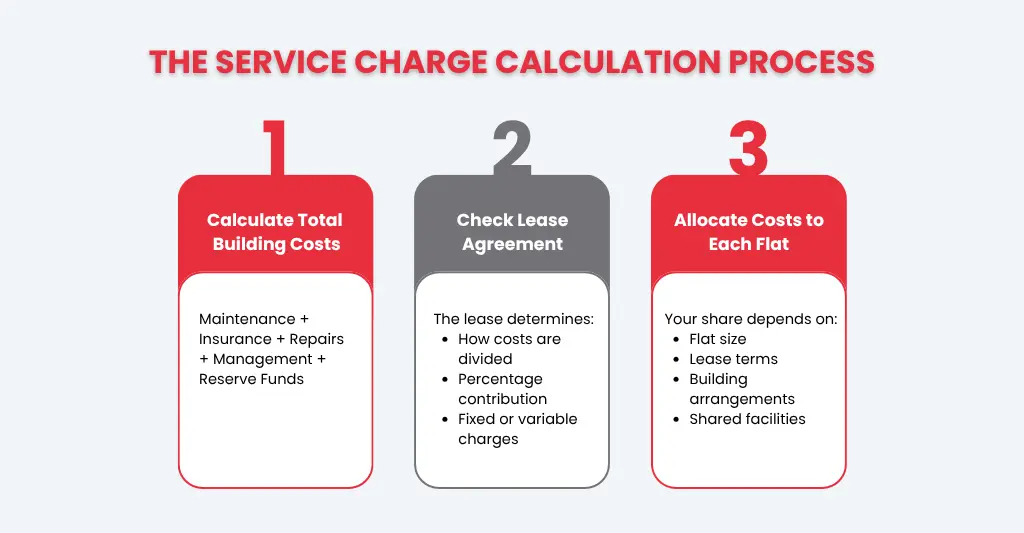
Flat service charges are calculated by assessing the cost of maintaining and administering the shared parts of a residential building and then dividing those costs among leaseholders according to the terms set out in the lease agreement. Since every property and lease can have distinct arrangements, there isn’t a standard calculation formula utilised throughout the United Kingdom.
The building’s operating costs, the amenities offered, and the percentage of those expenses allocated to your apartment determine how much you pay annually.
Factors That Affect Flat Service Charge Calculations
Here are the main factors that determine how your service charge is worked out:
The Terms of Your Lease: The most crucial document for figuring out service fees is your lease. It clarifies:
- How costs are divided between leaseholders.
- Which services and repairs are included.
- Whether charges are fixed or variable.
- If contributions to a reserve or sinking fund are required.
While some leases share expenses equally across all apartments, others assign fees according to a formula or a percentage.
Building Maintenance Costs: The majority of service fees are mostly composed of routine maintenance. This could consist of:
- Cleaning communal areas
- Lift servicing and repairs
- Roof and structural maintenance
- Plumbing and electrical work
- Grounds maintenance and gardening
The more maintenance a building requires, the higher the service charge is likely to be.
Shared Facilities and Amenities: Because these amenities need constant personnel and upkeep, buildings with extra facilities typically have higher service fees.
Examples include:
- Concierge or reception services
- CCTV and security systems
- Gyms or fitness centres
- Underground parking
- Landscaped gardens
- Residents’ lounges
- Electric gate maintenance
Compared to smaller apartment buildings with less shared amenities, luxury projects typically have higher annual service fees. Recent industry data backs this up directly: buildings with a lift carry roughly a 16% service charge premium, a gym adds around 24%, and a concierge service adds around 39%, compared to equivalent buildings without those amenities.
Building Insurance: Most leaseholders contribute towards the expense of insuring the entire structure. The annual service charge includes the premium, which is usually established by the freeholder or managing agency.
Insurance costs can increase depending on:
- Property value
- Claims history
- Building age
- Location
- Market insurance rates
Property Management Fees: The service charge typically includes the professional managing agent’s fees if the building is under their management.
These fees cover responsibilities such as:
- Organising repairs
- Collecting service charges
- Managing contractors
- Preparing annual budgets
- Handling legal and compliance requirements
- Communicating with leaseholders
The RICS Service Charge Code and 2024 Leasehold Reforms: What Changed
Two major developments now shape how service charges are calculated and administered in England:
- RICS Service Charge Residential Management Code, 4th edition — effective from 7 April 2026, replacing the 3rd edition that had been in place since 2016. It has been elevated from guidance to a formal professional standard, meaning compliance is mandatory for RICS members and regulated firms, and it can be relied on as evidence in First-tier Tribunal disputes. The new edition adds a dedicated section on the Building Safety Act 2022 and incorporates the Leasehold and Freehold Reform Act 2024.
- Leasehold and Freehold Reform Act 2024 (LAFRA) — introduces (or is phasing in) requirements including a standardised service charge format, annual service charge reporting, new rights for leaseholders to request cost information, and a proposed ban on insurance commissions being folded into service charges.
In practice, this means leaseholders can expect more standardised, itemised service charge demands going forward, and managing agents face stricter documentation and transparency obligations than under the previous code. For the full breakdown of what these changes mean for demands, trust accounts, and reporting deadlines, see our guide to new rules for service charge accounting.
Section 20 Consultation: When Must You Be Consulted on Major Works?
Under Section 20 of the Landlord and Tenant Act 1985, your landlord or managing agent must formally consult you before carrying out qualifying works or entering into a long-term agreement, if your contribution would exceed certain thresholds:
- Major works: consultation is required if any individual leaseholder’s contribution would exceed £250.
- Long-term agreements (contracts running more than 12 months, such as a lift maintenance contract): consultation is required if any leaseholder’s contribution would exceed £100 in any accounting period.
If the landlord skips this consultation without a valid dispensation from the First-tier Tribunal, they may be limited to recovering only £250 (or £100) per leaseholder for that item, regardless of the actual cost. This is one of the most common grounds leaseholders use to challenge a service charge.
What Costs Are Included in a Service Charge?
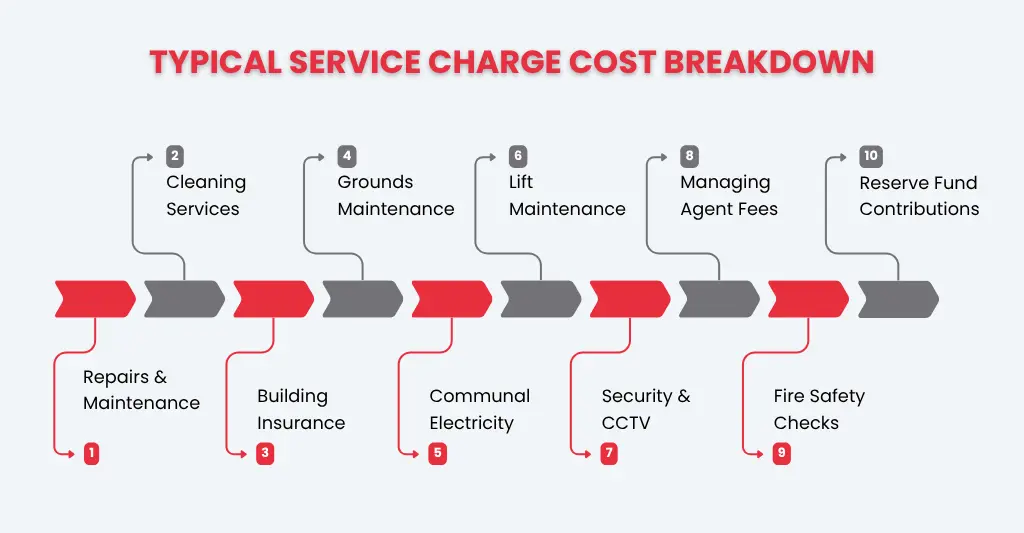
A flat service charge covers the expense of maintaining and administering the shared facilities and services within a residential complex. Your lease agreement will determine the precise expenses, but often include:
- Building maintenance and repairs
- Cleaning of communal areas
- Building insurance
- Gardening and grounds maintenance
- Communal electricity and lighting
- Lift maintenance and servicing
- CCTV, security, or concierge services (if applicable)
- Managing agent fees
- Fire safety and health & safety compliance
- Waste and recycling management
- Reserve or sinking fund contributions for future major repairs
These costs are shared among leaseholders according to the terms of the lease.
Service Charge Calculation Examples for UK Flats
Service charges are calculated by splitting the total annual cost of maintaining and administering a building among leaseholders based on the terms of the lease. Here are two easy examples.
Example 1: Equal Share
| Annual Building Costs | Amount (£) |
|---|---|
| Cleaning | 3,000 |
| Building Insurance | 7,000 |
| Repairs & Maintenance | 10,000 |
| Managing Agent Fees | 5,000 |
| Reserve Fund | 5,000 |
| Total | 30,000 |
If the building has 20 flats and each pays an equal share:
£30,000 ÷ 20 = £1,500 per flat per year
Example 2: Percentage Share
The total annual service charge for a building is £50,000. A lease states that a flat must contribute 2.5% of the total costs.
£50,000 × 2.5% = £1,250 per year
The amount each leaseholder pays depends on the cost of maintaining the building and the allocation method specified in their lease agreement.
How Much Is a Service Charge on a Flat in the UK?
Depending on the data source, kind of property, and services offered, the average service charge for UK flats in 2026 falls between £2,405 and £2,880 annually.
Hamptons Service Charge Index: In 2025, the average leasehold flat in England and Wales cost £2,405 annually (£200.42 per month), which was 32.6% more than in 2020 and 4.6% more than the year before. This was also the first time the average service charge passed £200 a month.
The Property Institute (TPI): Professionally managed residential structures recorded an average service charge of £2,880 per flat in 2026, with higher charges often seen in older and taller buildings. TPI’s data shows this gap clearly: leaseholders in buildings over 18 metres tall pay an average of £4,447 a year, compared with £2,418 in buildings under 11 metres, and those in buildings over 50 years old pay £5,208 on average versus £2,508 in buildings under 25 years old.
The building’s location, age, size, shared amenities (such lifts, gyms, or concierge services), insurance expenses, and scheduled maintenance tasks can all affect how much you spend.
Why Are Service Charges Increasing in the UK?
Service charges for UK flats have increased in recent years due to rising maintenance expenses, higher insurance rates, inflation, and stricter building safety rules. The exact increase varies by property, but many leaseholders have witnessed considerable raises in their annual fees.
The main reasons include:
- Increased rates for building insurance, especially for older and high-rise structures.
- Increased labor, material, and contractor service costs due to inflation.
- Adherence to the Building Safety Act 2022, including inspections, rehabilitation efforts, and fire risk assessments.
- Increased expenses for staffing and managing agents, including concierge and security services.
- Contributions to save aside (sinking) money to pay for upcoming significant repairs and lessen the need for expensive one-time expenses.
Building Safety Act compliance costs specifically have risen sharply, up 53% since 2024, according to TPI, though they still represent a relatively small share of the overall bill (around 1.5% of total budgeted spend in 2026). Reserve fund contributions have grown even faster, up 26% over the same period.
Note: For a closer look at what counts as a reasonable increase and how to challenge one, see our guide on whether your service charge should go up every year.
Can Managing Agents Increase Service Charges?
Yes, managing agents may raise service fees, but only if doing so is allowed by the conditions of the lease and represents the true cost of running and maintaining the building. They are not allowed to file charges at random.
Service charges may increase due to:
- Higher maintenance and repair costs
- Inflation and rising contractor fees
- Major works or unexpected repairs
- Compliance with new building safety regulations
Under UK law, service charges must be reasonable, and leaseholders have the right to request a breakdown of expenses and challenge exorbitant charges through the appropriate legal process if necessary. For major works or long-term contracts specifically, they must also have been through the Section 20 consultation process described above.
Your Rights as a Leaseholder — and How to Challenge a Service Charge
As a tenant, you are entitled to make sure that your service charges are fair and only include expenses that are allowed by your lease.
You can:
- Request a summary of service charge costs.
- Ask to inspect invoices, receipts, and supporting documents.
- Check that the charges comply with your lease agreement.
- Challenge service charges you believe are unreasonable or incorrect.
- Check whether a Section 20 consultation should have taken place for any major works or long-term contract charged to you.
You can ask the First-tier Tribunal (Property Chamber) in England (or the same tribunal in Wales) to decide whether the service charges are reasonable and payable if you are unable to settle the matter with the freeholder or managing agent.
FAQs: Frequently Asked Questions
Can I refuse to pay my service charge?
Generally, no. If a service charge is specified in your lease, you have to pay it. Instead of just refusing to pay, you should contest the charge through the proper legal procedure if you think it is unreasonable because failure to do so can result in legal action.
What happens if I don’t pay my service charge?
If you fail to pay your service charge, the freeholder or managing agent may pursue legal action to recover the debt and you may be subject to late fees or interest. If you continue to fail to make payments, you may face legal action or other enforcement measures that your lease permits.
Are service charges tax deductible for buy-to-let landlords?
Yes, In most situations, service charges paid by buy-to-let landlords are tax deductible as an allowed expense, providing they relate to the day-to-day operating and upkeep of the rental property. However, charges for renovations or major works may be regarded differently for tax purposes. It’s essential to consult a skilled tax advisor if you are unsure.
Can service charges be factored into my mortgage?
No, service charges must be paid directly to the managing agency or freeholder and are not included in your mortgage payments. However, when determining whether you can afford the property, mortgage lenders typically take service expenses into account. Some lenders now decline to lend on flats where the service charge exceeds 1% of the property’s value, a threshold that around 37% of flats in England and Wales now exceed.
How are service charges handled when selling a flat?
Service fees are typically divided between the buyer and seller upon completion of an apartment sale. The seller pays for the period they held the property, and the buyer becomes responsible for future service expenses from the completion date onward.
Do I pay a service charge if I own a share of the freehold?
Yes. It is still necessary to pay a service charge even if you own a portion of the freehold. As stated in your lease, you are still accountable for paying for the building’s upkeep, repairs, insurance, and management.
What is a service charge apportionment schedule?
When selling an apartment, a service charge apportionment schedule is used to determine how the buyer and seller will split service charges. It displays the amount each party is responsible for based on the property’s completion date.
Conclusion
You can boost your budget and prevent unforeseen expenses by being aware of how flat service charges operate. It’s easier to analyze your annual bills and make sure you’re paying a reasonable amount when you know what service charges cover, how service charges for flats are calculated, and your rights as a leaseholder.
If you are buying, selling, or managing a leasehold property, it’s always worth reading your lease agreement and service charge breakdown carefully. Cox Hinkins specialises in RICS and ARMA-compliant service charge accounting for residential managing agents, RMCs, and freeholders across Oxford and the wider UK. Get in touch with our team for expert guidance on your service charge accounts.
Disclaimer: Kindly note this blog provides general information and should not be considered financial advice. We recommend consulting a qualified financial advisor for personalised guidance. We are not responsible for any actions taken based on this content.