
- What Is a Service Charge Accountant?
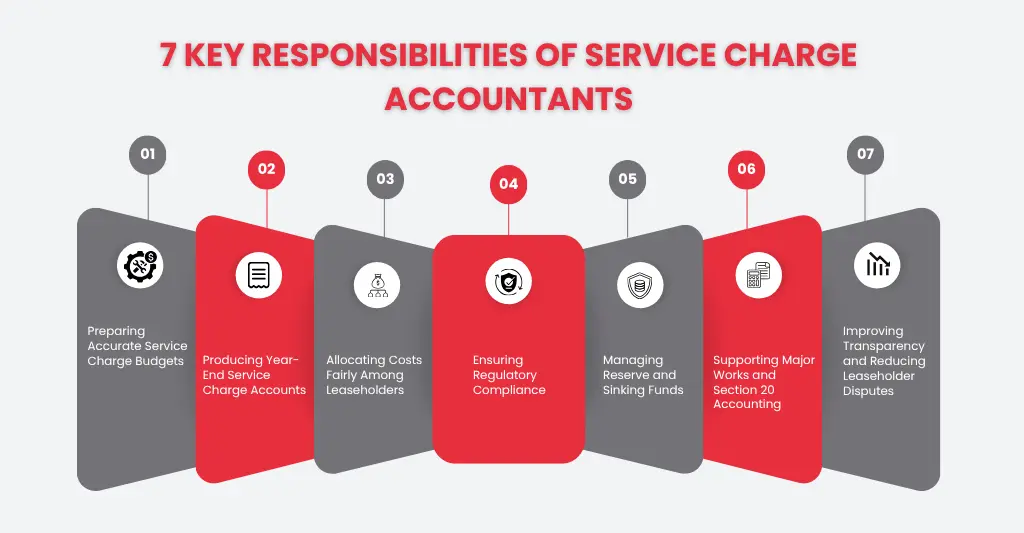
- 1. Preparing Compliant Service Charge Budgets
- 2. Producing Year End Service Charge Accounts and Certified Statements
- 3. Allocating Costs Fairly Across Leaseholders
- 4. Staying Current with LAFRA 2024 and the RICS Service Charge Code
- 5. Managing Sinking Funds and Reserve Fund Accounting
- 6. Supporting Section 20 Consultation and Major Works Accounting
- 7. Reducing Leaseholder Disputes Through Transparent Financial Reporting
- How Much Does a Service Charge Accountant Cost in the UK?
- Service Charge Accountant vs. General Accountant: What Is the Difference?
- Why UK Property Managers Need a Service Charge Accountant in 2026
- Why Property Managers Choose Cox Hinkins for Service Charge Accounting
- FAQs: Frequently Asked Questions
- Conclusion
A service charge accountant manages the budgeting, reconciliation, and statutory reporting of service charge funds for residential and commercial property, ensuring every pound collected is accounted for, allocated fairly under the lease, and reported in line with UK regulation, including the RICS Service Charge Residential Management Code (4th edition) and the Leasehold and Freehold Reform Act 2024. For property managers, this specialist role is what stands between a smooth year end and a leaseholder dispute at the First Tier Tribunal.
Managing service charge finances has moved from an administrative task to a specialised discipline as portfolios grow, regulation tightens, and leaseholders become increasingly aware of their statutory rights and demand more transparency. In this guide, we break down the seven core duties a service charge accountant performs, what has changed for 2026, and how to know whether your building needs one.
What Is a Service Charge Accountant?
A service charge accountant is a professional who manages the budgets, reconciliation, and financial reporting of service charge monies for residential and commercial property on behalf of freeholders, Right to Manage (RTM) companies, Resident Management Companies (RMCs), and managing agents. Their work covers preparing compliant budgets, reconciling actual spend against on account payments collected from leaseholders, producing certified year end statements, and keeping records defensible enough to withstand scrutiny, whether from a leaseholder’s accountant or a First Tier Tribunal.
1. Preparing Compliant Service Charge Budgets
- Estimating annual costs for maintenance, repairs, utilities, insurance, and management.
- Allocating projected expenses in line with each lease’s apportionment schedule
- Building realistic budgets from historic spend and known upcoming costs.
- Flagging likely funding shortfalls before they become mid year surprises.
- Ensuring budgets reflect current RICS guidance and UK accounting standards.
- Providing landlords, RMCs, and leaseholders with a clear, itemised budget breakdown.
- Tracking actual spend against budget throughout the year so variances are caught early, not at year end.
2. Producing Year End Service Charge Accounts and Certified Statements
Year end service charge accounts give landlords, leaseholders, and RMCs a certified record of how service charge funds were collected and spent over the accounting year, and demonstrate that spending was within the terms of the lease.
- Compiles income, expenditure, reserve fund movements, and closing balances into full year end accounts.
- Reconciles bank statements, invoices, and supplier payments against the accounting records.
- Prepares certified statements where the lease requires them, in line with ICAEW and ACCA technical guidance and relevant lease clauses.
- Investigates and resolves discrepancies before accounts are finalised reducing the risk of disputes escalating to the First Tier Tribunal.
- Provides organised supporting records for independent examinations or external audits.
- Ensures accounts are issued within the timeframe set out in the lease, protecting the managing agent’s contractual position.
3. Allocating Costs Fairly Across Leaseholders
Getting apportionment wrong is one of the most common sources of leaseholder disputes. A service charge accountant reduces that risk by:
- Reviewing the lease to confirm the correct apportionment method, whether fixed percentage, floor area, or another lease defined formula
- Separating recoverable costs from non recoverable costs, so leaseholders are only charged for what the lease permits.
- Calculating reserve or sinking fund contributions needed to fund future major works.
- Cross checking allocations to catch under or over charging before demands go out.
- Maintaining a clear audit trail for every allocation decision, in case of a leaseholder challenge.
4. Staying Current with LAFRA 2024 and the RICS Service Charge Code
UK service charge regulation has changed substantially in the past 18 months, and property managers need financial records that hold up against the current standard, not the previous one.
The RICS Service Charge Residential Management Code (4th edition) took effect on 7 April 2026, replacing the 3rd edition that had been in place since 2016. Two changes matter in particular. The Code has been elevated from voluntary guidance to a mandatory professional standard for RICS members, and it can now be relied on as evidence before courts and tribunals. The 4th edition was updated specifically to reflect the Building Safety Act 2022 and the Leasehold and Freehold Reform Act 2024 (“LAFRA 2024”).
It is worth noting that not all of LAFRA 2024’s leaseholder facing provisions are in force yet. Measures such as a standardised service charge demand form, mandatory annual reporting, and a ban on opaque insurance commissions were the subject of a government consultation that closed in September 2025, with implementation expected to roll out over the following 12 to 24 months. A service charge accountant tracks which provisions are live and which are still pending, so property managers are not caught applying rules that have not commenced, or missing ones that have.
A specialist service charge accountant supports compliance by:
- Preparing budgets and accounts that reflect the current RICS Code and LAFRA requirements as they come into force
- Maintaining clear, defensible financial records in case of tribunal scrutiny
- Ensuring service charge accounts contain only legitimate, recoverable costs.
- Delivering reports and year end accounts on schedule.
- Updating internal accounting procedures as new provisions of LAFRA 2024 commence.
5. Managing Sinking Funds and Reserve Fund Accounting
Sinking and reserve funds cover major repairs and long term maintenance, and mismanaging them is a frequent cause of funding shortfalls when large works come due. A service charge accountant helps by:
- Recording all contributions to sinking and reserve funds.
- Keeping reserve funds legally and financially separate from day to day service charge accounts.
- Monitoring fund balances against known future works.
- Ensuring reserve money is spent only for the purposes set out in the lease.
- Producing clear reporting on the state of each fund for landlords and leaseholders.
- Supporting long term maintenance and capital expenditure planning alongside the property manager.
6. Supporting Section 20 Consultation and Major Works Accounting
Under Section 20 of the Landlord and Tenant Act 1985 (as amended), landlords must consult leaseholders before carrying out qualifying works or entering a qualifying long term agreement (QLTA) above set cost thresholds. Getting the financial side of this process wrong can invalidate cost recovery entirely. A service charge accountant supports this by:
- Preparing reliable cost estimates for planned major works.
- Ensuring costs are allocated in line with the lease once works are complete.
- Supplying the financial detail needed to support the Section 20 consultation notices.
- Maintaining records that stand up to leaseholder queries or a First Tier Tribunal challenge.
- Monitoring budgets against actual project costs and reporting variances as they arise.
7. Reducing Leaseholder Disputes Through Transparent Financial Reporting
Most leaseholder disputes start with a single unclear line item. Clear, well evidenced reporting closes that gap before it becomes a formal challenge. A service charge accountant helps by:
- Producing service charge reports that are easy for a non accountant to follow.
- Backing every charge with supporting financial records.
- Explaining how charges were calculated and allocated, not just what the total is.
- Delivering year end accounts and statements on time, every year.
- Catching and correcting errors before reports are issued, not after a leaseholder flags them.
- Giving property managers the evidence they need to respond confidently to leaseholder queries, and to defend the figures if a dispute reaches the First Tier Tribunal.
How Much Does a Service Charge Accountant Cost in the UK?
Fees vary by portfolio size, number of units, and whether certified statements are required, but most UK service charge accountants charge either a per block annual fee or a per unit rate, with certification, where the lease requires it, typically priced separately from bookkeeping and reconciliation work. Property managers should ask for a fee structure that separates routine reconciliation from year end certification, so costs scale predictably as a portfolio grows.
Service Charge Accountant vs. General Accountant: What Is the Difference?
A general accountant is trained in standard financial reporting and tax. A service charge accountant additionally understands lease apportionment methods, the Section 20 consultation process, RICS Code requirements, and the distinction between recoverable and non recoverable costs under a lease. Using a general accountant without this specialism is one of the most common causes of apportionment errors and failed audits in block management.
Why UK Property Managers Need a Service Charge Accountant in 2026
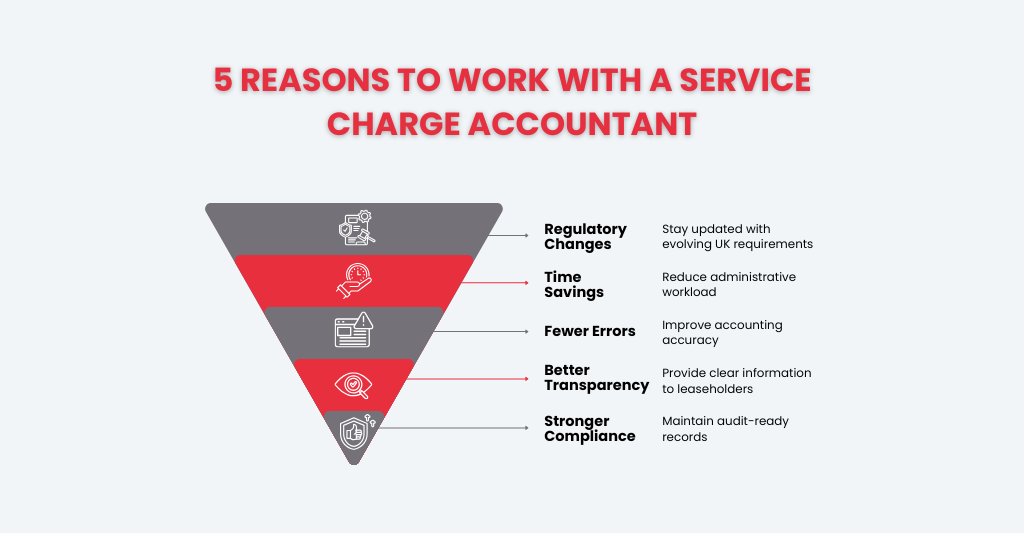
Managing service charges in 2026 means working against a moving regulatory target. The RICS Code has just been overhauled, LAFRA 2024 provisions are commencing in stages, and leaseholders are more aware of their rights than at any point in the past decade. Handling this alongside day to day property management increases the risk of errors, missed deadlines, and disputes.
A service charge accountant removes that risk by owning the financial side end to end. That means accurate budgets, compliant year end accounts, fair cost allocation, properly managed reserve funds, defensible Section 20 documentation, and reporting clear enough to keep leaseholders on side.
Why Property Managers Choose Cox Hinkins for Service Charge Accounting
Property managers work with Cox Hinkins for accurate, compliant, and transparent service charge accounting. Our team manages budgets, compiles year end accounts, allocates expenditure fairly, and maintains records aligned with the current RICS Code and UK legislation. Cox Hinkins was Highly Commended for Service Charge Firm of the Year at The Property Institute UK Awards.
Outsourcing to Cox Hinkins reduces administrative workload, lowers the risk of accounting errors, and strengthens leaseholder trust through timely, transparent reporting, freeing property managers to focus on the building, not the spreadsheet.
FAQs: Frequently Asked Questions
Why are service charge accountants necessary for property managers?
A service charge accountant assists property managers in keeping correct financial records, avoiding compliance problems, creating clear reports for tenants, and lowering the possibility of disagreements regarding service charge money.
Who is in charge of creating accounts for service charges?
The landlord, managing agent, or property management firm is typically in charge. To guarantee accuracy and compliance, many use a specialist service charge accountant.
Can a service charge accountant help with budgets for service charges?
Yes. They can assist in creating reasonable service charge budgets, projecting future expenses, keeping an eye on expenditures, and seeing chances to enhance cost control.
How much does a service charge accountant cost?
Fees are typically charged per block or per unit, with certification priced separately from routine bookkeeping. Costs scale with portfolio size and complexity.
Do I need a certified service charge statement?
Only if the lease requires it. Many leases specify that year end accounts must be certified by a qualified accountant, so check the lease’s accounting clause to confirm.
What happens if service charges are not reconciled correctly?
Incorrect reconciliation can lead to under or over charging, leaseholder disputes, and in some cases a challenge at the First Tier Tribunal, where poor record keeping significantly weakens the landlord’s position.
Is a service charge accountant different from my managing agent’s in house bookkeeper?
Yes. A specialist service charge accountant brings lease apportionment expertise, RICS Code knowledge, and Section 20 experience that general in house bookkeeping typically does not cover.
Conclusion
Getting service charge accounting right in 2026 means more than balancing the books. It means staying ahead of a newly overhauled RICS Code, a partially commenced LAFRA 2024, and leaseholders who know their rights better than ever. Done properly, it protects property managers from disputes, keeps buildings financially healthy, and builds the kind of trust that prevents problems before they start.
If you need reliable, compliant service charge accounting, Cox Hinkins is here to help, contact us to discuss your portfolio.