
- Why Auditing Service Charge Accounts Matters
- Service Charge Audit vs. Independent Service Charge Review
- Legal and Regulatory Framework Governing Service Charge Audits
- Step-by-Step Process to Audit Service Charge Accounts
- Common Errors and Red Flags Found During Service Charge Audits
- Pre-Audit Checklist for Property Owners and Managers
- FAQs: Frequently Asked Questions
- Conclusion
Landlords, property management firms, and housing societies may find it difficult to manage shared property expenses. This is where Service Charge Accounts Audit are very important. They offer an impartial and transparent assessment of service charge revenue and expenses, guaranteeing that money received from tenants or leaseholders is utilised suitably and in compliance with legal and regulatory standards.
For housing societies and property owners, keeping correct service charge records is crucial for establishing compliance, preventing conflicts, and building trust, in addition to being a matter of sound financial management. In order to find inconsistencies, enhance accountability, and reassure citizens that their contributions are being handled appropriately, service charge accounts are audited.
In this guide, you will get to know about Service Charge Accounts Audit, including its function, legal requirements, principal advantages, audit procedure, and best practices for keeping transparent and compliant records.
How the service charge audit helped our client
Residents of a housing society with more than 120 apartments frequently inquired about growing maintenance costs. Duplicate payments, misallocated expenses, and missing supporting documentation were discovered during an independent service charge audit.
The society fixed the mistakes, recovered overpayments, and enhanced record-keeping following the audit. Disputes decreased, residents were given a more transparent breakdown of expenses, and the community became more confident in its ability to manage service charge money going forward.
Why Auditing Service Charge Accounts Matters
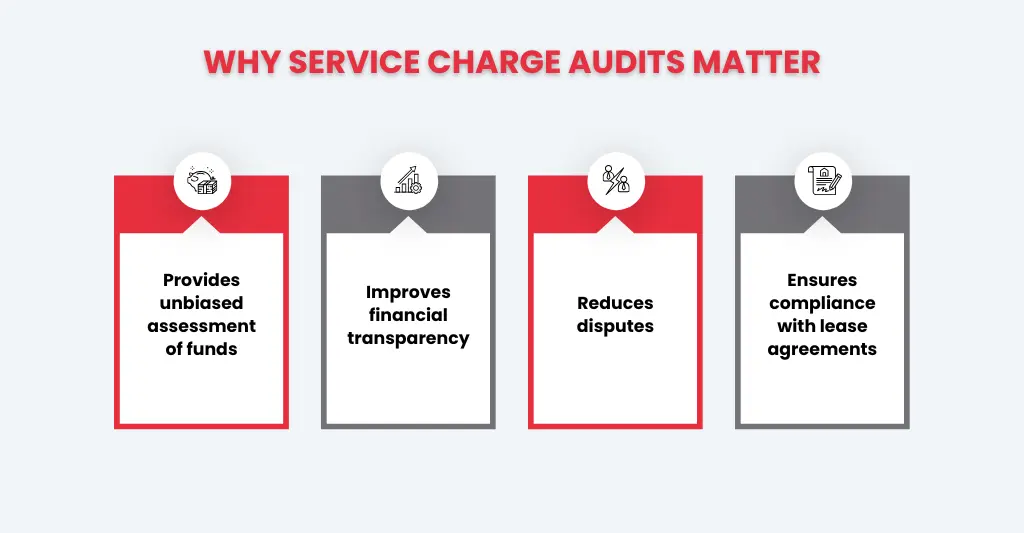
An unbiased assessment of the handling and reporting of service charge funds is provided by auditing service charge accounts. It assists in making sure that all earnings and expenses are properly tracked, distributed, and backed up by relevant records. An audit improves financial transparency, reduces the possibility of disputes, and shows that funds are being spent in compliance with lease agreements and legal obligations for property owners, housing organisations, and leaseholders.
Service Charge Audit vs. Independent Service Charge Review
What is a Service Charge Audit?
An evaluation of service charge accounts conducted by a certified accountant or auditor is known as a service charge audit. To verify that service charge expenses have been accurately documented and distributed in accordance with the lease terms, review financial records, invoices, receipts, and other supporting documentation. Landlords, managing agents, and leaseholders have greater confidence in the accuracy of the accounting thanks to the audit, which also helps clarify how funds have been spent.
What is an Independent Service Charge Review?
A detailed evaluation of a property’s service charges carried out by an unbiased third party is known as an Independent Service Charge Review. The main goal is to assure accuracy, transparency, and adherence to legal requirements and leasing agreements. This assessment looks at all service charge expenses, finds any mistakes or overcharges, and gives property owners or tenants an objective, transparent report. It is an essential way for preserving confidence between renters and landlords and avoiding disagreements regarding service charge accounts.
Side-by-Side Comparison Table
| Aspect | Service Charge Audit | Independent Service Charge Review |
| Scope | Detailed evaluation of financial records and supporting documents. | Limited review focused on the overall accuracy and reasonableness of accounts. |
| Level of Assurance | Provides a higher level of assurance. | Provides moderate assurance with less detailed testing. |
| Testing | Includes detailed verification of transactions, invoices, and supporting evidence. | Relies primarily on analytical procedures and inquiries. |
| Time & Cost | More time-consuming and typically more expensive. | Quick and more cost-effective. |
| Purpose | Detect errors and ensure compliance with lease requirements. | Confirm that accounts appear reasonable and properly prepared. |
| Best For | Larger properties, complex service charge arrangements, or where leases require an audit. | smaller properties or circumstances in which a complete audit is not required. |
How to Determine Which One Your Lease Requires
The lease agreement often specifies the kind of evaluation needed for your service charge accounts. Look closely for terms like “audit,” “certification,” “independent review,” or “accountant’s report” in the lease; each has a distinct set of criteria and assurance levels. To ensure compliance, consult a trained specialist service charge accountant or property management specialist if you find it confusing. Comprehending your lease duties may help you stay out of trouble, fulfill legal obligations, and make sure service charge accounts are made accurately.
Legal and Regulatory Framework Governing Service Charge Audits
- Lease Agreement Requirements: Whether service charge accounts need to be audited, reviewed, or certified is usually specified in the lease.
- Landlord and Tenant Legislation: When it comes to service fee collection, reporting, and disclosure, property owners and managing agents are required to follow applicable legislation.
- Accounting Standards: Accounting standards and industry best practices should be followed while preparing service charge accounts.
- Industry Guidance: Accounting standards and industry best practices should be followed while preparing service charge accounts.
- Record-Keeping Requirements: For review and auditing, accurate financial records, invoices, receipts, and supporting documentation must be kept.
- Dispute Resolution Compliance: Accounts that are properly prepared and independently reviewed can assist in settling disputes and prove that lease requirements are being fulfilled.
Step-by-Step Process to Audit Service Charge Accounts
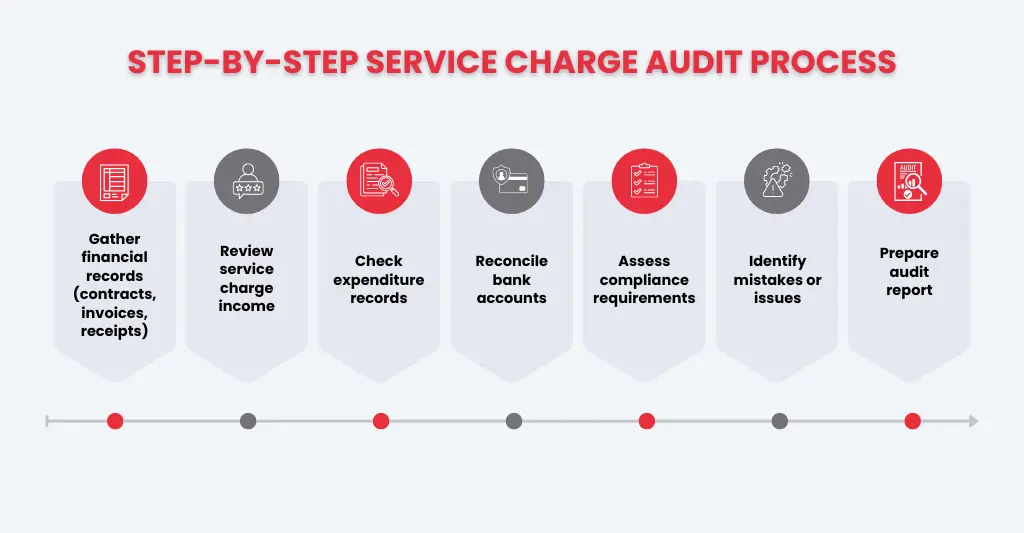
Gather Financial Records: Collect all documents that will be required, such as contracts, lease agreements, invoices, receipts, bank statements, and service charge statements.
Review Service Charge Income: Make sure that all service charge contributions have been accurately documented and correspond to the sums received from residents or leaseholders.
Check Expenditure Records: Assess costs to make sure they are correct, adequately justified, and connected to the daily maintenance and management of the property.
Reconcile Bank Accounts: Check the accuracy of transactions by comparing service charge account balances with bank statements.
Assess Compliance Requirements: Examine whether the accounts follow all applicable laws, applicable accounting standards, and leasing requirements.
Identify mistakes or Issues: Check whether any strange transactions are recorded, missing paperwork, or gaps that might need more explanation.
Prepare the Audit Report: Record findings, draw attention to any issues, and offer an unbiased assessment of the service charge accounts’ correctness and presentation.
Common Errors and Red Flags Found During Service Charge Audits
Early detection of the problems will reduce the possibility of leaseholder conflicts, maintain compliance, and improve financial transparency.
- Duplicate Payments – The same invoice or expense has been recorded and paid more than once.
- Accounting Errors – Wrong calculations, incorrect postings, or inaccurate account balances affect the reliability of the accounts.
- Poor Record Keeping – Incomplete financial records make it difficult to verify transactions and account balances.
- Delayed Bank Reconciliations – Bank statements are not reconciled on time with accounting records.
- Reserve Fund Mismanagement – Sinking or reserve fund contributions are not properly accounted or used for unintended purposes.
Pre-Audit Checklist for Property Owners and Managers
Being ready for a service charge audit reduces the possibility of problems or delays and ensures a more seamless process. Here are some points to be included in your to-do list:
- Collect all bank statements, contracts, receipts, invoices, and service fee statements.
- Make sure that all payments from tenants or leaseholders are accurately documented and current.
- Verify that charges are allocated equally and in accordance with lease conditions or prearranged methods of distribution.
- Make sure the auditor has easy access to all contracts, invoices, and receipts.
- Before the audit starts, draw attention to any odd transactions, missing paperwork, or irregularities.
FAQs: Frequently Asked Questions
Is a service charge audit legally required?
No, the lease agreement and any applicable laws will determine if a service charge audit is necessary. To find out the exact need, property owners can examine the conditions of their leases.
How often should service charge accounts be audited?
An annual audit of service charge accounts is routinely conducted at the end of every financial year. However, the frequency is determined by the conditions outlined in the property management agreements or the lease.
Who can carry out a service charge audit?
A neutral accountant or auditor with experience examining service charge accounts should do a service charge audit. It is easier to be sure that the accounts have been completed accurately and that expenses have been charged in compliance with the lease conditions and applicable accounting laws when the records are reviewed by an outside expert.
Can leaseholders request a service charge audit?
Yes, if their agreement gives them the option, tenants may ask for an audit. In order to guarantee openness and appropriate use of funds, many leases contain clauses that permit leaseholders to request an independent review or audit of service fee accounts.
What happens if a landlord fails to provide audited accounts?
If the landlord doesn’t provide the audited accounts report, then tenants can file a lawsuit or submit an application to a tribunal. Penalties and conflicts can result from noncompliance.
Conclusion
A clear picture of the collection, management, and expenditure of service charge money is given by service charge audits. They enable correct reporting,help in error detection, and guarantee that expenses have been distributed in accordance with lease terms. An audit gives landlords, managing agents, and leaseholders more insight into the accounting and can assist in resolving issues before they become problems. Maintaining well-prepared and independently audited service charge accounts is still a crucial component of effective property management, even as properties become more complicated to handle.
Schedule an Independent Audit today to Make Sure Your Service Charges Are Correct! Our professionals will review your accounts, identify mistakes, and provide an objective, concise report. Be at peace and secure your property with a proper audit.
Disclaimer: Kindly note this blog provides general information and should not be considered financial advice. We recommend consulting a qualified financial advisor for personalised guidance. We are not responsible for any actions taken based on this content.