UK businesses typically fail audits due to poor record-keeping, financial reporting errors, weak internal controls, or non-compliance with HMRC and Companies Act 2006 requirements. A failed audit can carry real consequences — financial penalties, regulatory scrutiny, and reputational damage — because auditors flag these issues when the underlying records or controls cannot demonstrate a “true and fair view” of the company’s financial position, as required under FRC and ICAEW standards.
One significant financial error is rarely the cause of a failed audit. Poor record-keeping, financial statement errors, missing paperwork, weak internal controls, or neglected compliance requirements are frequently the real issues. When auditors start looking over your books, minor financial mistakes that appear small throughout the year might turn into serious warning signs.
Therefore, the last thing you want as a UK business owner is to find serious financial problems while your audit is already in progress. Finding and fixing any flaws before they become expensive compliance issues is important.
If you’ve already failed an audit, recovery is very possible — we cover the exact steps later in this guide. Hence, we will be discussing “The top seven reasons UK companies fail audits”, along with useful tips to help you keep correct records, improve compliance, and be audit-ready all year long.
What are the Consequences of Failing an Audit
Both the company and the auditor may suffer if an audit is unsuccessful, regardless of whether it is required by law or is voluntary. There are numerous potential consequences, such as the following:
Financial losses: The company’s directors may make bad decisions due to inaccurate financial reporting. This could be borrowing or poor investments.
Reputational harm: The auditor may be viewed as careless or incompetent, and the company being audited may be seen as untrustworthy or unreliable.
Regulatory scrutiny: Following the audit, regulators can take additional action against the company and/or the auditor.
Do the 2025/26 Audit Threshold Changes Affect You?
For financial years starting on or after 6 April 2025, the UK audit exemption thresholds increased for the first time since 2016. A company now qualifies as small — and is exempt from a statutory audit — if it meets at least two of these three conditions: annual turnover of £15 million or less (up from £10.2 million), a balance sheet total of £7.5 million or less (up from £5.1 million), and an average of 50 or fewer employees (unchanged).
This is a substantial shift. An estimated 113,000 companies and LLPs are expected to move from “small” to “micro” status, with a further 14,000 moving from medium to small, and 6,000 from large to medium. If your business previously needed a statutory audit purely because of size, it’s worth checking whether you now qualify for exemption.
A few important caveats apply:
- The two-year rule still applies. Normally, a company only changes size category once it has met or failed to meet the relevant conditions for two consecutive financial years. A transitional provision allows companies to assume the new thresholds applied in the previous year too, when assessing eligibility for the first financial year beginning on or after 6 April 2025.
- Group and subsidiary rules can override your standalone position. A subsidiary that qualifies as small on its own may still require an audit if the wider group exceeds the medium-sized thresholds, or if any group member is a PLC or regulated entity.
None of this changes the underlying reasons audits fail, covered below — but it does mean fewer UK businesses are required to undergo one in the first place, making it even more important to get voluntary financial discipline right if you fall outside the exemption, or choose to retain a voluntary audit for stakeholder confidence. Whether your audit is mandatory or voluntary, the same seven issues are responsible for the vast majority of audit failures.
Top 7 Reasons UK Businesses Fail Audits
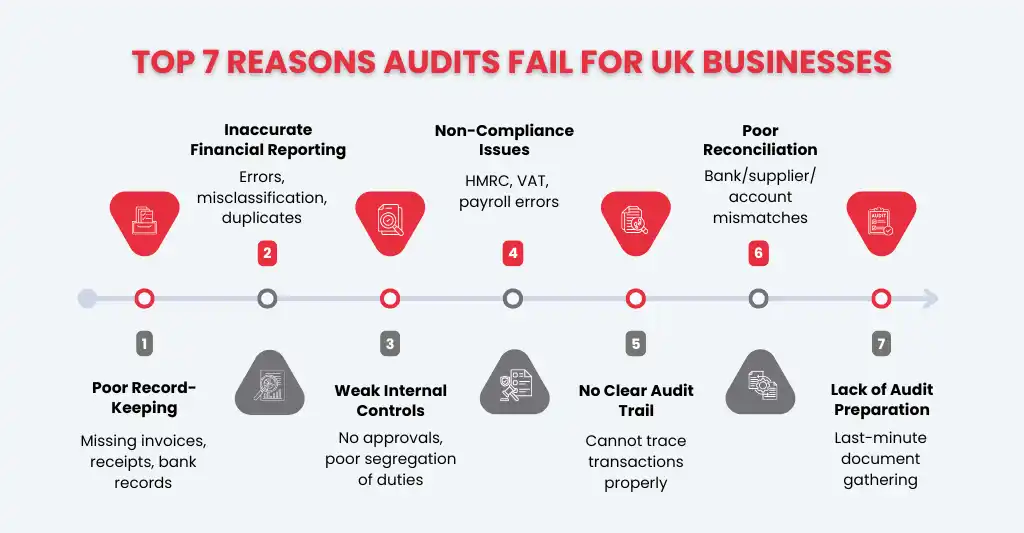
The majority of audit issues are actually avoidable. By understanding the key audit errors, you can positively impact the record-keeping, improve your financial processes, and reduce compliance risk through proactive action. The information on how auditors evaluate records will greatly assist you if you are preparing for your first audit or wish to improve subsequent audits.
The seven most frequent reasons UK companies fail audits are listed below:
1. Poor Record-Keeping
The most common cause of a fail audit is not providing complete and accurate financial records. This makes it difficult for auditors to confirm that the recorded transactions and balance sheet amounts are accurate because they do not have an adequate amount of documents available to them, such as invoices, receipts, bank statements, contracts, or expense documentation.
2. Inaccurate Financial Reporting
Financial statements that don’t fairly depict the company’s success may result from bookkeeping mistakes, inaccurate account classifications, duplicate entries, or unrecorded transactions. During an audit, even small errors can cause worries.
Where these errors are significant enough, auditors may issue a qualified opinion (stating the accounts are accurate except for specific identified issues) or, in more serious cases, an adverse opinion (stating the accounts do not give a true and fair view at all).
3. Weak Internal Controls
Errors, fraud, and compliance violations are more likely to occur in companies that lack adequate approval procedures, segregation of roles, or financial supervision. Internal controls are frequently evaluated by auditors to check the accuracy of financial data.
4. Non-Compliance with Tax and Regulatory Requirements
Audit findings and possible penalties may arise from noncompliance with HMRC legislation, VAT requirements, payroll duties, or industry-specific compliance standards.
5. Inadequate Audit Trail
Transactions must be tracked by auditors from the source papers to the financial statements. It becomes challenging to validate financial information in the absence of a clear audit trail, which could raise audit concerns.
6. Failure to Reconcile Accounts Regularly
Differences that go undetected until the audit process starts can be caused by unreconciled bank accounts, supplier balances, payroll records, or customer accounts.
For example, a property management company that fails to reconcile service charge accounts for two consecutive years can find the discrepancies have compounded significantly. In serious cases, this can lead auditors to raise a going concern query — a flag that the business may not be able to continue operating without addressing the underlying cash position.
7. Lack of Preparation Before the Audit
Instead of viewing audits as a continuous process, many companies only conduct them once a year. Errors and delays are frequently caused by rushing to compile documentation, address differences, and respond to auditor inquiries at the last minute.
How to Prevent a Failed Audit?
In order to overcome any audit obstacles and uphold the highest standards of ethics and integrity throughout the audit process, the auditor must be well prepared and knowledgeable.
Conduct Internal Audits and Reviews
Internal evaluations on a regular basis can find flaws in financial procedures before external auditors do. Creating an internal audit checklist to solve problems early can save a lot of time, money, and stressful situations.
Work with Experienced Accounting Professionals
Expert accountants can assist in maintaining the accuracy of your records, fulfilling compliance requirements, and identifying potential risks before they affect the results of an audit.
Cox Hinkins’s audit services are carried out to ICAEW and FRC standards, combining hands-on review with modern analytics tools to catch the kind of discrepancies listed above before they reach audit stage.
Strengthen Internal Controls
Establish a proper audit preparation guide within your company, divide up financial duties, and implement clear approval procedures. Effective internal controls lower the possibility of fraud, mistakes, and poor financial management.
Stay Compliant with HMRC and Regulatory Requirements
Keep an eye on modifications to tax laws, filing requirements, VAT laws, and industry-specific restrictions. In addition to preventing fines, proactive compliance shows good financial management.
Invest in Reliable Accounting Technology
Automating record-keeping, tracking transactions, maintaining audit trails, and lowering the possibility of human error are all possible with modern accounting software. Additionally, cloud-based technologies facilitate the access and review of financial data.
Can a Business Recover After a Failed Audit?
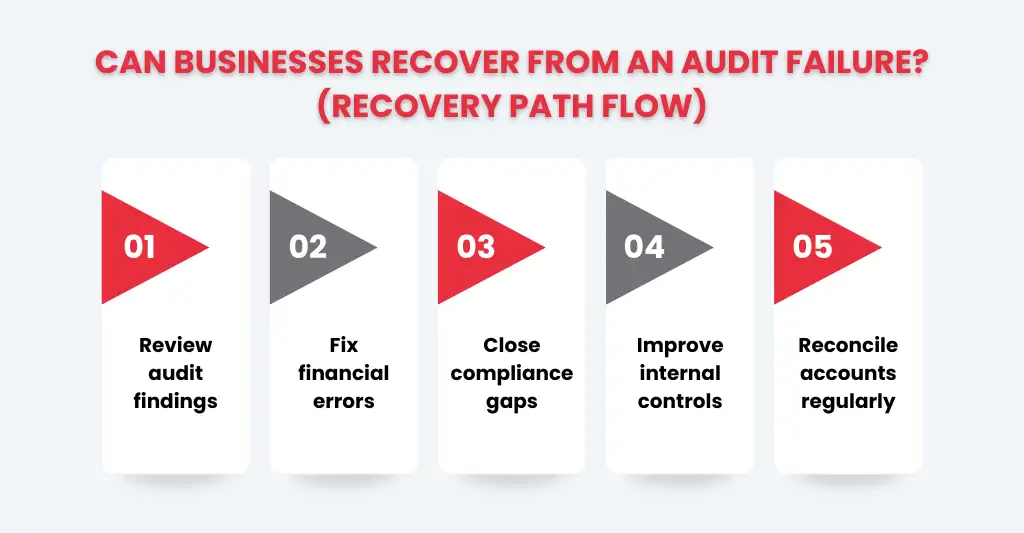
Definitely. A failed audit in the UK is not the end of the road for a business. Most organisations may recover, improve their financial procedures, and get better audit results in the future with the appropriate remedial actions.
Here are the key steps businesses can take to recover:
- Examine the auditor’s findings in detail to determine the precise cause of the audit failure.
- Update any missing or inadequate audit documentation requirements and rectify financial statement errors.
- To lower the possibility of mistakes, fraud, and reporting problems in the future, strengthen internal controls.
- Perform routine account reconciliations to find disparities before they become more serious issues.
FAQs: Frequently Asked Questions
What does it mean if a business fails an audit in the UK?
A business fails an audit when auditors discover serious mistakes, missing documents, problems with compliance, or flaws in financial controls that compromise the accuracy of a company’s financial statements.
What is the due date for corporation tax payment?
Typically, nine months and one day after the end of your business’s accounting period, corporation tax is due. It’s crucial to make payments on time since HMRC may impose interest and penalties on late payments.
How long does an audit take for UK businesses?
The size and complexity of the company determine how long an audit takes. Planning, fieldwork, and the final audit report often take a few weeks to several months in the UK. Financial data that is well-organised might speed up the procedure.
Are audit failures common in small UK businesses?
Any company size can fail an audit, but small businesses are frequently more susceptible because of their lack of resources, weak internal controls, and irregular record-keeping. The majority of audit problems are caused by avoidable mistakes like incomplete paperwork, inaccurate financial records, or gaps in compliance.
Does my business still need a statutory audit under the new 2025 thresholds?
Possibly not. Following the threshold increase for financial years starting on or after 6 April 2025, a private company is generally exempt if it meets at least two of the following: turnover of £15 million or less, a balance sheet total of £7.5 million or less, and an average of 50 or fewer employees. Group companies, PLCs, and regulated businesses are subject to different rules regardless of size.
Conclusion
Although an unsuccessful audit could lead to significant adverse results, these types of events can usually be avoided altogether. Major reasons why audits fail include inaccurate financial reporting, poor record-keeping, weak internal controls, and compliance gaps. Appropriate procedures and diligent monitoring over time have been proven to correct these issues.
The secret is to prioritise audit readiness throughout the year, not just at the last minute. Businesses can greatly lower audit risks and increase financial transparency by keeping correct records, adhering to HMRC regulations, carrying out frequent financial reviews, and strengthening internal controls.
With professional accounting assistance, you can avoid expensive audit penalties. Cox Hinkins assists UK companies in keeping correct records, enhancing compliance, and being ready for any audit.
Get in touch with Cox Hinkins right now to maintain the financial stability of your company. Our team is ICAEW-regulated and has supported UK businesses with accounting and audit compliance for over 50 years.
Disclaimer: Kindly note this blog provides general information and should not be considered financial advice. We recommend consulting a qualified financial advisor for personalised guidance. We are not responsible for any actions taken based on this content.