- What Is an Audit?
- What are the Different Types of Audit?
- UK Audit Thresholds and SME Exemptions
- What is Assurance?
- Types of Assurance Engagements
- Examples: Audit and Assurance in Practice
- Key Differences Between Audit and Assurance
- Key Similarities Between Audit and Assurance in Accounting
- Why Audit and Assurance Are Important for Businesses and Stakeholders?
- Common Misconceptions About Audit and Assurance Explained
- FAQs: Frequently Asked Questions
- Conclusion
Audits and assurance services are key to maintaining trust and accuracy in business financials. An audit is a detailed examination of financial records to verify compliance with regulations and accounting standards. Assurance services look at the whole business and its processes and data to increase stakeholder confidence.
Understanding the difference between audit and assurance helps businesses, investors and regulators have transparency, reduce risk and make informed decisions with trusted information, financial and non financial.
In this blog, we have defined audit and assurance, explore their various types, and highlights the key differences that business owners, financial professionals, and accounting students should understand. By the end, you will gain a full insight into how these services improve accountability, reliability, and support better decision-making within organisations.
What Is an Audit?
An audit is an independent, systematic examination of an organisation’s financial records, transactions, and internal controls, carried out by a competent professional such as a Chartered Accountant (CA). The purpose is to provide stakeholders with an objective opinion on whether the financial statements give a true and fair view, and that they comply with applicable accounting standards and legal requirements. While the scope and format vary depending on the type of audit, all audits share a common goal: to give those relying on the financial information, investors, lenders, regulators, and directors justified confidence in its accuracy.
What are the Different Types of Audit?
The most common types of audits include:
Financial audits
A financial audit is an independent examination of a company’s financial statements, including the income statement, balance sheet, and cash flow statement, to verify that they accurately represent the organisation’s financial position. Conducted by a qualified auditor, the process involves testing transactions, reviewing supporting documentation, and assessing internal controls. The auditor then issues a formal opinion, which lenders, investors, and regulators rely on to make informed decisions.
Reviews of financial statements
Reviews of financial statements concentrate on the company’s financial data for correctness, accountability, and legality. They are typically less costly than comprehensive audits and have a more restricted scope.
Tax audits
To ensure that tax laws are being followed, HMRC conducts tax audits (commonly known as compliance checks). Understanding the goal and scope of tax audits is essential when preparing for them, this enables you to compile the relevant documents and provide accurate answers to any queries raised.
Compliance audits
These audits make sure a company complies with rules or guidelines. In order to protect the interests of stakeholders, compliance audits also assist in finding gaps and creating regulations.
Internal audits
Businesses carry out internal audits to verify that internal policies and procedures are being followed. Finding avenues for organisational improvement is the main objective. Internal audits encompass a variety of topics, including operational procedures, risk management, financial reporting, and regulatory compliance.
External audits
External auditors who are not connected to the organization look into the procedures and offer objective reports. These auditors’ judgments are often regarded as credible because they are not affiliated with the organisation. Financial and tax compliance are two topics that may be covered by external audits.
To learn more about the key differences between internal and external audits, check out our detailed blog post: Internal Audit vs External Audit.
UK Audit Thresholds and SME Exemptions
Not all UK businesses need a full audit. SMEs can be exempt from audit if they meet the criteria set by Companies House and the FRC. These thresholds are usually based on turnover, assets and employee numbers. Understanding these exemptions helps smaller businesses decide when they need to engage an auditor or opt for tailored assurance services for their business.
As of the latest thresholds, companies are exempt if they meet at least two of the following: turnover ≤ £10.2m, assets ≤ £5.1m, employees ≤ 50.
Audit requirements by business type
| Business Type | Likely Audit or Assurance Requirement |
| Small company (below thresholds) | No statutory audit required; voluntary assurance may be requested by lenders |
| Medium or large company (above thresholds) | Statutory audit required under Companies Act 2006 |
| FCA or PRA regulated firm (any size) | Statutory audit required regardless of size |
| Charity (income above £1m, England and Wales) | Statutory audit required under Charities Act 2011 |
| Subsidiary of a PIE parent | Audit likely required regardless of subsidiary size |
| Owner managed SME seeking bank funding | Lender may require a review engagement or full audit as a condition |
What is Assurance?
Assurance is a professional service in which an independent expert evaluates specific information, financial or non financial, against agreed criteria, and communicates their findings to increase the confidence of intended users. Audit is one specific type of assurance engagement. Assurance as a whole covers a much broader range of subject matter, from internal controls and risk management to sustainability reporting and IT systems.
Assurance services apply across legal, tax, financial, and operational domains. In the financial domain, assurance confirms the reliability of balance sheets, cash flows, and income statements. More broadly, it can also evaluate internal policies and processes to verify adherence to laws, accepted standards, and industry best practices.
Enhancing confidence among stakeholders, such as managers, investors, and business owners, is the main goal of assurance. Credibility is increased by having an expert examine reports, procedures, and controls. Additionally, organisations may choose to voluntarily look for assurance services to be transparent and accountable.
Types of Assurance Engagements
Assurance engagements can be used in a variety of contexts where stakeholders want information confidence, and they extend beyond financial audits. The following categories apply to these engagements, which are governed by professional standards (such as those published by the International Auditing and Assurance Standards Board, or IAASB):
Audit Engagements
- The most often used assurance method.
- Involves looking over financial statements on your own.
- Ensures that there are no significant misstatements in the accounts.
Review Engagements
- Less thorough than an examination.
- To offer a limited level of assurance, the auditor conducts analytical procedures and queries.
- Smaller businesses or situations where stakeholders require assurance but not a complete audit frequently employ it.
Risk Assessments
- Focuses on locating and assessing hazards in corporate procedures.
- Assures management that risk management strategies are effective.
Compliance Engagements
- Assesses a company’s adherence to internal policies, laws, and regulations.
- Typical of regulated sectors, including insurance, banking, and healthcare.
Internal Controls Assurance
- Investigates the layout and performance of internal controls and systems.
- Contributes to the dependability of operational procedures, IT systems, and financial reporting.
Sustainability and ESG Assurance
- Gives stakeholders assurance on non-financial reporting, like CSR or sustainability reports.
Information Systems Assurance
- Data management, cybersecurity, and IT systems are the main topics.
- Confirms if technological systems are safe and efficient in assisting with business operations.
Examples: Audit and Assurance in Practice
The MOT analogy: Think of a statutory audit like an MOT certificate for your business. An MOT confirms that your vehicle meets the minimum legal standard for roadworthiness, not that the car is perfect, just that it clears the required threshold. An audit opinion confirms the same thing for your financial statements. Assurance is broader, more like a full service. It can cover far more than the legal minimum and is tailored to whatever area of your business your stakeholders need confidence in.
Example 1: Manufacturing SME. A Midlands based manufacturing company with an annual turnover of £18 million is above the statutory audit threshold. Each year its external auditors test a sample of sales invoices, attend the year end stock count, and review significant estimates such as depreciation and provisions. The auditors issue an unqualified opinion confirming the accounts give a true and fair view, giving the company’s bank and shareholders the confidence they need.
Example 2: Property developer. An Oxford based property development company sits below the statutory audit threshold but its lender requires independent assurance over management accounts before renewing a development finance facility. Rather than commissioning a full audit, the company arranges a review engagement. The result is limited assurance, sufficient for the lender’s purposes at a fraction of the cost of a full audit.
Key Differences Between Audit and Assurance
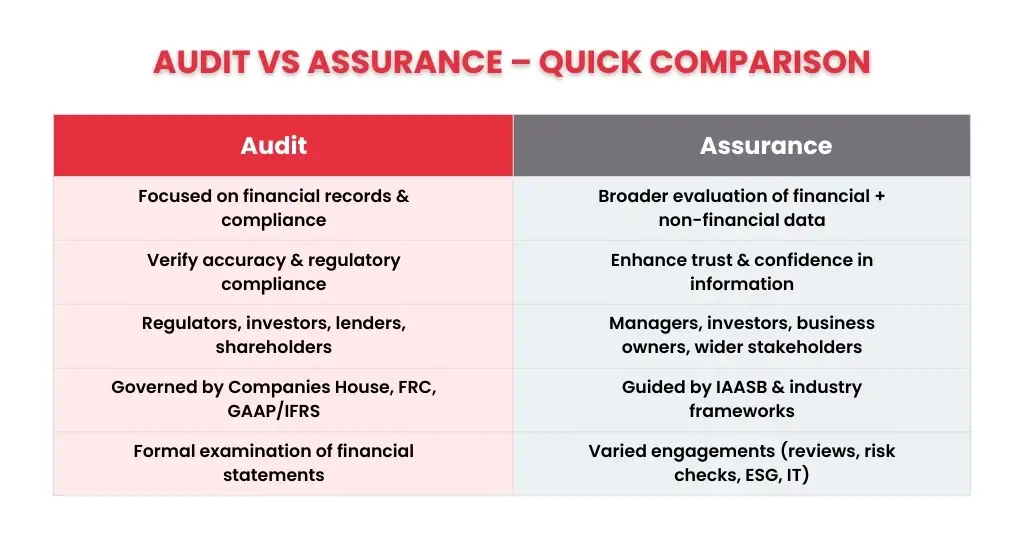
| Aspect | Audit | Assurance |
| Scope | Focused on financial records and compliance | Broader evaluation of processes and data |
| Purpose | Verify accuracy and regulatory compliance | Enhance confidence and trustworthiness |
| Regulator/Standard | Regulated by FRC, Companies House, UK GAAP, and Companies Act 2006 | Governed by IAASB & industry standards |
| Users | Stakeholders, regulators, investors | Managers, investors, business owners |
| Engagement Type | Formal financial statement examination | Varies from reviews to risk assessments |
Despite having many similarities, assurance and auditing are not the same in the following ways:
Nature
An audit examines financial records and internal controls against defined standards to verify accuracy and compliance. Assurance is the broader framework within which audits sit, extending to any subject matter where stakeholders need independent confidence.
Purpose
An audit gives an independent opinion on whether financial statements comply with applicable standards and legislation. The purpose of assurance is broader: to increase the confidence of intended users in any information or subject matter under examination.
Uses
Audits are used primarily by investors, lenders, and regulators relying on financial statements. Assurance serves a wider audience, used wherever a business needs to demonstrate the reliability of information to an external party.
Agent
Both are conducted by independent qualified accountants regulated by the FRC. Statutory audits must be led by a Registered Auditor. Broader assurance engagements may be conducted by other appropriately qualified practitioners depends on the subject matter.
Scope
The scope of a statutory audit is defined by legislation and auditing standards. The scope of an assurance engagement is agreed between the practitioner and the client, meaning it can be narrowly focused on a single area or wide ranging across an entire set of non financial reporting.
Key Similarities Between Audit and Assurance in Accounting
Professionals: Both audits and assurance engagements are carried out by qualified professionals holding credentials from bodies such as the ICAEW, ACCA, CIMA, or ICAS, all overseen by the Financial Reporting Council. Whatever the engagement type, practitioners are bound by the same obligations of independence, objectivity, and professional scepticism.
Objective: Both services share the same core purpose, to increase confidence in the information being relied upon. The form and level of assurance may differ, but both give stakeholders reliable, independently verified information for decision making.
Reporting: Both engagements result in a formal written report addressed to the intended users, communicating the practitioner’s findings, the basis of conclusions, and the level of assurance provided.
Why Audit and Assurance Are Important for Businesses and Stakeholders?
As you must have read above, what role audit and assurance play in the business. Audit improves accountability, openness, and trust in the corporate world. Whereas, assurance evaluates whether the audit is done properly. Beyond merely meeting legal obligations, they are useful instruments for long-term sustainability and decision-making. Here’s why they’re important:
Enhancing Credibility: Trust in financial accounts, reports, and disclosures is increased via independent audits and assurance activities.
The information offered reduces confusion for regulators, lenders, and investors.
Supporting Better Decision-Making: Stakeholders and management can make the right strategic decisions with the use of accurate and valid information. Stronger business planning is supported by assurance of risk management and internal controls.
Ensuring Compliance: Audits verify compliance with tax laws, industry-specific rules, and accounting standards. Assurance engagements make sure that reporting frameworks, policies, and procedures follow best practices and legal requirements.
Detecting and preventing errors: Finding significant fraud, irregularities, or misstatements is aided by routine audits. System and process flaws are brought to light via assurance evaluations, enabling prompt remedial action.
Long-Term Value Creation: Resilience and growth are supported by assurance in domains including IT systems, risk management, and sustainability. Companies that exhibit honesty and conformity draw in greater capital and customers.
Common Misconceptions About Audit and Assurance Explained
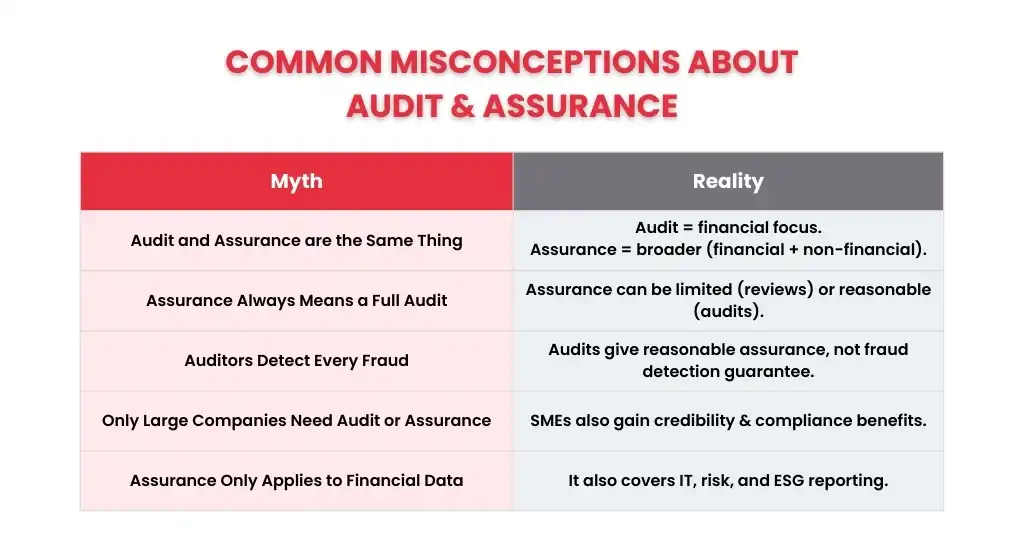
As said before, audit and assurance are often misunderstood by several people. Both terms are closely related but have different goals, objectives, and results. The following are common misconceptions:
Audit and Assurance Are the Same Thing
Reality: A particular kind of assurance engagement that focuses on financial statements is called an audit.
The scope of assurance is wider and might include non-financial domains like internal controls, sustainability, and compliance.
Assurance Always Means a Full Audit
Reality: Different levels of assurance can be offered, ranging from reasonable (audits) to limited (reviews).
Not every assurance assignment entails the extensive testing and evidence collection necessary for an audit.
Auditors Detect Every Fraud
Reality: Audits offer a reasonable level of assurance rather than absolute certainty.
The primary goal is not to find every incidence of fraud or error, but rather to make sure financial statements are free from substantial misstatement.
Only Large Companies Need an Audit or Assurance
Reality: The truth is that small and medium-sized companies gain as well.
Assurance enhances credibility, processes, and compliance even in situations when audits are not mandated by law.
Assurance Only Applies to Financial Data
Reality: Assurance also encompasses non-financial domains such as risk management, IT systems, and ESG reporting.
Assurance is being used by businesses more and more for cybersecurity and sustainability assessments.
Audit and Assurance Are Just Regulatory Burdens
Reality: They are instruments for increasing stakeholder trust, lowering risk, enhancing governance, and creating value.
They can improve reputation and competitiveness rather than only being a compliance exercise.
FAQs: Frequently Asked Questions
Who needs an audit, and is it compulsory for all businesses?
Not all UK businesses are legally required to have a statutory audit. Under the Companies Act 2006, small companies qualify for an exemption if they meet at least two of: annual turnover of £10.2m or less, total assets of £5.1m or less, and 50 employees or fewer. Public interest entities, FCA regulated firms, and charities above a given income threshold must have one regardless of size. Many businesses also choose one voluntarily to satisfy lenders or investors.
Which assurance engagement types, aside from audits, are most frequently used?
The most common non audit assurance engagements are review engagements, internal controls assurance, and compliance engagements. Businesses are also increasingly seeking ESG and sustainability assurance as stakeholders demand greater transparency on non financial reporting. The right engagement depends on the level of confidence required and the subject matter being examined.
Can information that isn’t financial be covered by assurance services?
Yes. Assurance is not limited to financial data. Modern engagements cover sustainability and ESG disclosures, cybersecurity, IT systems, regulatory compliance, and risk management frameworks. Investors, regulators, and customers increasingly want confidence across a wider range of business information, not just financial statements.
Can assurance help small enterprises even if they don’t have to audit?
Yes. Even without a statutory audit requirement, assurance services provide real value to smaller businesses. A review engagement or internal controls assessment can strengthen credibility with lenders, identify weaknesses, and demonstrate sound governance at a fraction of the cost of a full audit. For SMEs seeking funding, new contracts, or preparing for a sale, voluntary assurance is a worthwhile investment.
Can you explain what assurance in accounting involves?
Assurance in accounting is a professional service that helps businesses and stakeholders gain confidence in financial or operational information. Essentially, it’s a way to ensure that reports, processes, or systems are accurate, reliable, and comply with regulations. Assurance services can cover financial statements, internal controls, or even sustainability reports—anything that benefits from an expert review to build trust.
What is the main difference between audit and assurance services?
While both audit and assurance aim to improve confidence in business information, they’re not the same:
Audit: A specific type of assurance service, usually focused on reviewing financial statements to verify their accuracy.
Assurance: A broader category that includes audits but also other services like risk assessments, compliance checks, and operational reviews.
Think of assurance as the umbrella, with audits being one of the services underneath it.
What are the key types of assurance services offered by firms?
Assurance services come in various forms depending on the needs of a business. Some of the most common types include:
Financial statement audits: Verifying accuracy and compliance of financial reports.
Internal control reviews: Checking if systems and processes are efficient and reliable.
Compliance assurance: Ensuring the business meets legal, regulatory, or contractual obligations.
Risk management assessments: Identifying potential risks and evaluating controls.
Sustainability or ESG assurance: Confirming environmental, social, and governance reports.
Each type helps businesses make informed decisions and maintain stakeholder trust.
Conclusion
Assurance and audit are essential instruments that assist companies in establishing accountability, openness, and trust. Although the primary objective of an audit is to confirm the integrity and compliance of financial statements, assurance goes beyond this to offer trust in both financial and non-financial data, such as internal controls, risk management, and sustainability reporting.
In addition to fulfilling legal obligations, they enhance decision-making, win over investors, and promote sustained company expansion. In the UK, aligning with FRC regulations and Companies Act requirements ensures that audits and assurance engagements not only meet legal obligations but also strengthen stakeholder confidence.
At Cox Hinkins, our audit and assurance team works with UK businesses of all sizes, from owner managed SMEs navigating audit exemption thresholds to growing companies requiring statutory audits and bespoke assurance engagements. If you would like to discuss your specific requirements, speak with one of our qualified accountants today.
Disclaimer: Kindly note this blog provides general information and should not be considered financial advice. We recommend consulting a qualified financial advisor for personalised guidance. We are not responsible for any actions taken based on this content.