- What is a Company Audit?
- Who Needs to Comply with UK Audit Requirements?
- What Changed in April 2025: Old vs New Thresholds
- The Two-Year Rule: You Cannot Claim Exemption Immediately
- Group Companies and Subsidiaries Different Rules Apply
- Dormant Companies
- How to Prepare for a UK Audit?
- Organise Your Financial Records
- Review Internal Controls
- Reconcile Accounts
- Prepare Key Reports
- Communicate with Your Auditor
- Address Potential Issues Early
- Ensure board minutes, bank reconciliations, and supporting schedules are ready
- Confirm your audit trail is complete
- Check that accounting policies are consistent year to year
- Consequences of Non-Compliance With UK Audit Requirements
- How Cox Hinkins Can Help With UK Audit Compliance
- FAQs: Frequently Asked Questions
- Conclusion
Whether your company needs a statutory audit in the UK depends on three things: your size, your structure, and whether you have changed size recently. Most private limited companies can avoid a mandatory audit by qualifying as small but the rules are more detailed than a single turnover figure, and they have changed significantly from April 2025.
This guide covers the current thresholds (updated for financial years starting on or after 6 April 2025), how the two-of-three test works in practice, which companies must have an audit regardless of size, what the UK audit requirements are, how group and subsidiary rules apply, and what the transition from the old limits means for your 2026 year-end accounts.
If you just need a quick answer: a private limited company is generally exempt from a statutory audit if it meets at least two of these three conditions: annual turnover of £15 million or less, a balance sheet total of £7.5 million or less, and an average of 50 or fewer employees. Those are the new 2025 thresholds. If your company exceeds two of those figures, a statutory audit is likely required.
What is a Company Audit?
A company audit is an independent examination of a company’s financial statements and supporting records to assess whether they present a true and fair view. Its goal is to guarantee that the accounts adhere to UK accounting standards and legal obligations while offering a true and fair picture of the company’s financial situation.
Qualified auditors typically conduct audits, reviewing transactions, verifying internal controls, and evaluating the accuracy and dependability of financial reporting. Audits are most commonly associated with larger companies, but small and medium-sized businesses in the UK may also be required to have one if they exceed the size thresholds described below, or if other conditions apply regardless of size.
Who Needs to Comply with UK Audit Requirements?
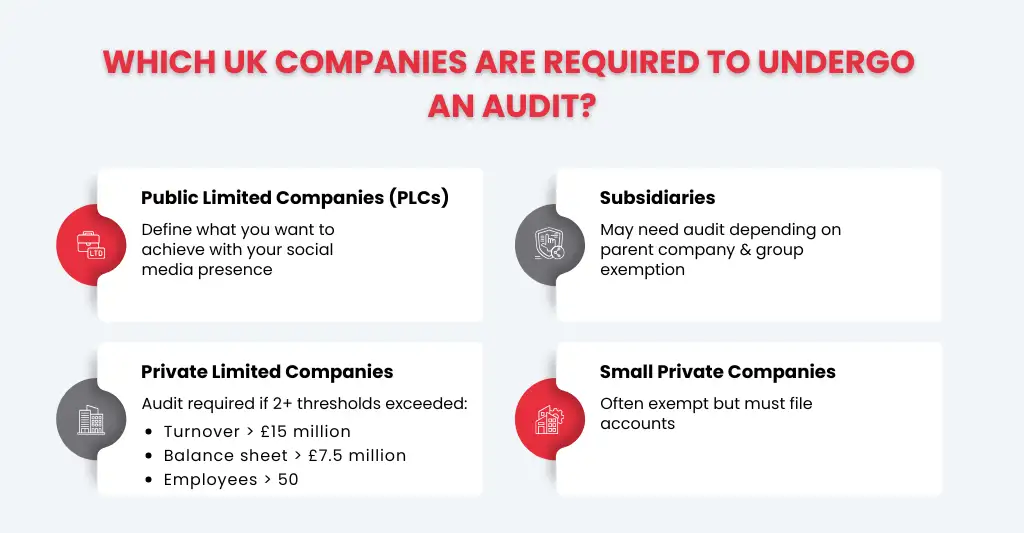
In the UK, audits are not mandatory for all businesses. Depending on its size, structure, and financial activities, a corporation may or may not be required to comply with UK audit regulations.
Companies that must have an audit regardless of size
- Public limited companies (PLCs): All PLCs require a statutory audit, regardless of turnover or balance sheet size.
- Regulated businesses: Banks, insurance companies, e-money issuers, and certain FCA-regulated firms are required to have an audit under their sector’s rules.
- Public interest entities (PIEs): Large listed companies and certain financial institutions have additional audit obligations under UK law.
- Companies whose own articles of association require one: Some companies include audit requirements in their founding documents these override the statutory exemption.
The small company audit exemption the two-of-three test:
A private limited company is exempt from a statutory audit if it qualifies as small. To qualify as small, a company must meet at least two of the following three conditions:
What Changed in April 2025: Old vs New Thresholds
The audit exemption thresholds increased for financial years starting on or after 6 April 2025, the first rise since 2016.
| Condition | Pre April 2025 | From April 2025 |
|---|---|---|
| Annual turnover | £10.2 million | £15 million |
| Balance sheet total | £5.1 million | £7.5 million |
| Average employees | 50 | 50 (unchanged) |
If your year started before 6 April 2025, the old limits apply. From that date onwards, the new higher thresholds apply. Companies with turnover between £10.2M and £15M may now be moving out of audit scope for the first time, subject to the two-year rule below.
March 2026 year-ends:If your financial year started 1 April 2025, this is your first year under the new thresholds. Confirm your audit position now if you have not already done so.
The Two-Year Rule: You Cannot Claim Exemption Immediately
A company must qualify as small in both the current year and the preceding year to claim audit exemption. One qualifying year is not enough. This requirement is set out in section 477 of the Companies Act 2006, which cross-references the size criteria in section 382.
This means:
- If your company has just crossed below the new thresholds for the first time in 2025 26, you cannot automatically claim audit exemption in that year you must have also qualified as small in the previous year under the old thresholds.
- Conversely, if you have just grown above the thresholds, you do not immediately lose your exemption. You typically have a one-year grace period before audit becomes mandatory.
A newly incorporated company, however, can claim audit exemption in its first year without a prior year comparison.
Group Companies and Subsidiaries Different Rules Apply
Being part of a group changes your audit position. A subsidiary that qualifies as small on its own may still require an audit if the group as a whole exceeds the thresholds, or if any group member is a PLC, bank, insurer, or regulated entity. This is governed by section 479 of the Companies Act 2006.
Group size is assessed on an aggregate basis. From April 2025, the gross group thresholds are: turnover £18 million, balance sheet £9 million, and employees 50. If your company is a subsidiary, assess both its standalone position and the group’s aggregate size before concluding on exemption.
Dormant Companies
A dormant company (one with no significant accounting transactions during the year) is generally exempt from audit under section 480 of the Companies Act 2006 and can file dormant accounts with Companies House. However, any income received, payments made, or intercompany transactions can remove dormant status and trigger the need to reassess audit obligations.
| Condition | Small company limit (exempt from audit) | Exceeds limit (audit likely required) |
|---|---|---|
| Annual turnover | £15 million or less | More than £15 million |
| Balance sheet total | £7.5 million or less | More than £7.5 million |
| Average number of employees | 50 or fewer | More than 50 |
If a company exceeds two or more of these limits, it is no longer classified as small and a statutory audit is generally required. If it meets two or more of them, it qualifies for audit exemption provided no other condition makes an audit mandatory.
How to Prepare for a UK Audit?
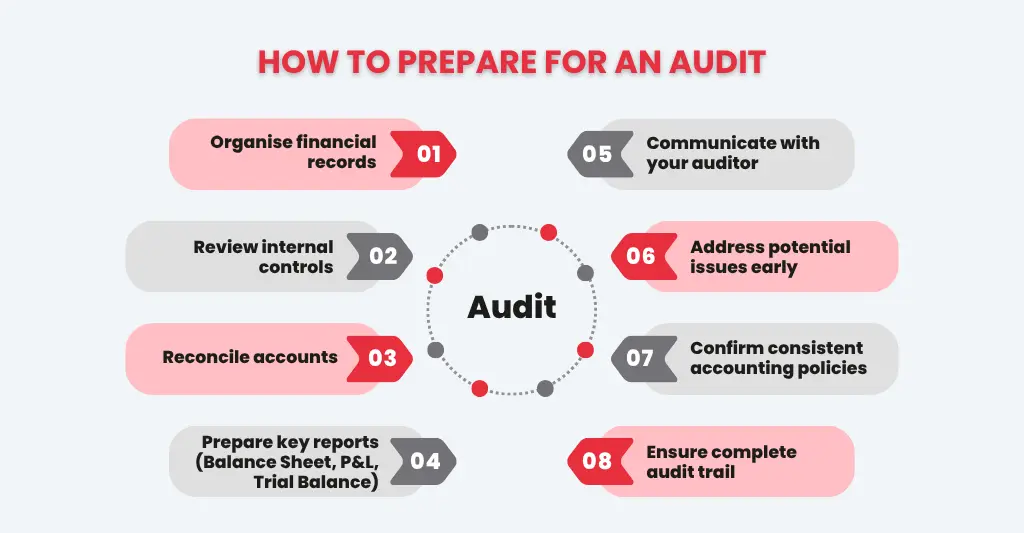
It doesn’t have to be difficult to prepare for a UK audit. You can make the process easy, effective, and even insightful for your company with the correct strategy. This is how:
Organise Your Financial Records
Make sure that all bank statements, invoices, receipts, and accounts are updated and properly documented. The foundation of a successful audit is accurate bookkeeping.
Review Internal Controls
Verify the documentation and efficiency of your internal procedures, including approval workflows, payroll management, and expenditure monitoring. Auditors will evaluate the strength of your company’s controls.
Reconcile Accounts
Verify that all balances match your records and are reconciled, including bank accounts, creditor and debtor accounts, and payroll records. The audit process may be delayed by mistakes.
Prepare Key Reports
Gather important reports, including the balance sheet, profit and loss statement, and trial balance. These are used by auditors to confirm financial correctness.
Communicate with Your Auditor
Make documents easily accessible and well-organised, and respond quickly to inquiries. Effective communication lowers the possibility of mistakes or miscommunications and expedites the audit.
Address Potential Issues Early
If you notice potential problems like odd transactions or late invoices, address them in advance. Strong financial management is shown by this proactive strategy.
Ensure board minutes, bank reconciliations, and supporting schedules are ready
Make sure key records are organised and easy to access. Board minutes show important decisions, bank reconciliations confirm cash balances are correct, and supporting schedules provide the detail behind figures in the accounts.
Confirm your audit trail is complete
Check that every important transaction can be followed from the final accounts back to the original source documents, such as invoices, receipts, and approvals. A complete audit trail helps auditors verify accuracy quickly.
Check that accounting policies are consistent year to year
Review whether you are using the same accounting methods and rules as last year. Consistent policies make financial statements easier to compare and help avoid confusion or questions during the audit.
Consequences of Non-Compliance With UK Audit Requirements
It is mandatory to follow UK audit requirements otherwise your business can face serious consequences legally and financially. Understanding the risks can help you stay proactive and avoid costly mistakes.
Financial Penalties: Late filing penalties can apply if accounts are not filed on time, and failure to comply with statutory filing obligations can create legal and practical consequences for the company and its directors.
Legal Consequences: Failing to file accounts or meet statutory filing obligations can lead to penalties, enforcement action, and in serious cases director consequences. In severe situations, continuous noncompliance with audit requirements may potentially result in the disqualification of directors or legal action.
Loss of Credibility: Audited accounts provide trust to investors, lenders, and business partners. Without proper audit, your credibility and trustworthiness in the eyes of investors can be damaged affecting future growth and profitability.
Operational Risks: If you skip audit it can hide your financial issues that need to be rectified. Or it may result in cash flow problems, mismanagement, or even insolvency.
Difficulty in Securing Finance: As a trust factor, banks and investors often prefer audited financial accounts before providing loans or doing investment. Non-compliance may limit access to capital if you need any time in the future.
How Cox Hinkins Can Help With UK Audit Compliance
Dealing with UK audit requirements can be challenging for growing businesses already managing day-to-day operations. Cox Hinkins can support your business with practical guidance to help you stay compliant and better prepared for UK audit requirements. Our team can assess whether your company meets audit exemption criteria and identify any obligations that apply
We can help with audit readiness reviews, account reconciliations, and organising supporting documents so your records are prepared for audit. We can also support liaison with auditors and help manage queries efficiently during the process. Alongside compliance support, we can provide practical advice to improve transparency, strengthen internal controls, and improve reporting accuracy. With Cox Hinkins on your side, audit time becomes an opportunity to take a closer look at your business and gain some real confidence rather than just something you have to get through.
FAQs: Frequently Asked Questions
What are the UK audit thresholds for 2026?
For financial years starting on or after 6 April 2025, a private limited company is exempt from audit if it meets at least two of: turnover £15 million or less, balance sheet total £7.5 million or less, average employees 50 or fewer. For financial years that started before that date, the old limits apply (£10.2 million turnover, £5.1 million balance sheet).
Does my UK subsidiary require an audit?
It depends on both the subsidiary’s own size and the group’s aggregate size. A subsidiary that is small on a standalone basis may still require an audit if the group as a whole exceeds the small company thresholds, or if any group member is a PLC or regulated entity. Group audit exemption is available in some cases but requires specific conditions to be met take advice before relying on it.
Can shareholders still request an audit?
Yes. Even if a company is normally exempt, shareholders who own at least 10% of shares by number or value can request an audit. The request must be made in writing and must reach the company at least one month before the end of the financial year.
What must be included if a company claims audit exemption?
If your company is claiming audit exemption, you still need to file annual accounts with Companies House. The balance sheet must include the correct audit exemption statement, and the directors must confirm that the company qualifies for exemption and that the shareholders have not asked for an audit.
What is the difference between audit exemption and filing exemption?
Audit exemption means your company does not need to have its accounts audited, but it still has to prepare and file annual accounts. Filing exemption is different — it means a company is not required to file certain accounts or documents at Companies House, but that only applies in specific cases and is not the same as being exempt from audit.
I claimed audit exemption last year under the old thresholds. Can I still claim it this year under the new ones?
Possibly, but you need to check the two-year rule. If your company was below the old thresholds in the prior year and is also below the new thresholds in the current year, you can claim exemption. If your company was above the old thresholds last year (and therefore had an audit), you will need to confirm whether this is the first year you qualify as small before relying on the exemption.
Is a voluntary audit ever worth it even if we are exempt?
Yes, in several situations. Lenders and investors often require audited accounts regardless of legal obligation. If you are preparing to sell the business or raise equity finance, audited accounts reduce due diligence friction significantly. Some large commercial contracts also require suppliers to provide audited accounts. For companies with complex transactions, related party dealings, or external shareholders, a voluntary audit adds credibility and can identify issues before they become material.
Conclusion
Understanding UK audit requirements isn’t supposed to be a complicated challenge. Being aware of who needs an audit, what the threshold is they have to meet, and what exemptions might be available lets you prepare ahead and dodge the stress and fines that come with getting it wrong. But you can turn a regulatory headache into a useful tool for getting a clearer picture of your finances and boosting company confidence – if you know how to get it right. That means getting your records in order, checking your accounts are balanced and working closely with the auditors you’re working with.
But having a team behind you like Cox Hinkins means you can be confident your company is always up to speed and getting expert advice to boot. Whether you’re a small business trying to figure out whether you qualify for any breaks or a growing company facing the prospect of a mandatory audit, being proactive is the key. So why put off until it’s too late? Take charge of your audit process now and build a solid foundation for your company – rather than leaving it till the last minute and stressing about deadlines.