
- What Is a Service Charge in the UK?
- Who Pays the Service Charge on a Rented Flat in the UK?
- How Service Charges Are Handled in Rental Agreements?
- Can Tenants Ever Pay Service Charges Directly?
- Service Charge vs Ground Rent: What’s the Difference?
- Does It Matter Who Pays the Service Charge?
- Are Service Charges Tax Deductible for Landlords?
- What Should Tenants Check Before Renting?
- How Much Are Service Charges in the UK?
- How Cox Hinkins Can Help You with Service Charge
- FAQs: Frequently Asked Questions
- Conclusion
When you first start renting, it appears simple; agree on the rent, pay your expenses, and move in. However, a common debate is do tenants pay service charges in the United Kingdom or if the landlord should cover them.
Service charges can feel like a hidden expenditure, creeping on top of your monthly rent and paying everything from building upkeep to common utilities. Knowing what you are responsible for and what your landlord must pay, can help you avoid surprise costs and difficult arguments.
Before you sign anything, or if you are already renting, you should understand how these fees work. In this blog, we will break down everything in simple words so you know precisely where you stand and how to prevent surprises along the way.
What Is a Service Charge in the UK?
In the UK, a service charge is a fee paid to support the costs of maintaining and managing shared parts of a property, typically flats or apartment complexes. These fees are normally paid by the property owner (landlord), but they may be passed on to tenants depending on the rental agreement.
Service costs are used to keep the building condition good and the common areas safe, clean, and well-maintained. They may include a variety of charges, such as:
- Lift maintenance and servicing
- Security services or concierge
- Building insurance (sometimes included)
- Management or administrative fees
The fee varies according to the type of property, location, and level of service given. Some are set, while others vary annually based on real expenditures.
Who Pays the Service Charge on a Rented Flat in the UK?
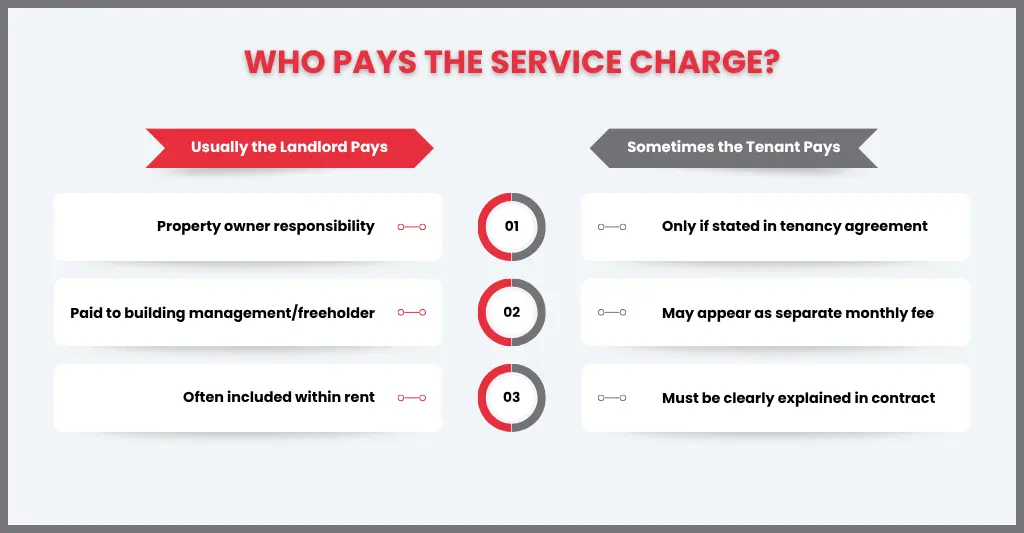
In most situations, the landlord is responsible for paying the service charge because they own the property. However, whether or not tenants pay service costs in the UK is determined by their leasing agreement.
If your contract specifies whether service charges are included in your rent or paid separately, you may be compelled to pay them. If no mention is made of it, the landlord is normally responsible for the cost.
How Service Charges Are Handled in Rental Agreements?
Generally, service charges in the UK are clearly mentioned in the tenancy agreement. How they are handled may differ according to the landlord’s choice, but it will fall into any of the following categories.
- Included in the rent: The most common approach is landlords cover the service charge amount from the rental cost.
- Charged separately: The agreement may state that you must pay a specified service charge in addition to rent.
- Not mentioned at all: In this case, the landlord is usually accountable, and you should not be expected to pay later.
Make a habit of reading your contract thoroughly before signing. If service prices are not clearly explained, it is necessary to seek clarification to avoid unexpected fees.
Can Tenants Ever Pay Service Charges Directly?
Yes, tenants can occasionally pay service charges directly, but only in certain circumstances. This typically occurs when the leasing agreement expressly indicates that the tenant is responsible for paying all or a portion of the service charge.
Tenants may pay it as part of their rent in some situations, but it may also be specified as a separate payment. Direct payment to a managing agent is less typical, but it is possible if agreed upon in the contracts.The crucial point is that tenants should only pay service charge if they are clearly stated and agreed to in the leasing agreement.
Example:
Sarah lives in a rented flat where her lease agreement says that she must pay for cleaning the common areas. She pays this directly to the managing agent, separate from her rent.
Service Charge vs Ground Rent: What’s the Difference?
| Basis | Service Charge | Ground Rent |
| Purpose | Covers maintenance and upkeep of the building | Fee for occupying the land |
| What It Includes | Cleaning, repairs, lifts, security, gardens, etc. | No services included |
| Payment Type | Variable (can change yearly) | Usually fixed annual amount |
| Who Pays | Landlord (may be passed to tenant if agreed) | Property owner (landlord) |
| Paid To | Managing agent or building management company | Freeholder (landowner) |
Does It Matter Who Pays the Service Charge?
Yes, as a tenant it is important to know who will be responsible for paying service charges. Do tenants pay service charges or the landlord will be paying it? It is important to get clarity on this question before finalising the agreement.
If the landlord covers the service charge, it is usually included in your rent, giving you a single monthly payment. However, if it is charged individually, you might end up paying more than you expected each month.
Example:
James rents a flat where the landlord includes service charges in the rent. He pays one fixed monthly amount, so there are no surprise extra costs.
Are Service Charges Tax Deductible for Landlords?
Yes, in most situations, service charges are tax deductible for landlords in the UK, but only if they are classified as a business expense. If a landlord pays service charges on a rental property, they can typically claim them as an allowed expense against rental income, to lower their taxable profit. This refers to charges for property maintenance, repairs, or management.
However, if the cost is passed on to the tenant and completely recovered, the landlord may not receive a tax benefit because it is not a real outlay. Landlords should keep reliable records and guarantee that the charges are solely for the rental party.
What Should Tenants Check Before Renting?
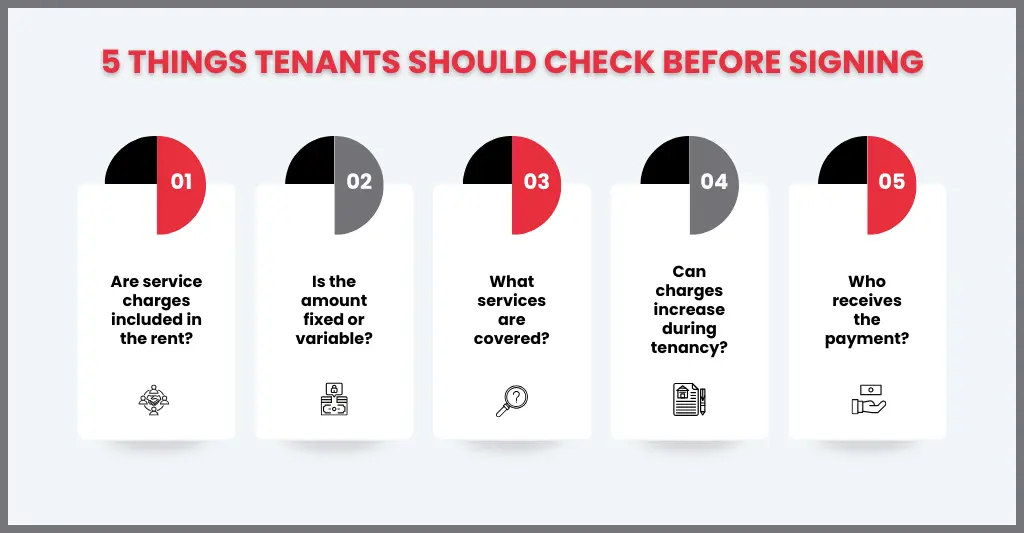
Before signing a lease agreement, it is critical to double-check a few key details to avoid unexpected fees later:
- Service charges clause – See if service charges are included in the rent or listed separately
- Breakdown of costs – Ask what the charge actually covers (cleaning, repairs, maintenance, etc.)
- Total monthly cost – Understand the full amount you’ll pay, not just the rent
- Payment terms – Check how and when any extra charges are due
- Changes or increases – Find out if charges can go up during your tenancy
How Much Are Service Charges in the UK?
In the UK service charges can differ widely depending on the property type, location and level of services provided. On average, they can range from £1,000 to £3,000 per year for a basic flat, but in larger buildings with extra amenities like gym, parks or malls the service charge cost can be higher.
For tenants, the amount you pay depends on your tenancy agreement. It may be:
- Included in the rent (most common)
- Charged separately as a fixed or variable fee
Always ask for a breakdown on costs included in the lease agreement, so that you can understand exactly how much you will be paying and is it fitting your budget. There are new rules for service charge accounting which you can read in our blog, New Rules for Service Charge Accounting 2026: Complete Guide to Compliance, Changes, and Business Impact
How Cox Hinkins Can Help You with Service Charge
By creating compliant year-end service charge accounts, assisting with realistic budgeting and forecasting, managing surpluses and deficits in accordance with lease terms, responding to questions from tenants and leaseholders with clear, customised reports, integrating with property management systems to maintain accurate and current records, and guaranteeing that your block or estate stays compliant with RICS guidelines, HMRC regulations, and company law while enhancing transparency and cash flow.
FAQs: Frequently Asked Questions
Do tenants pay service charges in the UK?
Most of the time, tenants don’t directly pay service charges; the landlord is responsible as the property owner. However, tenants may still pay the service charge if cost is directly included in the rent or clearly mentioned as a separate charge in the legal tenancy agreement.
Who pays the service charge on a rented flat in the UK?
Mostly, landlords pay the service charge cost as they own the property. However, the cost may be passed to the tenant if it’s included in the rent cost or legal lease agreement.
Can tenants refuse to pay service charges?
Only in cases where service costs are not expressly included in the leasing agreement may tenants refuse to pay them. You are legally obligated to pay if the agreement has a legitimate payment clause.
It’s best to discuss the charge with your landlord or get counsel before declining if you think it’s unfair or confusing. Failure to pay could result in conflicts.
Are service charges tax deductible?
Yes, service charge can be tax deductible but mainly for landlords not the tenants. If the landlord pays a service charge for maintaining a rental property, they can usually claim them as an allowable expense against rental income.
Why are service charges increasing?
The main reasons for rising service charges are higher energy costs, inflation, and increased maintenance expenses.
Is service charge included in rent?
Yes, occasionally. Rent often includes servicing charges, so you only have to pay a set sum each month. They might, however, be billed individually in some agreements.
Conclusion
Understanding service charges is important if you are staying on rent in the UK. Generally, landlords are responsible for paying service charges. The main question, do tenants pay service charges totally depends on what is written in your tenancy agreement.
Once your tenancy agreement is prepared, read it carefully to know what is included in it. These will help you avoid unexpected costs and confusion in the future. Make sure whether the service charge is included in your rent or listed separately, or the landlord will be paying it, be clear no hidden surprises.
Need help with managing your service charge accounts? We provide expert service charge account services to ensure everything is handled smoothly and transparently. Contact us today to learn more!
Disclaimer: Kindly note this blog provides general information and should not be considered financial advice. We recommend consulting a qualified financial advisor for personalised guidance. We are not responsible for any actions taken based on this content.