- Your year-end accounting checklist (step by step)
- Organise and reconcile your financial records
- Chase outstanding invoices and settle unpaid bills
- Review payroll records and PAYE liabilities
- Review VAT returns and confirm submissions
- Review assets and update depreciation schedules
- Confirm your confirmation statement is up to date
- Plan and optimise your corporation tax position
- Prepare statutory accounts and file with Companies House
- Set financial goals and a budget for the new year
- When should you start preparing your year-end accounts?
- Can you do year-end accounting yourself, or do you need an accountant?
- What happens if a director doesn’t file on time?
- FAQs: Frequently Asked Questions
- Conclusion
A Year-End Accounting Checklist is your road map to accurate reporting, easier tax filing, and wiser financial decisions for the upcoming year. It covers reconciling accounts, reviewing payroll and VAT, updating asset records, planning your corporation tax position, and filing statutory accounts with Companies House — all before your year-end deadline.
Many UK firms are scrambling to organise records, balance accounts, analyse expenses, and get ready for compliance deadlines as the fiscal year draws to a close.
However, year-end accounting doesn’t have to be last-minute or unpleasant. Businesses may find financial gaps, avoid costly blunders, improve cash flow visibility, and start the year with confidence if they are well prepared.
We will take you through the crucial year-end accounting checklist that every UK company has to follow to maintain correct records, stay compliant, and strengthen your financial foundation through this comprehensive 2026 guide.
Your year-end accounting checklist (step by step)
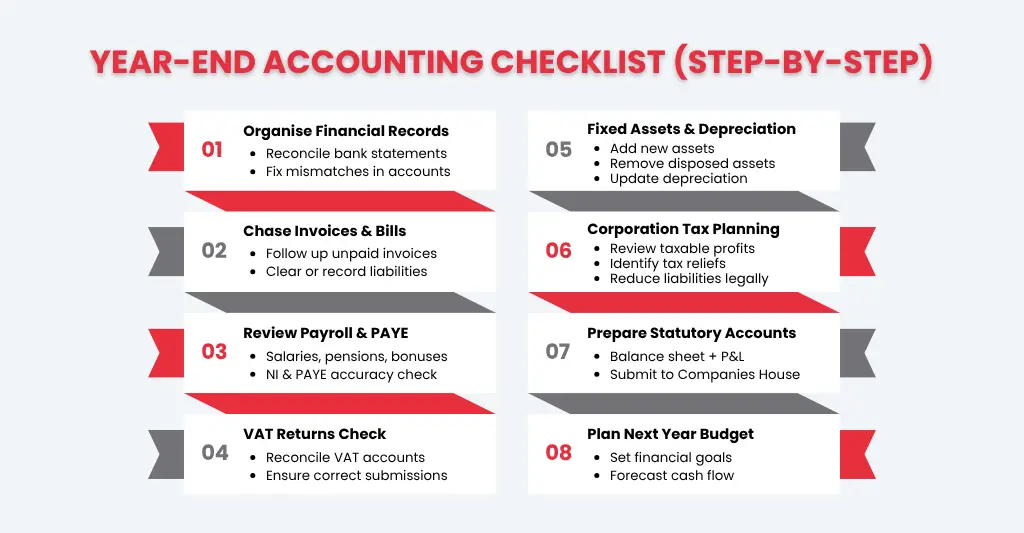
Although closing the books for the year might be a difficult process, it becomes a lot more manageable with the correct strategy and a well-defined plan. Use the checklist below to work through each step in order.
Organise and reconcile your financial records
To find and fix any inconsistencies, compare your bank statements with your accounting records.
Chase outstanding invoices and settle unpaid bills
Check unpaid supplier invoices, track all spending, and ensure bills are paid or accrued appropriately.
Review payroll records and PAYE liabilities
Verify that all payroll, pensions, bonuses, PAYE, and National Insurance records are accurate and comprehensive.
Review VAT returns and confirm submissions
Verify transactions, reconcile VAT accounts, and make sure your VAT returns are correct before submitting them.
Review assets and update depreciation schedules
To document any purchases, sales, or write-offs made throughout the fiscal year, review your fixed assets. To guarantee proper financial reporting, tax compliance, and a genuine representation of your company’s asset values, update depreciation schedules.
Confirm your confirmation statement is up to date
Your confirmation statement is separate from your annual accounts and confirms details such as your registered office, directors, and people with significant control (PSCs). It must be filed at least once every 12 months, and missing it carries its own penalty risk distinct from late accounts filing.
Plan and optimise your corporation tax position
To lawfully reduce your corporate tax liability, review your taxable profits, possible reliefs, and permitted costs before the end of the year. Early tax planning ensures complete compliance with HMRC regulations, enhances cash flow, and prevents surprises.
Note for 2026: HMRC doubled its corporation tax late filing penalties from 1 April 2026 — the first increase since 1998. A CT600 filed even one day late now triggers a £200 fixed penalty (up from £100), rising to £400 if more than three months late, and up to £2,000 per return for repeat offenders. This applies even to dormant or nil-return companies, so file on time regardless of whether tax is owed.
Also note: the joint HMRC and Companies House filing service (CATO) closed permanently on 31 March 2026. Company tax returns must now be filed separately using commercial software — factor this into your year-end timeline if you previously relied on the combined service.
Prepare statutory accounts and file with Companies House
Create accurate statutory accounts that accurately depict the financial situation of your company and adhere to UK accounting requirements. To stay in compliance and avoid fines, file them with Companies House before the deadline.
From 2025–2026, Companies House is also rolling out mandatory identity verification for directors, people with significant control, and anyone filing on a company’s behalf. Build time into your year-end process to complete this if you haven’t already.
Set financial goals and a budget for the new year
Make a budget for the next year and set reasonable business goals based on your year-end financial achievements. Improved cash flow, cost control, and sustainable business growth are all facilitated by a well-defined financial strategy.
When should you start preparing your year-end accounts?
Two to three months before the end of your financial year is the ideal time to prepare year-end accounts. By starting early, you can avoid the stress of impending deadlines and have enough time to balance accounts, fix mistakes, collect missing documents, and take advantage of tax planning options.
In addition to preventing last-minute compliance problems and ensuring accurate financial reporting, early planning enables you to make well-informed business decisions prior to the start of the new fiscal year.
Can you do year-end accounting yourself, or do you need an accountant?
If your company is small and has simple finances, you might be able to use accounting software to create your year-end accounts. To avoid costly errors, you will still need a thorough awareness of UK accounting rules, tax laws, and filing requirements.
Working with an accountant is frequently a preferable option for companies with employees, various revenue sources, VAT responsibilities, or complex transactions. A skilled accountant can help you avoid fines from HMRC or Companies House, guarantee compliance, find tax-saving options, and prepare correct statutory accounts.
What happens if a director doesn’t file on time?
Failing to file accounts or a confirmation statement is a criminal offence, not just a financial one. Directors or LLP designated members can be personally fined in the criminal courts, separately from any penalty issued against the company. Persistent non-filing can also lead to Companies House striking the company off the register.
FAQs: Frequently Asked Questions
What should be included in a year-end accounting checklist?
Bank account reconciliation, income and expense reviews, accounts receivable and payable checks, updating depreciation, confirming your confirmation statement is current, compiling statutory accounts, corporation tax planning, and making sure all HMRC and Companies House filing obligations are fulfilled should all be included in a year-end accounting checklist.
When should I start my year-end accounts?
Preparing your year-end accounts should ideally begin two to three months prior to the end of your financial year. You can organise documents, fix mistakes, and fulfil filing deadlines without undue stress if you start early.
What is the penalty for filing accounts late with Companies House?
The late submission of your accounts determines the late filing penalty. For individual private businesses, penalties can be anything from £150 to £1,500, with larger fees for longer delays, and up to £7,500 for public companies. This penalty doubles automatically if accounts are filed late in two consecutive years. Note: this Companies House penalty is separate from HMRC’s CT600 corporation tax filing penalty, which now starts at £200 from 1 April 2026 — directors can face fines from both bodies for a single missed deadline.
Do small businesses in the UK need to prepare statutory accounts?
Yes, the majority of UK limited corporations are required to create and submit statutory accounts to Companies House. Although partnerships and sole proprietors typically have different reporting obligations, proper records are necessary for tax purposes.
How long does year-end accounting take?
The intricacy of your records and the size of your company determine how much time is needed. If your financial records are thorough and well-organized, year-end accounts usually take a few days to several weeks.
Conclusion
Completing your year-end accounts gives you important information about your company’s financial situation and prospects, so it’s not just about meeting the filing date. You can guarantee compliance and avoid needless penalties by checking business records, monitoring tax obligations, reconciling accounts, and creating accurate financial statements.
You can detect any problems, enhance cash flow planning, and make well-informed decisions for the upcoming year by starting the process early. A well-organised year-end accounting process positions your company for sustained development and success, regardless of whether you handle accounts yourself or partner with a year-end accountant.
Disclaimer: Kindly note this blog provides general information and should not be considered financial advice. We recommend consulting a qualified financial advisor for personalised guidance. We are not responsible for any actions taken based on this content.