
- What Are MTD Deadlines?
- Complete MTD Deadline Calendar (2026 to 2028)
- How MTD Quarterly Reporting Deadlines Work
- Final Declaration Deadline Under MTD
- MTD Tax Payment Deadlines
- MTD for VAT Deadlines
- Who Needs to Follow MTD Deadlines?
- What Happens If You Miss an MTD Deadline?
- MTD Deadlines vs MTD Timeline: What Is the Difference?
- FAQs: Frequently Asked Questions
- Conclusion
MTD deadlines represent one of the biggest changes to UK tax reporting in decades. From April 2026, Making Tax Digital for Income Tax will begin rolling out in phases. Instead of submitting a Self Assessment return once a year, many taxpayers will move to quarterly digital updates. If your qualifying income from self-employment or property exceeds £50,000 in the 2024/25 tax year, the clock is already ticking. If you are closer to the £30,000 mark, April 2027 is when your obligations begin.
Whether you run your own business, rent out property, or both, knowing these dates early helps you stay organised instead of rushing at the last minute. This article covers every key MTD deadline between 2026 and 2028, explains what each submission actually involves, and tells you what happens if you miss one.
What Are MTD Deadlines?
MTD deadlines are the specific dates by which you must submit digital updates to HMRC under Making Tax Digital for Income Tax. The old system gave most people one major deadline a year: 31 January for the Self Assessment return. Under MTD, that changes significantly.
There are two types of submission you need to plan for:
- Quarterly update deadlines are four times a year, covering each three-month period of the tax year.
- The Final Declaration deadline falls once a year, on 31 January, and is where you confirm your final tax position.
One point that often causes confusion is the difference between reporting and paying tax. These deadlines relate to reporting only. MTD changes how often you send updates to HMRC about your income.
Complete MTD Deadline Calendar (2026 to 2028)
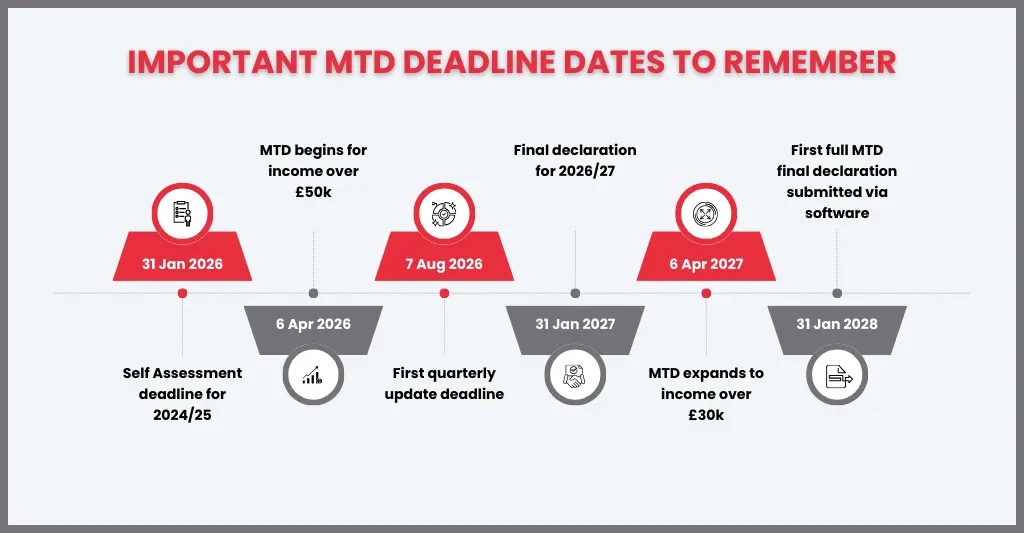
Here is your full reference table covering every key date across all three phases of the MTD rollout:
| Date | Event | Who It Applies To |
| 31 Jan 2026 | Submit 2024/25 Self Assessment return | All affected taxpayers |
| 6 Apr 2026 | MTD for Income Tax begins | Qualifying income over £50,000 |
| 7 Aug 2026 | Q1 quarterly update deadline | MTD participants (£50k+) |
| 7 Nov 2026 | Q2 quarterly update deadline | MTD participants (£50k+) |
| 31 Jan 2027 | Final Declaration for 2026/27 + standard SA return for 2025/26 | MTD participants + non-MTD filers |
| 7 Feb 2027 | Q3 quarterly update deadline | MTD participants (£50k+) |
| 7 May 2027 | Q4 quarterly update deadline | MTD participants (£50k+) |
| 6 Apr 2027 | MTD begins for Phase 2 | Qualifying income over £30,000 |
| 7 Aug 2027 | Q1 quarterly update deadline | MTD participants (£30k+) |
| 31 Jan 2028 | First MTD Final Declaration submitted via software | MTD participants (£50k+) |
| 6 Apr 2028 | MTD begins for Phase 3 | Qualifying income over £20,000 |
One thing to keep in mind: in your first year of MTD reporting, you will still need to file a standard Self Assessment return for the previous tax year alongside your new MTD obligations. For example, if you join MTD in April 2026 for the 2026/27 tax year, you still owe a traditional SA return for 2025/26 by 31 January 2027. The two run in parallel for that first year.
How MTD Quarterly Reporting Deadlines Work
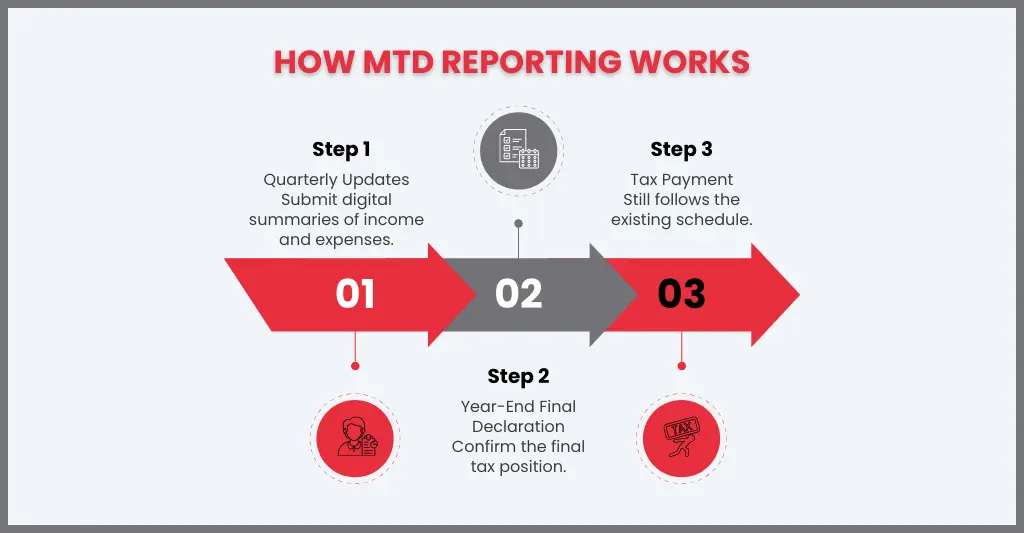
So what actually needs to be included in a quarterly update?
Four times a year, you will need to submit a digital update to HMRC summarising your income and expenses. Each submission is cumulative, meaning it reflects your year-to-date totals from 6 April rather than just the most recent three months. If you made an error in a previous quarter, you correct it in the next submission.
Here are the four quarterly deadlines that apply every tax year once you are within MTD:
| Quarter | Period Covered | Submission Deadline |
| Quarter 1 | 6 April to 5 July | 7 August |
| Quarter 2 | 6 April to 5 October | 7 November |
| Quarter 3 | 6 April to 5 January | 7 February |
| Quarter 4 | 6 April to 5 April | 7 May |
What does a quarterly update actually involve?
Less than most people expect. A quarterly update is not a mini tax return. You are not working out your tax liability or making accounting adjustments at this stage. All you are doing is telling HMRC:
- Gross Income for the Period
- Allowable Expenses
- Corrections to Earlier Figures if Something Was Entered Incorrectly
If your bookkeeping is already up to date, the submission usually only takes a few minutes.The real discipline is not in the deadline, it is in recording transactions regularly rather than leaving everything to catch up on in the final week.
Final Declaration Deadline Under MTD
The Final Declaration is submitted once per tax year, by 31 January following the end of that tax year. It is the MTD equivalent of the old Self Assessment return, and it is where the year is properly closed off.
During the Final Declaration, you will:
- Confirm Your Quarterly Figures Are Accurate
- Make Accounting Adjustments Such as Accruals or Prepayments
- Claim Personal Tax Reliefs and Allowances
- Report Any Additional Income Not Included in Quarterly Updates
- Confirm your final tax liability for the year
The date itself, 31 January, will already be familiar to most taxpayers. What changes is the quality of the data going into that submission. For many small businesses, this can actually make the year-end process simpler than the traditional once-a-year rush.
MTD Tax Payment Deadlines
This is a common question, so it’s worth being clear about it: MTD does not change when you pay your tax. The shift is entirely about reporting frequency. Your actual payment schedule stays the same.
| Payment | Deadline |
| First Payment on Account | 31 January |
| Second Payment on Account | 31 July |
| Balancing Payment | 31 January (following the end of the tax year) |
Some people read “quarterly submissions” and assume they will owe HMRC money four times a year. That is not how it works. HMRC may use your quarterly data to show you an estimated tax position within their systems, but no payment falls due at those points. Your liability is still settled through the existing payments on account system and the January balancing payment.
MTD for VAT Deadlines
MTD for VAT is a separate scheme that has been in place for several years now. If your business is VAT-registered and your taxable turnover exceeds £90,000, you should already be filing VAT returns digitally through compatible software.
There are a few important points to understand about how MTD for VAT and MTD for Income Tax relate to each other:
- They are completely separate systems. Being compliant with one does not make you compliant with the other.
- You may need to register separately for MTD for Income Tax, even if you already use accounting software for your VAT returns.
- Not being VAT-registered does not exempt you. If your gross income exceeds the relevant MTD for Income Tax threshold, the new reporting rules apply regardless of your VAT status.
Put simply, a business owner turning over £55,000 with no VAT registration still needs to comply with MTD for Income Tax from April 2026. The £90,000 VAT threshold and the MTD for Income Tax thresholds operate entirely independently of each other.
Who Needs to Follow MTD Deadlines?
MTD for Income Tax applies to unincorporated businesses that file a Self Assessment tax return. The key factor is your qualifying income, and it is important to understand exactly what that means.
What Counts as Qualifying Income?
Qualifying income is your total gross income from self-employment and property, before expenses are deducted. It is not your profit. This catches a lot of people out. If you look at your net profit figure and assume you are below the threshold, you may be looking at the wrong number entirely.
For example, someone running a small consulting business while also renting out a property would need to combine both income sources when checking whether they cross the threshold.
Here is a practical example. A consultant billing £44,000 in fees, who also receives £8,000 a year in rental income from a property, has a qualifying income of £52,000.
What Does Not Count Towards the Threshold?
Some income is excluded from the qualifying income calculation entirely:
- Wages from employment paid through PAYE
- Interest from savings accounts
- Pension income
Who Is Currently Exempt?
Not everyone falls within the scope of MTD for Income Tax. The following groups are currently exempt:
- Limited companies are not affected. MTD for corporation tax has no confirmed start date at the time of writing.
- Partnerships including general partnerships and LLPs are deferred to a later, as yet unconfirmed, phase.
- Trusts and estates are excluded from the current rollout.
- Those who are digitally excluded can apply to HMRC for an exemption if it is not reasonably practicable to use digital tools due to age, disability, location, or religious beliefs. This exemption is not automatic and requires a direct application.
What Happens If You Miss an MTD Deadline?
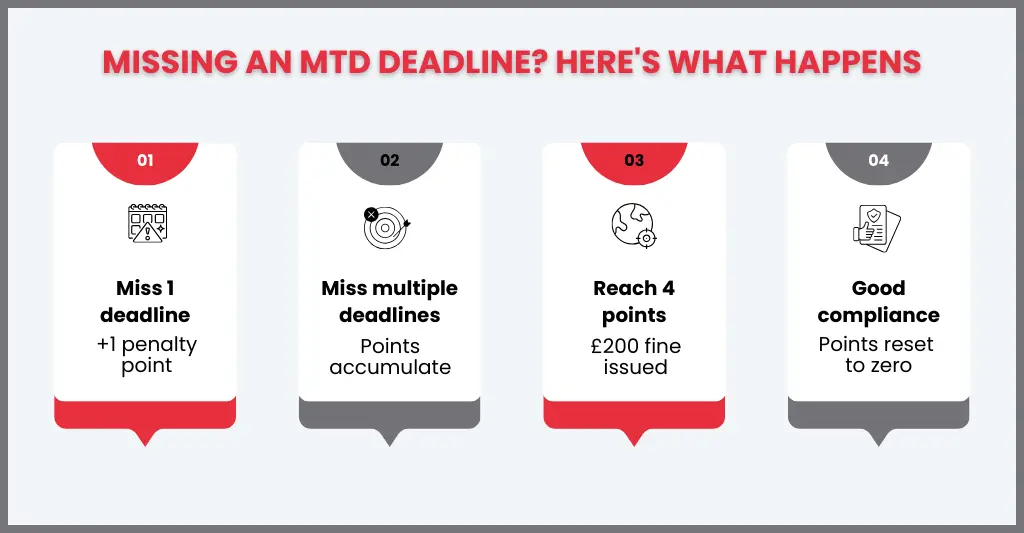
HMRC is bringing in a points-based penalty system alongside MTD. The aim is to create a system that is fairer, particularly for people who occasionally miss a deadline by mistake.
Here is how the system works:
- Miss a quarterly deadline and you receive one penalty point. There is no immediate financial fine at this stage.
- Reach four points (the threshold for quarterly reporters) and a fixed £200 fine is issued.
- Comply consistently after reaching the threshold for a set period and your points can be reset to zero.
The system is designed to target persistent non-compliance rather than catching out business owners who slip up once. If you miss a quarter because of an unexpected situation, one point is unlikely to cost you money, provided you get back on track.
That said, the points do accumulate over time. Missing deadlines across multiple tax years could result in fines and a poor compliance record. The safest approach is simply to treat each quarterly deadline as a routine task and submit it on time.
MTD Deadlines vs MTD Timeline: What Is the Difference?
These two terms sound similar, but they refer to different things.
- The MTD timeline refers to the broader rollout schedule. It covers when each phase begins, which income thresholds apply at each stage, and how the scheme is being introduced gradually from 2026 through to 2028 and beyond.
- MTD deadlines are the specific submission dates within each tax year once you are already enrolled. These are the dates covered throughout this article.
If you want to understand the full rollout picture, including how to work out your personal start date based on your income, you can check our separate MTD Timeline guide covers this in detail. This article focuses specifically on the submission calendar once you are within the system.
FAQs: Frequently Asked Questions
When is the first MTD quarterly update deadline?
If you join MTD from April 2026, your first quarterly update covers 6 April to 5 July 2026. The submission deadline is 7 August 2026.
Do I have to pay tax every quarter under MTD?
No. Quarterly updates are reporting submissions only, not payment triggers. Tax payments remain on the same schedule as before: 31 January and 31 July for payments on account, and 31 January for any balancing payment.
Can I use a spreadsheet to meet MTD deadlines?
Yes, but there is one important condition. Spreadsheets are still allowed for record keeping, but you must use bridging software to connect your spreadsheet to HMRC’s systems. You cannot submit directly from Excel or Google Sheets on their own.
What if my income drops below the threshold after I have registered?
You may still be required to continue MTD reporting until HMRC formally confirms you can stop. Do not simply cease submitting if your income falls. Speak to an accountant or contact HMRC directly to clarify your position.
Is the Final Declaration deadline the same as the old Self Assessment deadline?
The date is the same: 31 January. But the process is different. The Final Declaration is submitted through your MTD-compatible software and replaces the traditional Self Assessment return for that tax year. In your first year of MTD, you will also need to submit a standard SA return for the previous tax year alongside it.
Does MTD apply if I am not VAT-registered?
Yes. MTD for Income Tax and MTD for VAT are separate schemes with separate thresholds. If your gross income from self-employment or property exceeds the relevant MTD threshold, the new rules apply regardless of whether you have ever registered for VAT.
What software do I need?
You need HMRC-recognised software capable of submitting quarterly updates directly to HMRC. Well-known options include Xero, QuickBooks, FreeAgent, and Sage. If you prefer to keep working in spreadsheets, look for compatible bridging software that connects your existing files to HMRC. Always check HMRC’s official list of approved software on GOV.UK before making a decision.
Conclusion
MTD deadlines introduce a more frequent reporting rhythm, but for those who prepare properly, they do not have to mean more stress. Businesses that handle the transition well usually focus on three things: choosing their software early, keeping their records updated, and treating quarterly updates as a routine task.
If your qualifying income crosses the £50,000 mark for 2024/25, the April 2026 start date is approaching quickly. If your income is close to the £50,000 threshold, it’s worth reviewing your position now and making sure you have the right software in place before April 2026 arrives.
If you are unsure whether MTD applies to your situation, or if you want help getting your records and software set up correctly, speaking to an accountant sooner rather than later will save you a great deal of time and uncertainty further down the line.
At Cox Hinkins, we work with business owners at every stage of MTD preparation, from assessing whether the scheme applies to your specific circumstances through to setting up software and managing quarterly submissions on your behalf. If you have questions about your MTD obligations or would like support getting ready ahead of the April 2026 deadline, please get in touch with our team.
Disclaimer: Kindly note this blog provides general information and should not be considered financial advice. We recommend consulting a qualified financial advisor for personalised guidance. We are not responsible for any actions taken based on this content.