- What Is Making Tax Digital (MTD)?
- MTD Timeline: Key Dates (2025-2028)
- Who Does the MTD Timeline Apply To?
- Who Is Exempt From Making Tax Digital?
- Key Differences Between Self Assessment and MTD
- What Happens If You Don’t Comply With the MTD Timeline?
- MTD Timeline vs MTD for VAT – Don’t Confuse Them
- How to Prepare Before the April 2026 Start Date
- FAQs: Frequently Asked Questions
- Conclusion
MTD UK 2026: Your Start Date Checklist
When do you join MTD for Income Tax?
- £50,000+ → 6 April 2026
- £30,000+ → 6 April 2027
- £20,000+ → 6 April 2028
What changes? Quarterly digital updates replace annual Self Assessment.
Who? Self-employed + UK landlords (gross income combined). 780,000 affected starting April 2026, per HMRC, with nearly 1M more in 2027. Here’s your compliance roadmap
After years of preparing businesses for digital VAT submissions, HM Revenue & Customs is expanding Making Tax Digital (MTD) to include income tax. It means that thousands of self-employed people and landlords earning more than £50,000 will no longer file a single annual Self Assessment return. Instead, they will need to keep digital records and make quarterly updates using MTD-compatible software.
It represents a complete transformation in the way income is recorded, examined, and reported. Accountants are already experiencing pressure. Clients are confused whether they meet the requirement. Some still use spreadsheets without digital links. Others assume that quarterly reporting is optional. It isn’t.
The 2026 MTD period includes organised reporting cycles, digital record standards, and enhanced compliance demands. Missing deadlines or using incompatible software may result in penalties, extra administrative effort, and unnecessary inconvenience during busy seasons.
In this blog, we will go over the entire MTD UK 2026 timetable, explain who must comply and when, and highlight the practical steps you should take now to prepare. Understanding these crucial deadlines early on can help you keep compliant, organised, and ahead of the curve, whether you are a business owner, landlord, or accountancy firm.
What Is Making Tax Digital (MTD)?
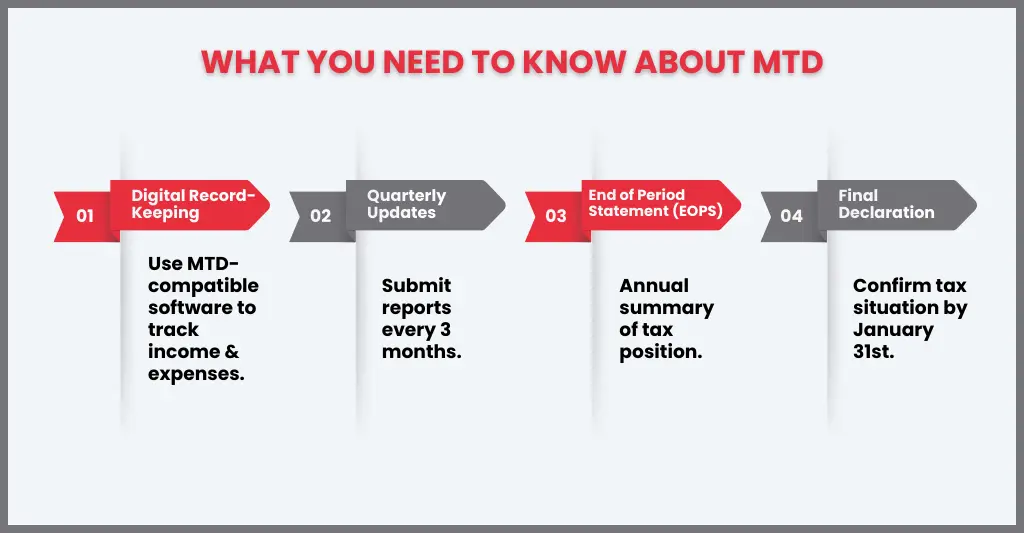
Making Tax Digital (MTD) is the UK government’s long-term project to update the tax system by requiring businesses and people to retain digital records and submit tax information using suitable software rather than manual or paper-based processes.
MTD, which was introduced by HM Revenue & Customs, was initially applicable to VAT-registered firms. However, beginning April 6, 2026, MTD will be expanded to include Income Tax for self-employed individuals and landlords earning more than £50,000. Individuals earning more than £30,000 will follow in April 2027.
Under MTD for Income Tax, affected taxpayers must:
- Maintain digital records of income and expenses
- Submit quarterly updates to HMRC
- Provide an End of Period Statement (EOPS)
- File a final declaration to confirm their tax position
This is not just a filing change, it is a structural shift in how tax reporting works.
Why Does the Timeline Matters?
The MTD timeline specifies who must comply and when. Missing the relevant start date puts you at risk of noncompliance, penalties, and last-minute system modifications during peak tax season.
For accounting practices, the timeline is even more critical. It affects:
- Client onboarding strategy
- Software migration planning
- Workflow restructuring
- Capacity during quarterly reporting cycles
For business owners and landlords, waiting until early 2026 to prepare may result in operational interruption. Software must be chosen, digital record systems tested, and processes implemented long before the deadline.
MTD Timeline: Key Dates (2025-2028)
Making Tax Digital (MTD) is being implemented in phases. Your start date is determined by the amount you earn from self-employment or property in a given tax year.
The three key start dates are:
- From 6 April 2026 – If your total income from self-employment and property in the 2024-25 tax year is over £50,000
- From 6 April 2027 – If your total income from self-employment and property in the 2025-26 tax year is over £30,000
- From 6 April 2028 – If your total income from self-employment and property in the 2026-27 tax year is over £20,000
HMRC calculates these qualifying income criteria based on your total gross income, not profit.
You do not join MTD halfway through a tax year. You join at the beginning of the following tax year after reaching the income threshold. HMRC will know when you meet the threshold based on your tax return.
Key deadlines you need to know:
MTD replaces one annual self-assessment deadline with regular reporting periods throughout the year, as well as a single year-end deadline.
When you join MTD, you must meet five deadlines per tax year:
- Four quarterly update deadlines: You must send a summary of your revenue and expenses every three months.
- One final deadline on January 31st: validate your total income for the year, make any necessary modifications, and submit your final tax return. This replaces the traditional self-assessment returns.
Quarterly update deadlines
Most people tend to follow standard tax-year quarters. If you do this, your deadlines stay the same each year and are as follows:
- 6 April to 5 July – Deadline 7 August
- 6 July to 5 October – Deadline 7 November
- 6 October to 5 January – Deadline 7 February
- 6 January to 5 April – Deadline 7 May
You must send each update within one month of the quarter’s end.
You are free to use various accounting periods if you prefer to follow your own quarterly plan, but the one-month deadline still applies.
Who Does the MTD Timeline Apply To?
The Making Tax Digital (MTD) schedule does not apply to everyone equally. Instead, HMRC has implemented it in stages based on income levels and taxpayer type.
Here’s who falls within scope:
1. Self-Employed Individuals
From 6 April 2026, self-employed individuals with qualifying income over £50,000 must comply with MTD for Income Tax.
From April 2027, the threshold reduces to over £30,000.
Qualifying income includes total gross trading income before expenses.
2. Landlords
If you earn rental income from UK property and your total combined trading and property income exceeds the threshold, you must enroll in MTD on the same phased timeframe (2026 or 2027, depending on income level). This is applicable to both single-property landlords and those with bigger portfolios.
3. Individuals with Combined Income
If you are both self-employed and a landlord, HMRC will combine your qualifying income from both sources to decide if you meet the threshold.
For example:
- £35,000 trading income + £20,000 rental income = £55,000 total → MTD applies from April 2026.
4. Those Likely to Be Included Later
Individuals earning less than £30,000 may be subject to MTD in future phases (possibly starting in 2028), subject to further confirmation.
Who Is Exempt From Making Tax Digital?
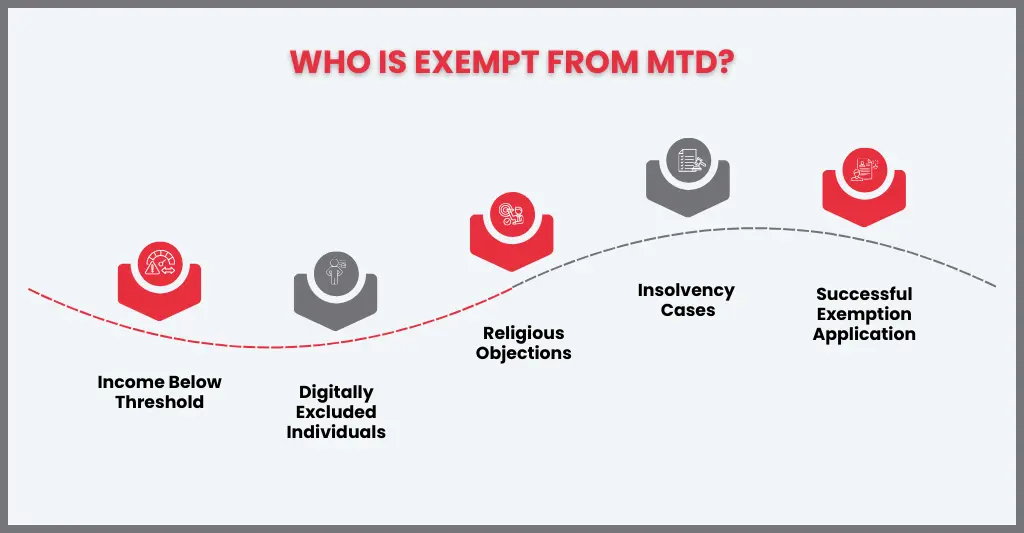
HMRC recognises the following groups as exempt from MTD:
- Income below the MTD threshold: If your total business and/or property income is less than the MTD income threshold for the applicable tax year, you are not required to join.
- Digitally excluded individuals: Taxpayers who are unable to use digital tools due to age, disability, remote location, or a lack of internet access can request for an exemption.
- Religious objections: Taxpayers who are unable to use digital tools due to age, disability, remote location, or a lack of internet access can request for an exemption.
- Specific insolvency cases: Depending on the conditions, certain taxpayers may be excluded from bankruptcy or insolvency proceedings.
- Successful exemption application: Even if you are typically in scope, you can apply to HMRC and be excluded if your case is successful.
Key Differences Between Self Assessment and MTD
Understanding a difference between Self Assessment and MTD is important, especially as the UK transitions to real-time digital reporting through HM Revenue & Customs.
Filing Frequency
Self-assessment: A single tax return submitted once a year after the tax year finishes.
MTD requires quarterly updates throughout the year, as well as a final declaration at year-end.
Record-Keeping Method
Self-assessment: Records can be kept manually or in spreadsheets.
MTD: Records must be stored digitally with MTD-compatible software.
Submission Process
Self Assessment: Figures are manually entered into HMRC’s web portal.
MTD: Data is submitted directly from accounting software using a digital link.
Visibility of Tax Position
Self-Assessment: Tax liability is determined only when the return is filed.
MTD: Offers near-real-time visibility into income and projected taxes throughout the year.
Accuracy & Error Risk
Self-assessment: Higher risk of errors owing to manual entry and last-minute filing.
MTD: MTD reduces errors with automated computations and constant reporting.
What Happens If You Don’t Comply With the MTD Timeline?
If you fail to comply with the MTD timeline, there are several consequences to keep in mind:
1. Penalty Points System
From April 2026, missing MTD deadlines will result in penalty points:
- One point for each missed deadline
- Once you accumulate 4 points, you’ll face a £200 fine.
2. Increased Risk of Fines
Consistent failure to meet deadlines could lead to:
- Financial fines after reaching the penalty threshold
- Potential interest on unpaid taxes and audit risks
3. Disruption to Your Tax Filing
- Late or missed submissions may affect your cash flow and tax filings.
- You might miss out on tax reliefs or deductions.
4. Damage to Business Reputation
- Repeated non-compliance could hurt your business reputation, especially when applying for loans or partnerships.
MTD Timeline vs MTD for VAT – Don’t Confuse Them
| Aspect | MTD for VAT | MTD for Income Tax |
| Who | VAT-registered businesses | Self-employed + landlords |
| Status | Fully live and mandatory | Phased rollout (starts 2026) |
| Type of tax | Value Added Tax (VAT) | Income tax |
| Submission | VAT Return via MTD software | Quarterly updates via software |
| Common confusion | Often mistaken as all taxes | Assumed to replace VAT MTD |
How to Prepare Before the April 2026 Start Date
With MTD for Income Tax beginning in April 2026, early planning is essential for staying compliant with HM Revenue & Customs and avoiding last-minute anxiety. Here’s how to prepare:
- Check if you’re eligible: Confirm whether your total self-employment and/or property income exceeds £50,000. If yes, you’ll have to comply with regulations by April 2026.
- Move to Digital Record-Keeping: Begin keeping digital financial records for your income and expenses. MTD will render paper records and manual techniques obsolete.
- Choose MTD-Compatible Software: Choose accounting software that enables quarterly submissions, digital linkages, and HMRC integration. Early instruction minimises the likelihood of subsequent errors.
- Review Your Current Bookkeeping Process: Assess how frequently records are updated. MTD works best when bookkeeping is done on a regular basis (monthly or weekly), rather than at year-end.
- Get Professional Support Early: Speak with an accountant to confirm software configuration, reporting structure, and compliance readiness, especially if you have several income streams.
- Set Up Internal Deadlines: Quarterly upgrades result in shorter timescales. Creating internal reminders and routines today will help to prevent missing submissions in the future.
FAQs: Frequently Asked Questions
Can I wait until April 2026 to upgrade my system?
Yes, however it is not recommended. Leaving it too late raises the likelihood of errors, missed deadlines, and penalties. Early planning makes the move go more smoothly and stress-free.
Do quarterly updates mean I have to pay taxes four times a year?
No. Quarterly submissions are strictly informational. Income tax is still paid after the tax year has ended and the final declaration has been submitted.
Can I continue to use Excel for MTD?
Spreadsheets can only be used if they are connected to MTD-compatible software via digital links. Manual copying or re-entering statistics shall be prohibited.
Do partnerships need MTD?
Yes. Each partner uses individual threshold (£50k/£30k), not business total.
Conclusion
Making Tax Digital is more than just reporting changes; it is a fundamental shift in the way income is recorded, reviewed, and reported to HMRC. MTD for Income Tax is becoming mandatory from April 2026, many taxpayers may find it unsustainable to rely on annual, last-minute Self Assessments.
Preparing ahead of time by switching to digital records, selecting the correct software, and changing your bookkeeping habits will help you avoid errors,penalties, and have a better understanding of your tax situation throughout the year. This transformation provides a chance for landlords and self-employed persons to obtain better financial control, rather than simply meeting compliance.
The earlier you plan, the easier and less stressful your transition to MTD will be. If you don’t know where to begin or want to get it right from the start, professional help of CoxHinkins team can make all the difference.
Disclaimer: Kindly note this blog provides general information and should not be considered financial advice. We recommend consulting a qualified financial advisor for personalised guidance. We are not responsible for any actions taken based on this content.