- What Is the Personal Allowance?
- Why Is My Personal Allowance Less Than £12,570?
- What Does a Reduced Personal Allowance Mean for Your Take-Home Pay?
- How to Check Why HMRC Reduced Your Personal Allowance
- What to Do If the Reduction Looks Wrong
- Frequently Asked Questions
- Still Not Sure What Triggered the Reduction?
- How We Can Help You?
You are a full-time employee. Your employer runs payroll, your tax is deducted at source, and you have never needed to think much about it. Then a letter arrives from HMRC, or you log into your Personal Tax Account, and something does not look right. Your personal allowance for the coming year is less than £12,570.
If you have been asking yourself why is my personal allowance reduced, you are not alone. It is a confusing situation, and a surprisingly common one. A reduced personal allowance does not mean you have done anything wrong. It does not mean your employer has made a mistake. It means HMRC has adjusted your tax code to collect tax on something they know about that your payroll does not automatically account for.
This guide explains the main reasons HMRC reduces the personal allowance for PAYE employees, what it means for your actual take-home pay, and what you can do about it.
What Is the Personal Allowance?
The personal allowance is the amount of income you can earn each tax year before Income Tax applies. For 2025/26, that figure is £12,570.
For PAYE employees, the allowance is not applied as a lump sum. It is built into your employee tax code. The standard code, 1257L, tells your employer’s payroll system to leave the first £12,570 of your annual income untaxed and to deduct tax only on anything above that.
A quick way to read any tax code: the number multiplied by ten gives your annual tax-free amount. A code of 1000L means £10,000 tax-free; 1100L means £11,000. When HMRC sends you a code with a lower number, your tax-free amount has been reduced. The question is why.
Why Is My Personal Allowance Less Than £12,570?
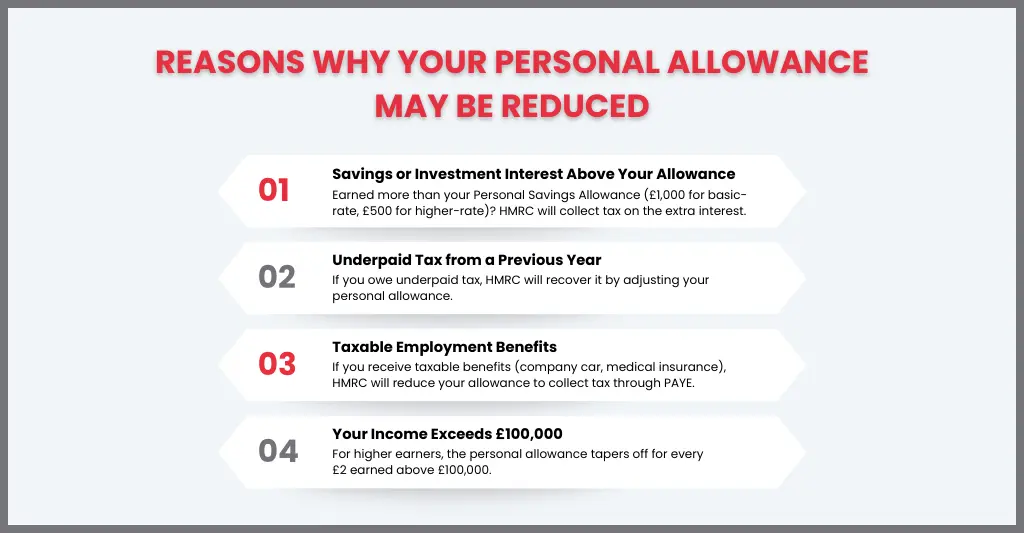
There are four main reasons HMRC adjusts the personal allowance for PAYE employees. Most people fall into the first two.
1. You Earned Savings or Investment Interest Above Your Allowance
Basic-rate taxpayers receive a Personal Savings Allowance of £1,000 per year. Higher-rate taxpayers receive £500. Any interest earned above that figure is taxable, but because banks do not deduct tax at source, HMRC collects it a different way.
Banks report your interest figures directly to HMRC each year. If HMRC can see that you earned £1,230 in savings interest and your allowance is £1,000, you owe tax on £230. Rather than issuing a separate bill, they reduce your PAYE allowance by £230 for the following year, so that the extra tax is collected gradually through your payslips.
This has become one of the most common reasons PAYE employees see a reduced personal allowance in recent years, as savings rates have risen considerably since 2022.
Fixed-Rate Savings Bonds: When Is the Interest Taxed?
A common question is whether interest is taxed when it is earned or when it is paid.
The answer is: when it becomes accessible to you. If you hold a fixed-rate bond that matures at the end of year two, all the accumulated interest, including what accrued in year one, is taxed in the year the bond matures and the funds become available. If you chose to have interest paid out annually into your current account, each year’s interest falls into the year it was paid.
2. HMRC Is Recovering Underpaid Tax from a Previous Year
This is perhaps the most unsettling one to receive. The natural reaction is: “I am employed, my tax is deducted at source. How can I have underpaid?”
The answer is that PAYE operates on estimates. Throughout the year, your employer deducts tax based on the information HMRC holds at that point. If something changes, such as new savings interest reported by your bank, a benefit value submitted by your employer, or a small piece of additional income, there can be a shortfall between what was collected and what was actually owed.
HMRC can recover underpaid tax of up to £3,000 by reducing your tax code for the following year, rather than issuing a separate demand. If you underpaid £400 in 2024/25, your personal allowance for 2025/26 might be adjusted from £12,570 to £12,170. Your payroll then collects the extra £80 in tax spread across twelve monthly payslips, roughly £6.67 per month.
The adjustment clears after that year. Your allowance returns to the standard figure once the underpayment has been recovered in full.
3. You Have Taxable Employment Benefits
If your employer provides benefits such as a company car, private medical insurance, or a company van, those have a taxable value. Your employer reports this annually to HMRC via a P11D form, and HMRC adjusts your tax code to collect the Income Tax owed on them through payroll.
As an example: if your company car has a taxable benefit value of £3,000, HMRC reduces your personal allowance by £3,000. Your code might move from 1257L to 957L. At a 20% tax rate, this collects £600 across the year, around £50 per month, without requiring any separate payment from you.
If your benefits change, for instance if you return the company car, your code should update the following year to reflect the reduced benefit value.
4. Your Income Exceeds £100,000
For higher earners, the personal allowance tapers away. For every £2 earned above £100,000, you lose £1 of your personal allowance. By £125,140, the allowance is gone entirely.
What makes this particularly significant is the effective rate on earnings in that band. You are paying 40% Income Tax on the extra income and losing the value of 20% tax relief on the allowance, producing an effective rate of 60% on earnings between £100,000 and £125,140.
Pension contributions are the most commonly used legal method to reduce Adjusted Net Income back below £100,000 and protect some or all of the allowance. The calculation depends on your specific circumstances and is worth reviewing with an accountant.
If your income is close to £100,000, the right pension contribution could restore your full personal allowance and reduce your effective tax rate significantly.
→ Speak to a Cox Hinkins accountant for a consultation specific to your situation.
What Does a Reduced Personal Allowance Mean for Your Take-Home Pay?
The impact on your pay depends on which Income Tax band you sit in. The table below uses a £230 reduction as an example, the kind of figure that commonly arises from a savings interest adjustment.
| Taxpayer Type | What Changes | Example (£230 reduction) |
| Basic-rate (under £50,270) | You pay 20% on £230 more income | Extra tax: £46/year (about £3.83/month) |
| Higher-rate (over £50,270) | Your 40% band begins £230 sooner | 40% kicks in at £50,040 instead of £50,270 |
The key point for higher-rate taxpayers is that the whole band structure shifts down. Your 40% threshold does not stay fixed while the 20% band shrinks. The point at which higher-rate tax begins moves down by exactly the same amount as your allowance reduction.
For most PAYE employees affected by savings interest adjustments, the additional tax is modest and spread quietly across monthly payslips. The more significant impact is felt by those with substantial benefit-in-kind values or those sitting in the £100,000 to £125,140 income range.
How to Check Why HMRC Reduced Your Personal Allowance
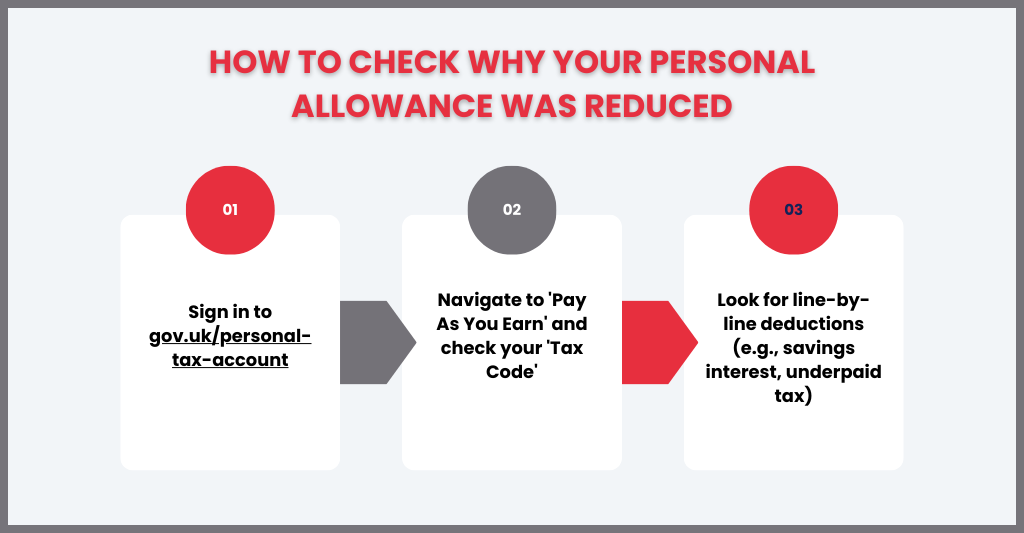
Many people log into their Personal Tax Account expecting a clear explanation and find the layout harder to follow than expected. Here is the most direct route to the information you need.
- Go to gov.uk/personal-tax-account and sign in with your Government Gateway login details.
- If you have received a P2 tax coding notice, which is a letter from HMRC. It contains the same information written in plain English. Keep it.
- Cross-check the figures where you can. For savings interest, log into your bank accounts and confirm the interest paid to you in the relevant tax year. Banks report automatically, but errors do happen. If HMRC’s figure does not match your records, that is worth querying.
- Check your current payslip. Your tax code is printed near the top. If it is lower than 1257L, the reduction is already being applied through payroll.
If the breakdown in your Personal Tax Account does not clearly explain the reduction, or if the figures do not match what you expect, do not leave it. An incorrect tax code applies across the full year. The longer it runs, the more tax you either overpay (and have to reclaim later) or underpay (and receive a bill for).
What to Do If the Reduction Looks Wrong
If you believe HMRC has used an incorrect figure, such as a savings interest estimate that is higher than what your bank actually paid or a benefit value that is out of date, you can challenge it.
The fastest route is through your Personal Tax Account, where you can provide updated figures directly. You can also call HMRC on 0300 200 3300. Before you call, have your National Insurance number, your employer’s PAYE reference (on your payslip), and any bank statements or documents that support your figures ready.
One point worth knowing: your employer cannot change your tax code. Only HMRC can instruct a code change. If you contact HR or payroll, they can confirm the code they are operating, but they have no ability to alter it. The conversation has to be with HMRC.
If the issue is savings interest and you want to prevent the same adjustment recurring next year, the simplest solution is to move savings into a cash ISA. Interest earned inside an ISA is completely free of Income Tax and is not reported to HMRC as taxable income. It will not appear in your tax code calculation.
For those with rental income being estimated by HMRC, ensuring your figures are accurate, and that all allowable expenses are claimed, can reduce the taxable profit HMRC uses in the code calculation.
Frequently Asked Questions
Why did HMRC reduce my personal allowance even though I’m a PAYE employee?
This is one of the most searched questions around this topic, and the answer surprises many people. HMRC adjusts PAYE tax codes to collect tax on income that your employer does not see, such as savings interest above your Personal Savings Allowance, untaxed rental income, or a shortfall from a previous year. It does not mean your employer has made an error. It is HMRC’s mechanism for collecting the correct amount of tax through your existing payslip, without issuing a separate bill.
Does a reduced personal allowance affect when I start paying 40% tax?
Yes, if you are already a higher-rate taxpayer. The basic-rate band is a fixed width of £37,700. If your personal allowance reduces by £230, the entire band shifts down by £230, so you begin paying 40% at £50,040 instead of £50,270. If you are a basic-rate taxpayer with income well below the higher-rate threshold, a small reduction only means you pay 20% tax on a slightly larger slice of income. The 40% rate is unaffected.
How do I find out exactly why my allowance was reduced?
Log into your HMRC Personal Tax Account at www.gov.uk/personal-tax-account. Under ‘Pay As You Earn’, select ‘Tax Code’ and look at the breakdown beneath your code. It lists each deduction by description and amount. A P2 tax coding notice, if you received one, contains the same information.
Can I get my personal allowance back to £12,570?
It depends on the cause. Savings interest: move future savings into a cash ISA to prevent the issue recurring. Underpaid tax being recovered: the reduction clears once the debt has been collected in full. Employment benefits: the allowance adjusts when the benefit ends or its value changes. High income: pension contributions can reduce your Adjusted Net Income and restore some or all of the allowance. The right approach depends on your specific circumstances.
Still Not Sure What Triggered the Reduction?
If you have been wondering why is my personal allowance reduced, the answer for most PAYE employees traces back to one of four things: savings interest above your allowance, a prior-year underpayment being recovered through the code, a taxable employment benefit, or income above £100,000. In the majority of cases, the adjustment is correct. It is simply not communicated in a way that makes it immediately clear.
That said, errors do happen. Banks occasionally submit incorrect interest figures. P11D submissions can include outdated benefit values. If something does not match your records, it is worth checking rather than assuming HMRC has it right.
And if you are in the £100,000 to £125,140 income band, the financial impact is larger than it might appear. The 60% effective rate in that range is one of the most significant and most fixable tax issues that PAYE employees at that level face.
How We Can Help You?
At Cox Hinkins, we have extensive experience in personal tax, PAYE, and tax code issues. Our team works with employed individuals and businesses to help them understand their tax position and make sure they are not paying more tax than they should.
If your personal allowance has been reduced and you are unsure why, our team can help review the situation. We offer a free, no-obligation 15-minute review where we look at your tax code, identify what may have caused the reduction, and explain the options available to you.
→ Book your tax code review at Cox Hinkins.
Disclaimer: Kindly note this blog provides general information and should not be considered financial advice. We recommend consulting a qualified financial advisor for personalised guidance. We are not responsible for any actions taken based on this content.