- What Are Service Charges?
- Why the New Rules for Service Charge Accounting Were Introduced
- What Are the New Rules for Service Charge Accounting in 2026?
- RICS Service Charge Code 2026 Updates: What Has Changed?
- Accounting and Reporting Changes: What Finance Teams Must Do Differently
- Business Impact of the New Rules for Service Charge Accounting
- When Do the New Service Charge Accounting Rules Take Effect?
- 2026 Compliance Checklist for Service Charge Accounting
- How the New Rules Affect Commercial Property Service Charges
- Conclusion
- How We Can Help
The new rules for service charge accounting are reshaping how landlords, managing agents, accountants, and leaseholders operate across the UK. Driven by the Leasehold and Freehold Reform Act 2024 (LAFRA 2024) and the updated RICS Service Charge Code 2025, these reforms mark the biggest overhaul of service charge regulation in decades. Whether you manage a block of flats or a commercial office complex, these changes directly affect how you collect, hold, report, and account for service charge funds.
This guide breaks down exactly what has changed, who it affects, when the new rules take effect, and what steps you need to take right now to stay compliant.
What Are Service Charges?
Service charges are payments that leaseholders or tenants make to cover the cost of maintaining and managing shared areas of a building. These costs typically cover building insurance, cleaning of communal areas, lift maintenance, gardening, roof repairs, and the management fees charged by the managing agent.
In residential properties, leaseholders pay service charges to their landlord or freeholder. In commercial properties, tenants pay them under the terms of their lease. The core problem driving these reforms is that for years, many leaseholders had very little visibility into how these charges were calculated, how the money was held, or how to challenge costs they believed were unfair.
Why the New Rules for Service Charge Accounting Were Introduced
The existing framework had fallen well behind the reality of modern leasehold living. Millions of flat owners in England and Wales were receiving large, unexplained bills with very little ability to question them. Managing agents could charge for work with minimal documentation, reserve funds were sometimes poorly handled, and the cost of taking a dispute to tribunal put many leaseholders off pursuing complaints that were entirely legitimate.
The government’s 2025 consultation identified four main problems the new rules aim to fix:
- A lack of standardised, readable demand formats
- Inconsistent or delayed annual accounts
- Limited access to supporting documents and invoices
- High costs when disputes reached tribunal or court
The RICS updates to its commercial service charge standards were driven by similar concerns: a need for clearer timelines, better fund management, and consistency across the sector.
What Are the New Rules for Service Charge Accounting in 2026?
The new rules span both residential and commercial property. Below we cover the most significant changes you need to understand.
Mandatory Standardised Service Charge Demands
Under LAFRA 2024, landlords must issue service charge demands in a prescribed format. This is one of the most significant service charge compliance requirements introduced by the Act.
The demand must clearly set out:
- The names and addresses of both the landlord and the leaseholder
- The total amount demanded, based on the annual service charge budget
- The period the demand covers
- Payment deadlines and consequences for non-payment
- A summary of the leaseholder’s rights
If a landlord issues a demand that does not follow the prescribed format, that demand may be unenforceable. This gives leaseholders a direct and practical tool to challenge incorrect or non-compliant billing. The budget must accompany the demand at the start of the service charge year.
Example: A managing agent sends out a service charge demand in their existing template. Under the new rules, unless that template matches the prescribed format, the leaseholder can legally withhold payment until the agent issues a compliant demand.
New Annual Reporting Requirements
One of the most impactful changes for finance teams is the new obligation to produce an annual statement of accounts. For residential buildings containing four or more dwellings, the landlord must provide a written statement of accounts within six months of the end of each service charge accounting year. This statement must include:
- An income and expenditure account
- A balance sheet
- Details of the reserve fund balance
- A summary of any major works carried out
For buildings with four or more properties, a qualified accountant must certify these accounts. This introduces formal audit requirements for service charge accounts into the residential sector in a way that was not previously standardised. The service charge reporting standards now align more closely with those already expected in the commercial sector.
The 18-Month Rule: Strict Time Limits
The 18-month rule for service charge has existed under the Landlord and Tenant Act 1985. Under the new rules, it is being tightened. Landlords cannot recover costs from leaseholders that were incurred more than 18 months before the demand is issued, unless they first serve a prescribed notice on the leaseholder within that 18-month window.
This matters because some landlords previously issued surprise bills for work carried out years earlier. Under the new rules, leaseholders receive advance warning, and landlords must follow a strict timetable. Miss the window, and you lose the right to recover that cost.
Example: A building’s roof was repaired in January 2025. The managing agent must notify leaseholders and demand payment before July 2026. If they wait until September 2026 without serving the prescribed notice, they cannot recover those costs through the service charge.
Enhanced Leaseholder Rights to Information
The new service charge transparency rules give leaseholders the right to request and receive a wide range of documents. Landlords must provide access to:
- Contracts with suppliers and contractors
- Invoices and receipts for work carried out
- Fire risk assessments
- Historic records going back up to six years
Managing agent service charge obligations now include responding to these requests promptly. Only genuinely commercially sensitive information can be withheld.
Changes to Insurance Commissions and Administration Charges
The new rules crack down on hidden income streams that have long frustrated leaseholders. Under LAFRA 2024, landlords must disclose any commission or payment they receive in connection with building insurance policies. If they fail to disclose this, they cannot recover the insurance premium through the service charge.
Administration charges, such as fees for providing information or granting consents, must also be reasonable and follow any prescribed limits set by secondary legislation.
Tribunal and Litigation Cost Reforms
One of the most controversial aspects of the old system was the ability of some landlords to pass their legal costs onto leaseholders through the service charge, even when the landlord lost a tribunal case. The new rules restrict this significantly.
Going forward, landlords cannot recover tribunal or court costs through the service charge unless a tribunal specifically orders otherwise. This lowers the risk of leaseholders facing financial punishment for exercising their legal rights, and it changes the economics of property management disputes.
How Service Charge Funds Must Be Held
The new rules introduce clearer service charge trust account rules. Service charge funds, whether held for routine costs or as a reserve fund, must sit in a designated trust account, separate from the landlord’s or managing agent’s own money.
This applies to both residential and commercial properties and strengthens the existing Section 42 trust provisions under the Landlord and Tenant Act 1985. Money in these accounts must be traceable, and interest earned must be credited back to the service charge fund.
RICS Service Charge Code 2026 Updates: What Has Changed?
For commercial property, the Royal Institution of Chartered Surveyors published the second edition of its Service Charges in Commercial Property Professional Standard in June 2025. It became effective on 31 December 2025 and is mandatory for all RICS-regulated firms managing commercial property service charges.
The headline changes include:
- A four-month deadline for accounts to be signed off after the year end. If accounts are late, the managing agent must provide a written explanation to tenants.
- Annual budgets must be issued at least one month before the start of the service charge year.
- Strict separation of service charge funds from all other money held by the agent or landlord.
- Clear rules on how landlords can forward-fund service charge costs and how deficits are treated.
ICAEW has also updated TECH 09/14, which guides accountants on how to provide assurance on commercial service charge accounts. This creates new obligations around how the certification process works and what accountants must check before signing off.
Accounting and Reporting Changes: What Finance Teams Must Do Differently
Finance teams and accountants who work with property clients need to update their workflows significantly. Here is what changes in practice:
- Produce a formal annual statement of accounts, not just a summary spreadsheet, for residential blocks of four or more dwellings.
- Accounts must be certified by a qualified accountant where required. This is not optional.
- Commercial accounts must be signed off within four months of year end. Build this deadline into your timetable now.
- Service charge money must sit in a separate, designated trust account. Review your client money policies if you are a managing agent.
- Track and disclose any insurance commissions or administration charges.
- Retain and provide access to historic records going back up to six years.
Practical tip: Check with your property management software provider whether their reporting templates meet the new prescribed formats. Many providers are updating their platforms ahead of the rollout of secondary legislation in 2026.
Business Impact of the New Rules for Service Charge Accounting
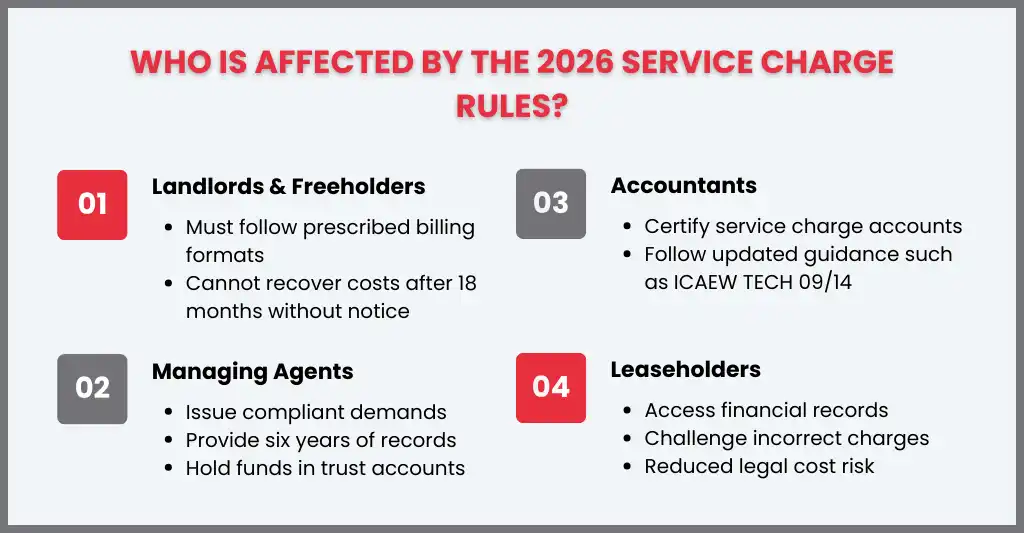
Impact on Landlords and Freeholders
Landlords face more administrative work and tighter deadlines. Non-compliance carries real financial risk: non-compliant demands can be unenforceable, costs incurred outside the 18-month window cannot be recovered, and undisclosed insurance commissions cannot be passed on. Landlords also face significant restrictions on recovering legal costs from leaseholders.
Impact on Managing Agents
Managing agents carry much of the operational burden. They must issue compliant demand formats, produce certified annual accounts, respond to information requests promptly, and hold funds in designated trust accounts. Under the new service charge transparency rules, agents who cut corners face not just regulatory risk but reputational damage as leaseholders gain the right to scrutinise records.
Impact on Accountants and Finance Teams
Accountants who certify residential service charge accounts now have defined responsibilities under the new framework. The certification requirement for buildings of four or more dwellings creates a new stream of compliance work. On the commercial side, the updated ICAEW TECH 09/14 guidance changes what accountant certification of service charge accounts involves, adding scrutiny to the assurance process.
Impact on Leaseholders and Tenants
Leaseholders gain real, enforceable rights for the first time. They can request years of documents, challenge demands that do not follow the correct format, and dispute charges without fearing a huge legal bill from the other side if the case fails. For millions of flat owners across England and Wales, this is a genuine and meaningful shift in power.
When Do the New Service Charge Accounting Rules Take Effect?
The timeline varies depending on the type of property and the specific rule:
- 31 December 2025: RICS second edition takes effect for commercial property managed by RICS-regulated firms.
- 2026 (phased): LAFRA 2024 residential rules come into force via secondary legislation. Simpler changes such as new demand formats and annual reporting obligations are expected first.
- Most core residential provisions are expected to be active during 2026, but some remain subject to further secondary legislation.
Penalties for Non-Compliance
The consequences of failing to comply with the new rules are more serious than before:
- Non-compliant service charge demands can be ruled unenforceable. Leaseholders do not have to pay until a compliant demand is issued.
- Costs incurred outside the 18-month window cannot be recovered if the prescribed notice was not served in time.
- Undisclosed insurance commissions cannot be recovered through the service charge.
- Legal and tribunal costs can no longer be routinely passed to leaseholders.
- RICS members face disciplinary action for breaching the mandatory commercial standards.
2026 Compliance Checklist for Service Charge Accounting
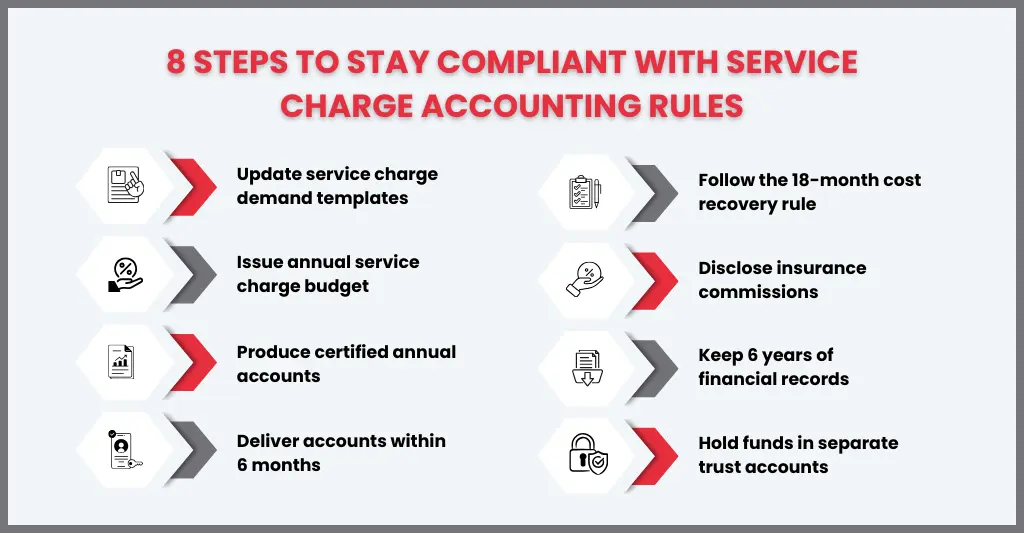
Use this checklist to audit your current processes against the new requirements.
- Review all service charge demand templates and update them to match the prescribed format once secondary legislation is published.
- Confirm that service charge funds are held in a designated, separate trust account.
- Set up a formal annual accounts process and engage a qualified accountant for buildings with four or more dwellings.
- Build the 18-month rule into your cost recovery workflow. Create alerts for costs nearing the 18-month limit.
- Audit all insurance commission and administration charge income to ensure full disclosure.
- Put in place a document retention and access system that covers six years of records.
- If you are RICS-regulated, ensure commercial accounts are signed off within four months of year end.
- Review your property management software to confirm it can produce compliant reports and demand formats.
How the New Rules Affect Commercial Property Service Charges
Commercial property operates on a different legal track to residential leasehold, but the pressure for greater transparency and consistency has driven significant change here too. The RICS Service Charge Code 2025 is mandatory from 31 December 2025 for RICS members.
Key differences in the commercial context:
- Tenants in commercial leases do not benefit from LAFRA 2024 directly, but they do benefit from the RICS code and can enforce compliance through lease terms and regulatory complaints.
- The four-month sign-off rule creates real operational pressure for managing agents who run many commercial buildings with different year-end dates.
- Sustainability costs, including energy efficiency improvements and EV charging infrastructure, must now be accounted for in a transparent and consistent way.
- Forward-funding rules clarify when landlords can advance money into the service charge account and how this must appear in the accounts.
Frequently Asked Questions
What is the new service charge law in 2026?
It’s the Leasehold and Freehold Reform Act 2024 – LAFRA for short. The UK government is bringing it in bit by bit through secondary legislation all through 2026. You’ll see standardised demand formats, mandatory annual accounts, much better access for leaseholders to information, stricter rules around insurance commissions, and limits on landlords passing legal costs onto leaseholders.
What are the changes in the RICS Service Charge Code 2025?
The second edition kicked in on 31 December 2025 and it’s mandatory for RICS-regulated firms handling commercial properties. The big shifts? Accounts need signing off within four months of year-end, budgets must go out at least a month before the service charge year starts, complete separation of service charge funds, plus fresh guidance on handling sustainability costs and how landlords can forward-fund expenses.
What is the 18-month rule for service charge accounts?
Basically, landlords can’t chase leaseholders for costs incurred over 18 months before they issue the demand – unless they served the right notice within that 18-month window. The new rules make this much stricter, closing the door on those surprise bills from years ago that used to catch people out.
What is the 6-month rule for service charge accounts?
LAFRA 2024 says landlords have to hand over annual service charge accounts to leaseholders within six months of the accounting year ending. This only applies to residential buildings with four or more flats – smaller setups might dodge this one.
Do service charge accounts need to be audited?
For residential blocks with four or more dwellings, yes – a qualified accountant needs to certify the accounts. What level of assurance that involves will be spelled out in upcoming secondary legislation. Commercial side follows ICAEW’s TECH 09/14 guidance on what certification looks like.
How must service charge money be held?
In a dedicated trust account, completely ring-fenced from the landlord’s or agent’s own money. This covers both day-to-day spending pots and longer-term reserve funds. Any interest earned goes straight back into the service charge pot, not the agent’s pocket.
Can landlords recover legal costs through service charges?
Not easily anymore. The new rules clamp down hard – landlords generally can’t pass tribunal or court costs onto leaseholders unless a tribunal specifically rules otherwise. It’s one of the biggest wins for leaseholders in the whole package.
When do the new service charge accounting rules come into force?
RICS commercial standards went live 31 December 2025. LAFRA residential changes roll out through 2026 as secondary legislation drops – keep watching gov.uk announcements for the exact dates on each bit, as they’re coming in phases.
What happens if service charge accounts are late?
Residential landlords risk leaseholders challenging the whole service charge at tribunal if accounts don’t land within six months. For commercial properties, RICS firms missing the four-month sign-off have to explain themselves to tenants in writing. Keep missing deadlines and RICS can take disciplinary action.
Are commercial properties affected by the new rules?
Absolutely – if managed by RICS-regulated firms, they’re under the updated RICS Service Charge Code (mandatory since 31 Dec 2025). LAFRA 2024 focuses on residential leaseholds, but the RICS code covers commercial comprehensively.
Conclusion
The new rules for service charge accounting mark a real shift in how property costs are managed, reported, and challenged in the UK. Whether you are a landlord issuing demands, a managing agent running a block, an accountant certifying accounts, or a leaseholder reviewing your bills, the 2026 reforms change your rights and responsibilities in concrete ways.
The most important steps right now are to review your demand formats, confirm your funds are held correctly, set up proper annual reporting processes, and build the 18-month rule into your recovery workflows. For commercial property professionals, the RICS changes are already live and in force.
Service charge accounting compliance is no longer a box-ticking exercise. It carries real legal and financial consequences for getting it wrong, and real protections for those who do it right.
How We Can Help
At Cox Hinkins, we specialise in service charge accounting for residential and commercial properties across the UK. Our team works closely with landlords, freeholders, and managing agents to prepare accurate annual service charge accounts, meet the new certified reporting requirements, and make sure funds are held and reported in line with current regulations.
Whether you need support getting your accounts ready for the LAFRA 2024 residential rollout, want a review of how your service charge funds are currently held, or need a qualified accountant to certify your statements, we can help. We take a practical, straightforward approach and work to deadlines that fit your property portfolio, not just ours.
If you are unsure where your current processes stand against the new rules, getting an early review in place is the most effective step you can take right now. We are happy to talk through your situation and point you in the right direction, with no obligation.
Disclaimer: Kindly note this blog provides general information and should not be considered financial advice. We recommend consulting a qualified financial advisor for personalised guidance. We are not responsible for any actions taken based on this content.