- Can You Extend a UK Filing Deadline?
- Key UK Filing Deadlines for 2026/27
- Valid and Invalid Reasons for an Extension or Appeal
- Self Assessment: Is There an Extension?
- What Happens If You Miss the Deadline?
- How to Extend Filing Deadline for Company Accounts with Companies House
- Companies House Late Filing Penalties
- Can You Extend the Corporation Tax Return (CT600) Deadline?
- What If You’ve Already Missed the Deadline?
- 2026 Changes That Affect Your Filing
- How to Avoid Needing an Extension
- FAQs: Frequently Asked Questions
- Conclusion
Can you extend filing deadline dates in the UK? Not for Self Assessment or Corporation Tax returns, where you can only appeal a penalty if you had a reasonable excuse. Limited companies can apply to Companies House for more time to file their accounts, but only before the deadline passes and only for events outside their control, such as serious illness or a fire.
That difference matters, because many people only find out how the rules work after a penalty notice arrives. This guide explains which UK filing deadlines can be extended, how to apply, what counts as a valid reason, what happens if you miss a date, and how to appeal. It is written for sole traders, landlords, limited company directors and the accountants who support them.
Can You Extend a UK Filing Deadline?
| Filing | Extension? | What to do |
|---|---|---|
| Self Assessment (SA100) | No | File ASAP, then appeal any penalty (reasonable excuse) |
| Company accounts (Companies House) | Yes, limited cases | Apply before the deadline, online or by post, with evidence |
| Company Tax Return (CT600) | No | File ASAP, then appeal any penalty |
Key UK Filing Deadlines for 2026/27
Start by confirming your standard deadline. Many people looking for an extension have simply lost track of the original due date.
Self Assessment Tax Returns (2025/26 tax year)
HMRC collects income tax from people who do not have it automatically taken from their salaries or pensions via the Self Assessment system. Self-employed people, landlords, directors of businesses, and people with other sources of income are usually included in this.
Note: Don’t miss out on important deadlines—find out how to register for Self Assessment and file your tax return on time.
Key Deadlines
- Paper tax return: 31 October 2026
- Online tax return: 31 2027
- Payment deadlines:
- 31 January 2027 – any tax owed for the previous year, plus the first “payment on account” for the current tax year (if applicable).
- 31 July 2027 – second “payment on account” deadline.
Example
For the 2025/26 tax year (covering income from 6 April 2025 to 5 April 2026):
- Paper return deadline: 31 October 2026
- Online return deadline: 31 January 2027
- Balancing payment and first payment on account: 31 January 2027
- Second payment on account: 31 July 2027
Company Accounts (Limited Companies)
In the UK, limited companies have two primary filing obligations: filing a Company Tax Return with HMRC and submitting yearly accounts to Companies House. Both have tight due dates, and failing to meet them may result in penalties for the company and possible problems with directors’ compliance.
Key Deadlines
- Annual accounts (Companies House): Must be filed 9 months after the company’s financial year end. First accounts: 21 months after incorporation.
- Corporation Tax return (HMRC): Must be filed 12 months after the end of the company’s accounting period.
- Corporation Tax payment: Due 9 months and 1 day after the end of the accounting period.
Example
If a company’s year-end is 31 March 2026:
- Accounts must be filed at Companies House by 31 December 2026.
- Corporation Tax payment is due by 1 January 2027.
Corporation Tax return must be filed by 31 March 2027.
Valid and Invalid Reasons for an Extension or Appeal
Businesses and individuals occasionally find it difficult to meet filing deadlines, even with the best preparation. The same test applies whether you ask for more time or appeal a penalty afterwards: was something genuinely outside your control?
Common Reasons That Can be Accepted for Extension
- Serious illness or bereavement: When a family member’s death, illness, or hospitalisation keeps them from filing on time.
- Unexpected technical issues: For instance, issues with Companies House filing systems or a failure of HMRC’s online services around the deadline.
- Delays outside your control: Documented postal delays, or evidenced delays such as an auditor being unable to complete work.
- Exceptional events: For example, fires, natural calamities, or cyberattacks that prevent access to company communications.
Reasons That Are Usually Rejected
- Poor time management – leaving everything until the last minute.
- Being too busy with work or holidays – day-to-day commitments are not considered exceptional.
- Relying solely on your accountant – HMRC and Companies House view filing as ultimately the responsibility of the taxpayer or director.
- Forgetting login details or passwords – these are preventable issues.
- Deliberate delay to manage cash flow – withholding a return or accounts because you cannot yet pay the tax due is not acceptable.
Whatever your reason, keep dates, correspondence, medical letters and screenshots of error messages. Evidence separates an accepted case from a refused one.
Self Assessment: Is There an Extension?
HMRC doesn’t grant extensions to the Self Assessment deadline. If you miss it, a penalty is charged automatically, even if you owe no tax. You can then appeal that penalty if you had a reasonable excuse.
Identify if You Have a Valid Reason
If any of the following stopped you from submitting, HMRC may accept your reasonable excuse:
- Bereavement, hospitalisation, or serious sickness.
- System malfunctions (outage of HMRC’s online service).
- Things that are out of your control, such as mail delays, floods, or fires.
File as Soon as Possible
As soon as you can, file your return, even if you miss the official deadline. The longer the delay, the more difficult it is to make your point.
Appeal the Penalty
If you’ve already missed the deadline and received a penalty, you can appeal it. You normally have 30 days from the date of the penalty notice. If you’re later than that, you can still appeal, but you’ll need to explain the delay. To appeal:
- Log in to your HMRC online account.
- Select ‘Self Assessment’ → ‘Appeal a Penalty’.
Explain your reasonable excuse and provide supporting evidence (e.g., hospital records, proof of system outages).
Alternatively, you can appeal by post using form SA370.
Provide Evidence
Your case will be stronger the more specific you are. HMRC typically requests:
- dates of incidents or illnesses.
- copies of official announcements, medical certifications, or other records.
- screenshots of HMRC error messages as proof that attempts were made to file on time.
Wait for HMRC’s Decision
Once HMRC has reviewed your appeal, they will decide:
- If your excuse is approved, the penalty is cancelled or reduced
- If they don’t think your justification is good, the penalty stands. You can then ask for an independent review or take the case to the tax tribunal.
What Happens If You Miss the Deadline?
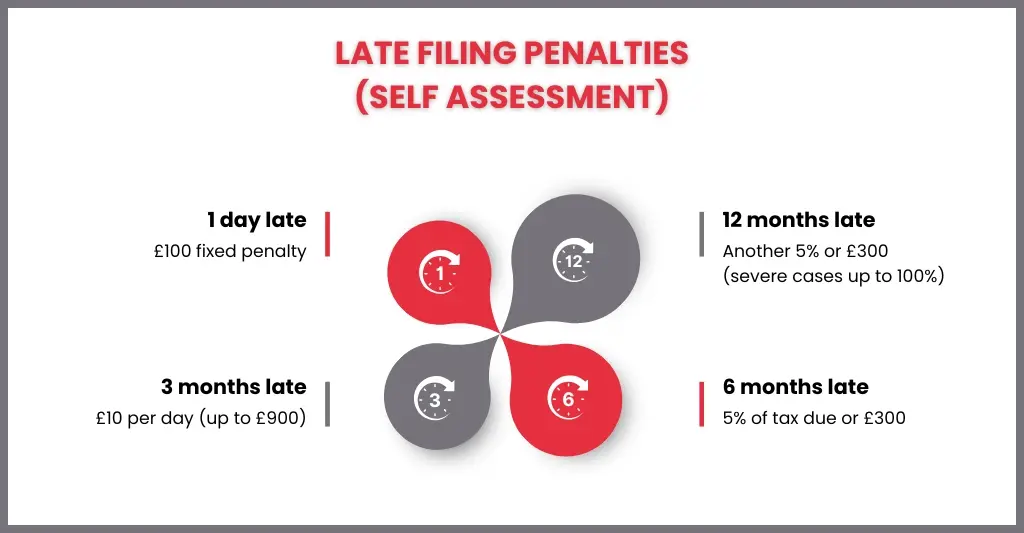
Even if you have no outstanding taxes, you will still be subject to automatic penalties if you miss the Self Assessment tax return deadline. The penalties increase with the length of the wait.
Penalties Timeline:
| How late | Penalty |
|---|---|
| 1 day | £100 fixed penalty (applies even if no tax is due) |
| 3 months | £10 per day (up to 90 days = £900) |
| 6 months | Further 5% of tax due or £300 (whichever is greater) |
| 12 months | Another 5% or £300; deliberate withholding can reach 100% of the tax owed |
Note: It’s always best to check the official HMRC website for the latest updates or changes to payment deadlines.
How to Extend Filing Deadline for Company Accounts with Companies House
If you’re having trouble meeting the deadline for filing your company’s accounts, you might be eligible to ask for an extension. But since extensions are only given in certain situations, it’s critical to follow the right procedure.
Check if you’re eligible
You can apply if an event outside your control stops you filing, for example a fire destroying your records, serious illness or an auditor problem. Workload or general delays don’t qualify. You may not be eligible if you’ve already extended the deadline or shortened your accounting period.
Apply before the deadline
You have to apply for an extension before the filing deadline expires. Applications made afterwards can’t avoid the penalty.
Gather the required information
- When submitting an application, you must provide:
- Your Company Number.
- The cause of your inability to file on time
- supporting documentation (such as an auditor’s letter or a doctor’s note)
Submit your application
You can submit your request by post or online. Applications submitted online are processed more quickly and are confirmed right away.
Await confirmation
- After reviewing your application, Companies House will confirm the outcome.
- If accepted, extensions are commonly granted for up to three months, but Companies House decides each case.
- If refused, you must still file by the original deadline to avoid a penalty.
File as soon as possible
Even if you have been given an extension, it is advisable to finish and submit your accounts well in advance of the revised due date in order to minimize the possibility of additional delays.
Note: If you’re running a limited company, you may want to learn how to register for Corporation Tax to meet your business tax obligations. Read our full step-by-step guide here.
Companies House Late Filing Penalties
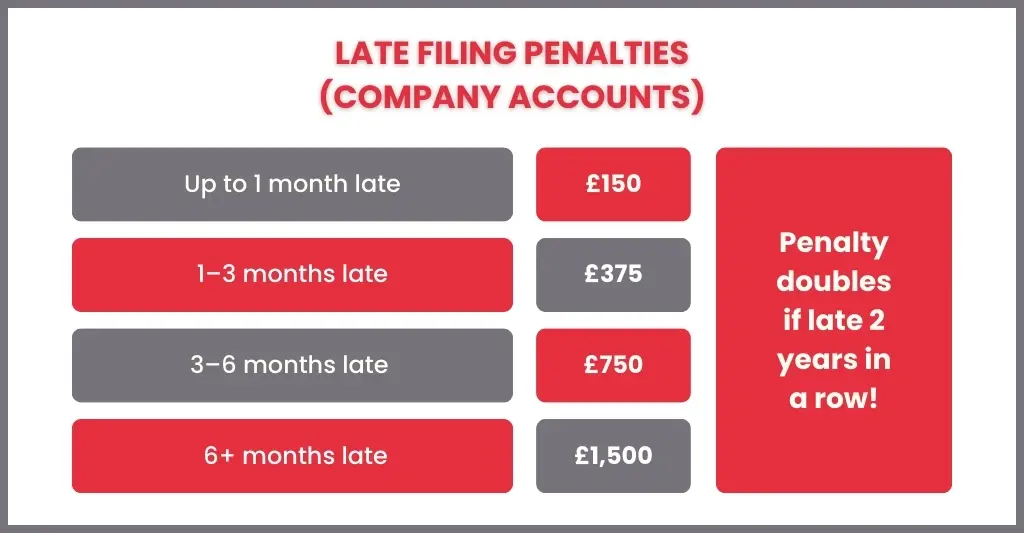
An extension can’t be requested once the deadline has passed. Penalties are automatic:
| How late | Private company |
|---|---|
| Up to 1 month | £150 |
| 1 to 3 months | £375 |
| 3 to 6 months | £750 |
| More than 6 months | £1,500 |
Penalties double if accounts are late two years in a row. Directors may face prosecution or disqualification if they continue to fail to file, or your company may be struck off the register. It might also damage your company’s reputation because late filings are made public. Filing your accounts as soon as possible may help you avoid penalties and other hazards.
Can You Extend the Corporation Tax Return (CT600) Deadline?
No. HMRC doesn’t grant extensions to the Company Tax Return deadline. If you file late, you can appeal the penalty if you had a reasonable excuse. The late filing penalty is £100 if up to three months late and £200 after that, with additional tax-based penalties at six and twelve months. Our Corporation Tax services team can file your return before the deadline.
What If You’ve Already Missed the Deadline?
- File as soon as you can. Penalties grow with time.
- Check the amount against the tables above.
- Appeal quickly with evidence, within the time limit.
- If you can’t pay, contact HMRC early about a payment plan.
- Get help. An accountant can file and draft your appeal.
2026 Changes That Affect Your Filing
- Making Tax Digital for Income Tax applies from April 2026 to sole traders and landlords above the income threshold. See our MTD service.
- Companies House identity verification is being rolled out for directors and people with significant control.
- Further Companies House filing changes are due from 2027. Check GOV.UK for dates.
How to Avoid Needing an Extension
- Put important dates on your calendar: Add reminders at least 30 days ahead.
- Keep records up to date throughout the year.
- File early: submission before the deadline allows you to correct any mistakes.
- Use accounting software to cut down on errors and automate calculations.
- Consult an accountant: send them your records at least eight weeks before the deadline.
- Plan for delays from directors, auditors, or paperwork.
FAQs: Frequently Asked Questions
Can I get an extension for my Self Assessment return?
No. File as soon as you can and appeal any penalty if you had a reasonable excuse.
Can I extend my Companies House accounts deadline?
Yes, if an event outside your control stops you filing, and only if you apply before the deadline.
Can I appeal against a late filing penalty?
Yes, you need to support your claim with evidence of a reasonable excuse. Common problems like being overly busy or forgetting the deadline are not acceptable.
Does HMRC give extensions for Corporation Tax returns?
No. File late and appeal the penalty if you have a reasonable excuse.
How can I avoid penalties in the future?
Use reminders, file early, keep records up to date, and consider hiring an accountant or using accounting software.
How long can the extension be?
If granted, Companies House commonly extends the period by up to three months.
Conclusion
Filing your company accounts and tax returns on time is essential to avoid costly penalties, safeguard your business’s reputation, and maintain compliance with UK law. Only Companies House accounts deadlines can be extended, and only if you apply before they pass. For Self Assessment and Corporation Tax returns there is no extension, so file early and appeal any penalty with strong evidence.
If you’re unsure about your filing deadlines or need assistance with appeals, don’t hesitate to seek professional advice.
Disclaimer: Kindly note this blog provides general information and should not be considered financial advice. We recommend consulting a qualified financial advisor for personalised guidance. We are not responsible for any actions taken based on this content.