- What is Bookkeeping for Self-Employed?
- The Benefits of Bookkeeping for Self-Employed
- How to Do Bookkeeping for Self-Employed: A Step-by-Step Guide
- Bookkeeping Methods: Single vs. Double-Entry for the Self-Employed
- Best Bookkeeping Software for Self-Employed
- Setting Up Your Bookkeeping System: Manual vs. Digital
- Managing Cash Flow as a Self-Employed Business Owner
- How Bookkeeping Helps with Tax Deductions and Filing?
- Common Bookkeeping Mistakes to Avoid
- Should You Hire a Professional for Bookkeeping?
- FAQs: Frequently Asked Questions
- Conclusion
A UK freelancer opened her laptop one morning, ready to dive into her project, but instead got sidetracked sorting tax reminders, receipts, and payment emails. She quickly realised that while bookkeeping for self-employed individuals offers independence, handling finances can turn chaotic without organisation.
Bookkeeping can help with that. Self-employed people who keep accurate books are better able to monitor their earnings, control their spending, and be ready for tax season. In this guide, you will learn simple bookkeeping tips to keep your finances organised and your business running smoothly.
What is Bookkeeping for Self-Employed?
For self-employed people, bookkeeping is the process of keeping track of and arranging all business-related finances. This includes keeping track of your income, expenditures, invoices, receipts, and other financial transactions.
Bookkeeping helps small business owners, consultants, and self-employed individuals maintain an accurate record of the money coming in and going out of their enterprises. It guarantees that you understand your true profit, control your cash flow, and remain ready to file taxes.
Monitoring business performance, avoiding financial errors, and making wiser financial decisions as your company expands are all made easier with proper bookkeeping.
The Benefits of Bookkeeping for Self-Employed
Self-employed people and small business owners can benefit greatly from proper bookkeeping. It keeps you organised and provides you with a clear financial picture of your company.
Better Financial Organisation: Bookkeeping makes managing your company’s finances easier by keeping all of your income, expenses, invoices, and receipts in a single place.
Easier Tax Preparation: Organising your financial records makes filing taxes much easier. You can minimise worry at the last minute by rapidly calculating your income and claiming deductions.
Clear Understanding of Profit and Loss: Keeping accurate records of your company’s earnings and expenses is made possible by bookkeeping. This makes it possible for you to comprehend your true profits.
Improved Financial Decisions: You can make better choices regarding pricing, budgeting, and business expansion if you have precise financial records.
Reduced Financial Errors: Regular bookkeeping helps you catch mistakes early and keeps your financial records accurate and reliable.
How to Do Bookkeeping for Self-Employed: A Step-by-Step Guide
It doesn’t have to be difficult for self-employed people to handle bookkeeping. You may maintain accurate and well-organised business finances by taking a few easy measures.
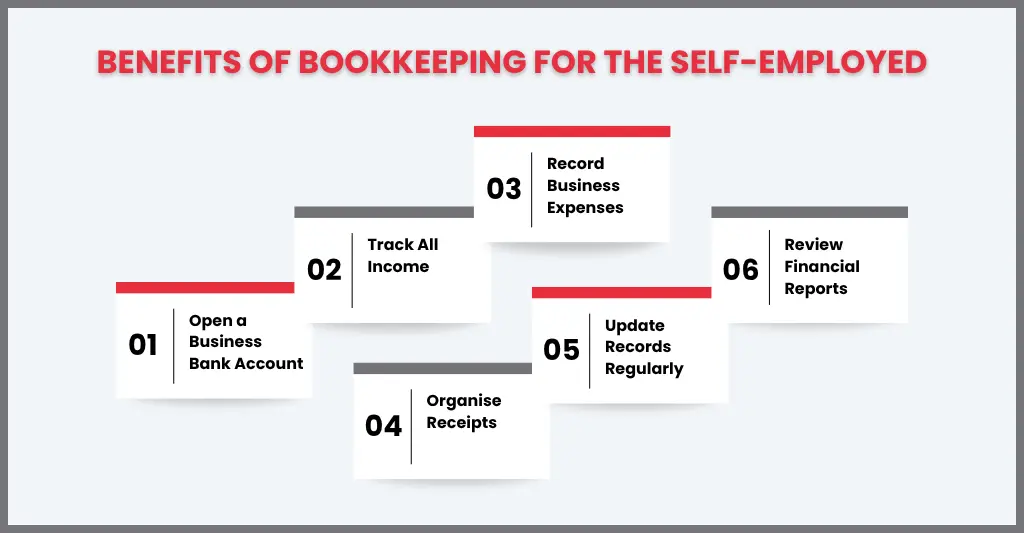
Open a Separate Business Bank Account: Keep your business and personal finances apart. This facilitates keeping accurate financial records and tracking corporate transactions.
Track All Income: Keep track of each payment you get from clients or customers. This guarantees proper financial reporting and aids in tracking your earnings.
Record Business Expenses: Keep track of all the costs associated with your business, including office supplies, travel, software, and tools. You can make tax deductions if you save your receipts.
Organise Receipts: Maintaining every receipt and invoices is most important. It will be useful at the time of tax filing or any audit verification process.
Update Your Records Regularly: To maintain your financial records correct and up to date, develop the practice of updating your bookkeeping on a weekly or monthly basis.
Review Your Financial Reports: To understand your profit, manage your expenditure, and make plans for future expansion, analyse your income and expense reports on a regular basis.
Bookkeeping Methods: Single vs. Double-Entry for the Self-Employed
There are two primary bookkeeping techniques available to independent contractors. The main differences between single-entry and double-entry bookkeeping are shown in the table below.
| Feature | Single-Entry Bookkeeping | Double-Entry Bookkeeping |
| Definition | Each transaction is recorded once as income or expense. | Each transaction is recorded twice as a debit and a credit. |
| Complexity | Simple and easy to maintain. | More detailed and complex. |
| Best For | Freelancers and small businesses with simple finances. | Growing businesses with more transactions. |
| Financial Tracking | Tracks basic cash flow (money in and out). | Tracks assets, liabilities, income, and expenses. |
| Accuracy | Less detailed and may miss errors. | More accurate because every transaction is balanced. |
Best Bookkeeping Software for Self-Employed
Managing your accounts can be greatly simplified by using bookkeeping software. These tools facilitate the creation of invoices, the tracking of income, the recording of expenses, and the automatic generation of financial reports. These are some of the top bookkeeping software choices for independent contractors.
- QuickBooks Self-Employed: This program was created especially for independent contractors and small business owners. It records receipts, keeps track of earnings and outlays, and even calculates quarterly taxes. Additionally, it makes it easier to prepare taxes by generating profit and loss reports.
- FreshBooks: FreshBooks is well-known for its time-tracking and simple invoicing capabilities. Freelancers and service-based workers that handle several projects or bill clients by the hour may find it particularly helpful.
- Wave Accounting: Wave provides free accounting tools, making it an excellent choice for new users. Without a monthly subscription, it enables users to make financial reports, track costs, and create invoices.
- Xero: Another effective software you can rely on is Xero, which is renowned for its straightforward user interface and robust business app integrations. It supports financial reporting, invoicing, and bank reconciliation.
- Zoho Books: Expense tracking, invoicing, automation, and tax computations are all supported by the feature-rich accounting software Zoho Books. For companies with lower yearly income, it also provides a free plan.
Setting Up Your Bookkeeping System: Manual vs. Digital
As a self-employed person, you have two options for beginning bookkeeping: digital bookkeeping or manual bookkeeping. The benefits of each approach vary based on your company’s requirements.
| Feature | Manual Bookkeeping | Digital Bookkeeping |
| Method | Records are kept using notebooks, spreadsheets, or paper files. | Uses accounting or bookkeeping software to track finances. |
| Ease of Use | Simple for very small businesses with few transactions. | Easier to manage as transactions increase. |
| Automation | Recorded manually, not automated. | Automates tasks like expense tracking, invoicing, and reports. |
| Accuracy | Higher chance of human errors. | More accurate due to automatic calculations. |
| Accessibility | Records are stored physically and may be harder to access. | Data can be accessed anytime from a computer or mobile device. |
Managing Cash Flow as a Self-Employed Business Owner
Managing cash flow is one of the most difficult tasks for self-employed individuals. Because your earnings can change every month so tracking actual income is difficult.
Begin by segregating your business and personal funds so that you can easily track your revenue and expenses. Keep a tight check on incoming payments, follow up on late invoices, and set aside funds for slow periods or unforeseen expenses. Regularly setting aside money for tax liabilities might also help to avoid financial hardship at the last minute.
With the correct procedures in place, you obtain a greater understanding of your financial position, allowing you to make confident decisions, manage spending effectively, and keep your business running efficiently.
How Bookkeeping Helps with Tax Deductions and Filing?
- Keeps all revenue and expenses tracked and organised.
- Identifies all eligible tax deductions (travel, software, office expenses, etc.).
- Reduces the possibility of missing claims, which could save you money.
- Makes tax filing faster because all data is easily available.
- Reduces errors and decreases the risk of HMRC penalties
- Ensures that you accomplish deadlines without last-minute stress
- Ensures clear visibility of your tax position throughout the year.
- Helps your accountant complete accurate and compliant returns.
Common Bookkeeping Mistakes to Avoid
- Mixing personal and business finances
- Not recording transactions regularly
- Unorganised receipts and invoices
- Misclassifying expenses and income
- Ignoring bank reconciliations
- Falling behind on bookkeeping updates
- Not keeping money aside for taxes
- Relying only on spreadsheets without proper systems
- Missing deadlines for tax filings and submissions
- Not reviewing financial reports regularly
Should You Hire a Professional for Bookkeeping?
Routine bookkeeping using the services of a professional bookkeeper is something that can make all the difference in the world when your business is expanding. Unfortunately, many owners attempt to manage their own books because they feel it is more economical. This decision usually backfires, because you have no expertise, and the activity takes much longer to complete than you would like.
Instead of making mistakes and regretting it later, hiring a professional bookkeeper at the appropriate point in time will save you money and ensure accurate, complete, and current financial records for your company.
Not only does an experienced bookkeeper provide your company with accurate reporting for HMRC, but they also make tax preparation much simpler and less stressful for you. A qualified bookkeeper will identify all permissible expenses and will assist you in identifying tax savings opportunities you might have otherwise missed, often saving you a significant amount of money in taxes.
FAQs: Frequently Asked Questions
Can I do my own bookkeeping rather than hire a professional?
Yes, there is no harm in managing your own bookkeeping task. But as your company grows it becomes difficult to manage a large volume of transactions.
What happens if my bookkeeping is not accurate?
Inaccurate bookkeeping can result in improper tax filings, lost deductions, and significant HMRC fines. It can also give you an inaccurate picture of your company’s finances.
What is the difference between bookkeeping and accounting?
Bookkeeping records daily financial transactions, whereas accounting analyse reports, and interprets financial data for decision-making.
Conclusion
The foundation of any solid self-employed business is a robust bookkeeping system. It captures every transaction, giving you a clear reference to manage income, expenses, and overall finances.
Mastering bookkeeping for self-employed UK pros keeps you organised, handles HMRC tax obligations like Self Assessment, and reveals exactly where your money goes. Ultimately, it goes beyond compliance, empowering control, confidence, and clarity in your financial journey.
Ready to get started? Implement these tips today for smoother business growth.
Disclaimer: Kindly note this blog provides general information and should not be considered financial advice. We recommend consulting a qualified financial advisor for personalised guidance. We are not responsible for any actions taken based on this content.