- What Is an HMRC Time to Pay Arrangement?
- Which Tax Debts Are Covered Under a Time to Pay Arrangement?
- Does Your Business Qualify? HMRC’s Eligibility Criteria
- How to Apply for an HMRC Time to Pay Arrangement: Step by Step
- Interest, Penalties and Your Obligations During the Arrangement
- What Happens If HMRC Rejects Your Time to Pay Application?
- HMRC Time to Pay vs Other Business Debt Solutions
- FAQs: Frequently Asked Questions
- Conclusion
If your company were unable to pay its tax bill tomorrow, what would happen?
The majority of business owners believe they have no choice but to arrange the money fast or risk fines. In reality, HMRC is aware that short-term cash flow issues can arise in even financially sound businesses. Because of this, HMRC Time to Pay Arrangements are available, which let qualified companies pay their taxes as time passes rather than all at once.
Understanding how Time to Pay Arrangements operates can help your business avoid needless stress and financial strain, whether you’re having trouble paying VAT, PAYE, Corporation Tax, or another tax obligation. Everything you need to know will be covered in this blog, from eligibility and application criteria to the benefits and what are the steps you need to take for TTP arrangements.
What Is an HMRC Time to Pay Arrangement?
HM Revenue & Customs (HMRC) offers a flexible arrangement called the Time to Pay (TTP) Arrangement that enables taxpayers who are unable to pay their tax obligations in full by the due date to stretch payments over a certain period of time. It is intended to help people and companies who are temporarily struggling financially while guaranteeing that HMRC collects taxes effectively. However, TTP agreements are not automatic and must comply with certain requirements set down by HMRC.
How Does a TTP Arrangement Work in Practice?
Rather than paying all of their taxes at once, UK firms can stretch them out over a specific period of time by using a Time to Pay (TTP) arrangement. This is generally how it operates:
Evaluation of Your Situation: HMRC examines the cash flow, unpaid taxes, and any prior compliance records of your company. Now, routine matters under specific thresholds, £30,000 for general debts (VAT, corporation tax, PAYE) or £50,000 for VAT (accounting periods from 2023+), can be addressed completely online through HMRC’s TPP tool without requiring a call. Contacting HMRC by phone or through an agent or insolvency practitioner may still be required for more complicated or expensive ideas.
Submission of a Proposal: You or your accountant should submit a request mentioning the amount and time frame that you are able to pay.
Agreement Terms: Depending on your company’s financial capacity, HMRC may negotiate the instalment amounts and payment schedule.
Regular Payments: You make the agreed-upon payments on schedule after approval. Penalties and cancellation of the agreement may result from late payments.
Ongoing Monitoring: To make sure payments are made on time and compliance is maintained, HMRC may monitor your account on a regular basis.
Businesses can manage cash flow and stay compliant with HMRC by using a TTP agreement, which offers them enough space for paying tax without stress.
Which Tax Debts Are Covered Under a Time to Pay Arrangement?
Businesses can handle short-term cash flow pressures by using HMRC’s Time to Pay (TTP) arrangements for a range of tax obligations. The following are the most typical categories of tax debts covered:
- VAT (Value Added Tax): If your business can’t pay the full VAT amount at once, you can divide the payments over an agreed period of time.
- Corporation Tax: Pay company tax liabilities in instalments rather than all at once.
- PAYE and National Insurance Contributions: Cover employee tax and NI contributions without facing immediate penalties.
- Other HMRC Liabilities: If negotiated during the arrangement process, penalties, interest, or other unpaid bills may occasionally also be included.
Note: In insolvency, HMRC has secondary preferential creditor status for VAT, PAYE and employee NICs (from 1 Dec 2020), meaning HMRC is paid ahead of unsecured creditors for these taxes.
Although a TTP agreement is flexible, HMRC will evaluate your company’s financial status and capacity to adhere to the suggested payment schedule in order to approve it.
Does Your Business Qualify? HMRC’s Eligibility Criteria
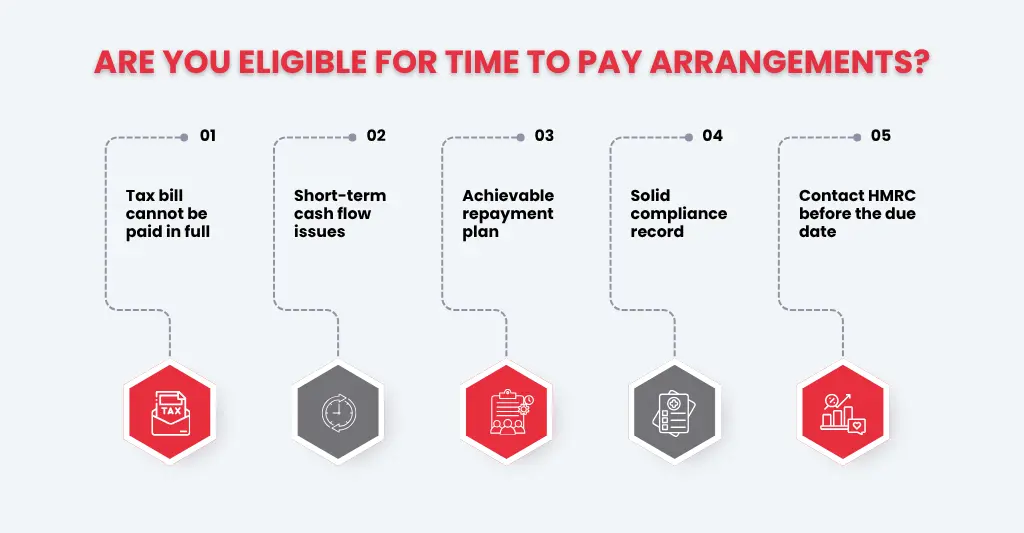
A Time to Pay (TTP) arrangement is not available to all businesses with tax bills. Businesses that are experiencing temporary financial difficulties but are still able to pay their taxes in instalments over time are typically granted TTP requests by HMRC.
Your business may be eligible if:
- Your tax bill cannot be paid in full before the deadline.
- The online TTP tool is useful for debts under HMRC’s online thresholds for VAT, corporation tax, or PAYE.
- The financial hardship is short-term rather than long-term.
- You have an achievable strategy to pay back the remaining balance.
- Your company has a solid track record of timely tax return filing and payment.
- You get in touch with HMRC as soon as you can, ideally before the due date.
- If asked, you can give information about your earnings, expenses, cash flow, and existing debts.
HMRC will consider your unique situation before making an option. HMRC will find it easier to evaluate your request if you can give them more details about your financial situation and repayment plan.
How to Apply for an HMRC Time to Pay Arrangement: Step by Step
If you follow the correct procedures, applying to HMRC for a Time to Pay (TTP) agreement is simple. Here are the detailed steps for UK companies:
Check Your Eligibility: Make sure your company is eligible for a TTP arrangement before applying. You must be able to provide a reasonable repayment plan and be going through brief cash flow issues.
Gather Financial Information: Compile information about your company’s revenue, costs, unpaid taxes, and cash flow. In order to evaluate your request, HMRC will require this information.
Contact HMRC Early: As soon as you realise you could have trouble making the payment, get in touch. To file a TTP request, you can use HMRC’s online tool or call their helpline.
Propose a Repayment Plan: Specify how much you are willing to pay and for how long. Larger debts may permit extensions beyond 12 months, subject to HMRC credit checks and security requirements, although most agreements are only valid for 12 months.
Negotiate Terms if Needed: HMRC can object to your suggestion or ask for more details. Decide on manageable instalments with them.
Receive Confirmation: After approval, HMRC will provide written confirmation of the agreement, together with the agreed-upon payment plan. Don’t forget to save a copy for your records.
Make Payments on Time: Make sure to follow the decided schedule of payments. If you fail to make the payment, your arrangement will be cancelled, leading to penalties or HMRC enforcement action.
Maintain Compliance: File tax returns and pay all pending liabilities on time because HMRC monitors compliance throughout the arrangement period.
If you properly follow these steps, the process will go more smoothly, and your company will be able to handle tax requirements without undue stress.
Interest, Penalties and Your Obligations During the Arrangement
While a Time to Pay (TTP) arrangement can extend the time your company has to pay a tax bill, it doesn’t relieve you of your responsibility to do so. You can prevent unexpected costs by being aware of how interest, fines, and continuing obligations operate. Or else, a Company Voluntary Arrangement (CVA) may be an option to handle debt more thoroughly in certain situations if your company is experiencing more severe financial problems.
Interest May Still Apply: Interest is charged on the remaining balance until the debt is settled. From 9 January 2026, HMRC’s late payment interest rate is 7.75% per annum (base rate + 4%), depending on the tax type.
Penalties Can Often Be Avoided: You might be able to avoid additional late payment penalties if you get in touch with HMRC early and adhere to the predetermined repayment schedule. Penalties might still be imposed, though, if tax returns were submitted after the deadline or if payments were not made on time.
Make Every Payment on Time: Making each instalment by the scheduled date is crucial after the agreement is in place. HMRC may terminate the agreement and take legal action to collect the unpaid balance if payments are not made. If TTP fails, HMRC can enforce via: statutory demand (21 days to pay), CCJ, distraint (seize assets), or winding-up petition. A Company Voluntary Arrangement (CVA) could be a systematic way to formally handle all creditors, including HMRC, in terrible situations when payments cannot be made.
Keep Up With Future Tax Obligations: Only the tax liability specified in the agreement is covered by a time-to-pay arrangement. You must keep filing your taxes on time and paying any additional taxes as they become due.
Inform HMRC if Circumstances Change: Get in touch with HMRC right away if your company faces additional financial challenges and you think you might find it difficult to make the agreed-upon payments. You have a greater chance of finding a solution before the arrangement is impacted if you address problems early.
CVA vs TTP: A Simple Example
Time to Pay (TTP) Arrangement: Jane can use HMRC to extend the £50,000 tax bill over a 12-month period. She pays her instalments, keeps up her regular trading, and timely files all of her tax filings. For short-term cash flow problems, TTP works best.
Company Voluntary Arrangement (CVA): Jane might request a CVA if her company is having problems with more than HMRC. HMRC and other creditors agree to accept lower payments over a longer time frame. Although the CVA is a formal legal agreement with extra control, Jane’s business still operates.
Key Difference: A CVA is a formal legal remedy for larger debt issues impacting several creditors, whereas TTP is an informal tax-only payback plan.
What Happens If HMRC Rejects Your Time to Pay Application?
Rejecting a Time to Pay (TTP) application does not always indicate that your company is at a loss. It merely indicates that, given your existing financial situation, HMRC is not certain that the suggested solution is appropriate.
There are several reasons why HMRC may refuse a request, including:
- A history of missed tax payments or late filings.
- Insufficient evidence of temporary financial difficulties.
- A tax debt repayment plan proposal that HMRC considers unrealistic.
- Concerns about the business’s ability to meet future instalments.
What Should You Do Next?
The tax liability should not be ignored if your application is not accepted. Get in touch with HMRC as quickly as possible to discuss your alternatives and know the reasons for rejection. In certain situations, offering more financial details or suggesting an updated payback schedule might produce a different result.
Seek Professional Advice: You can evaluate your alternatives and interact with HMRC on your behalf with the assistance of an accountant, tax advisor, or insolvency practitioner. Businesses frequently have greater flexibility and a higher possibility of discovering a practical solution when they start early.
Consider Other Debt Solutions: If your business is facing major debt issues other than tax debt, you can try other debt solutions. For example, A Company Voluntary Arrangement (CVA) can assist companies in continuing to operate while repaying several creditors under a predetermined repayment plan.
HMRC Time to Pay vs Other Business Debt Solutions
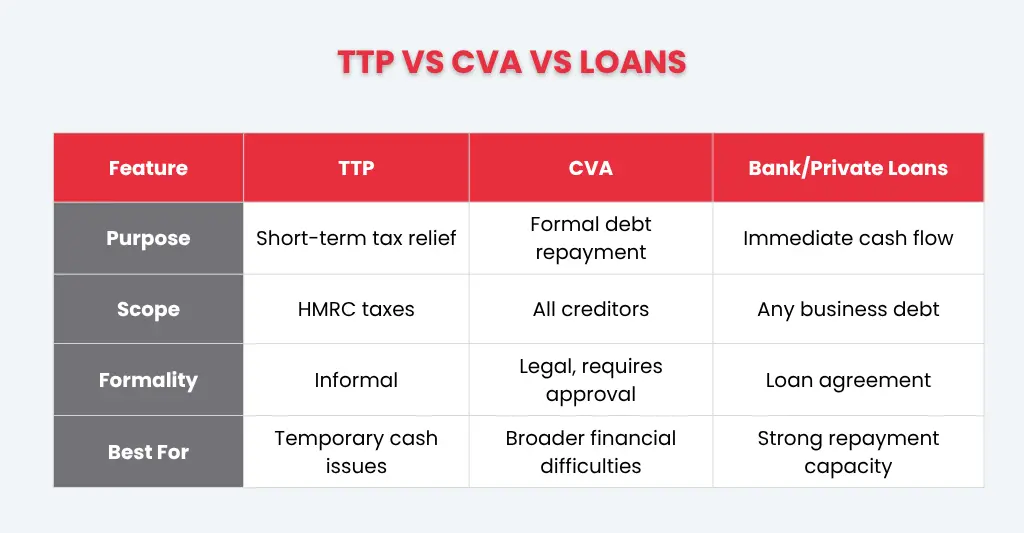
It’s critical to understand the options available when a company faces difficulties paying taxes or other bills. Time to Pay (TTP) arrangements offered by HMRC are just one of many options. This is how TTP contrasts with other popular solutions for corporate debt:
Time to Pay (TTP) Arrangement:
- Purpose: Divide the tax payments for a short period of time to manage temporary cash flow issues.
- Scope: Covers certain HMRC tax obligations, like income tax, corporation tax, VAT, and PAYE.
- Formality: Informal agreement with HMRC; no legal processes or courts are involved.
- Best For: Companies with sound financial status but temporary cash flow issues.
Company Voluntary Arrangement (CVA):
- Purpose: A formal legal solution to repay multiple creditors over time.
- Scope: Includes coverage for lenders, suppliers, and HMRC, among other debts.
- Formality: Legal agreement supervised by an insolvency practitioner; requires creditor approval.
- Best For: Businesses facing broader financial difficulties, not just tax debt, but want to continue trading.
Bank or Private Business Loans:
- Purpose: To pay for immediate commitments, such as taxes, and obtain additional funds.
- Scope: Can be used for any business debt, not limited to HMRC.
- Formality: Demands loan approval, interest payments, and possibly personal guarantees.
- Best For: Businesses with strong repayment capacity but temporary cash shortfalls.
FAQs: Frequently Asked Questions
Will HMRC reduce the amount of tax I owe under a TTP arrangement?
No, HMRC will not reduce the amount you need to pay under a TTP arrangement. It just allows you to extend the period of payment for your pending tax.
Can a Time to Pay arrangement last longer than 12 months?
Yes, in some cases. Depending on the amount owing and the financial situation of your company, HMRC may permit a longer payback period, even though many Time to Pay arrangements are set for up to 12 months. HMRC evaluates each application on an individual basis and takes into account whether the suggested repayment plan is reasonable and practical.
What happens if my business’s financial situation improves during the TTP period?
If your finances improve, you can pay off the remaining tax debt early, which will reduce the interest charged on the outstanding balance.
Can I include multiple tax debts in one Time to Pay arrangement?
Yes, depending on your financial circumstances and repayment plan, HMRC can permit you to include multiple tax liabilities, such as VAT, PAYE, and Corporation Tax, in a single Time to Pay agreement.
What happens if I miss a payment under my TTP arrangement?
Your Time to Pay agreement will be cancelled if a payment is missed. After that, HMRC can demand the full amount of unpaid taxes right away, impose fines, or conduct enforcement action. If you believe you have missed a payment, it’s critical to get in touch with HMRC right away.
Can a TTP arrangement cover future tax liabilities, not just existing debts?
No, a Time to Pay plan just pays current tax liabilities. You must continue to adhere to the terms of the agreement and pay any future tax obligations on schedule.
Can I negotiate a Time to Pay arrangement if I have had one before?
Sure. Even if a business has already had a Time to Pay arrangement, they are still able to request a new one. In order to determine whether a new repayment plan is reasonable and feasible, HMRC will examine your present financial circumstances.
Conclusion
A Time to Pay (TTP) arrangement can be a lifesaver for UK businesses, enabling them to handle tax debts without risking immediate penalties. It offers flexibility to spread payments and preserve HMRC compliance, even while it doesn’t lower the total amount payable.
To secure and effectively manage a TTP agreement, it is essential to comprehend the qualifying requirements, prepare reliable financial information, and communicate openly with HMRC. Options like a Company Voluntary Arrangement (CVA) might provide a more organised solution for companies facing more significant financial difficulties.
Take initiative and be proactive. For professional advice and useful assistance catered to your company, get in touch with Cox Hinkins right now if you need help with HMRC Time to Pay arrangements, CVAs, or other tax solutions.