- What is Corporation Tax?
- How to Determine Your Corporation Tax Rate?
- Understanding Corporation Tax Deadlines
- How to Calculate Your Corporation Tax Payment Deadline
- Can You Delay Your Corporation Tax Payment?
- How to Pay Your Corporation Tax?
- Consequences of Missing the Corporation Tax Deadline
- Tips for Staying Compliant and Reducing Errors
- FAQs: Frequently Asked Questions
- Conclusion
If you are a business owner in the UK filing corporation tax is a basic responsibility that needs to be fulfilled every year. For that purpose you should know what is the corporation tax payment deadline?
Imagine you are busy working on day-to-day tasks, suddenly you remember corporation tax payment is pending. You start asking yourself: “When is it actually due? How do I make sure I don’t get fined? Am I doing this right?” These are the most common questions that start stressing your mind.
Instead of taking stress you just need to know how to be prepared, how to pay it on time, and simple tips to stay compliant. You can breathe easier and focus on growing your business, instead of worrying about penalties. All you have to do is read this blog, to get the answers you need.
What is Corporation Tax?
All limited firms are subject to corporation tax, which is deducted from their profits. Businesses in the UK are charged on all of their profits when it comes to corporation tax because they do not have tax-free exemptions. Nevertheless, you can deduct certain costs and expenses, such as those related to travel or equipment, which will reduce your overall corporate tax liability.
How to Determine Your Corporation Tax Rate?
The taxable profits of your business determine your corporation tax rate. For the majority of UK businesses in 2026:
- For 2026 most companies pay 19% on profits up to £50,000.
- 25% on profits at or above £250,000, with marginal relief for profits between £50,001 and £249,999
HMRC gives precise instructions on which rate is applicable on your business. You can accurately calculate payments and prevent surprises by being aware of your rate early on.
Understanding Corporation Tax Deadlines
Corporate tax has rigid deadlines established by HMRC, compared to other bills that you can pay at any time. It is crucial to comprehend these corporation tax deadlines because failing to do so will result in fines, interest, and needless stress for your company.
Here’s what you need to know:
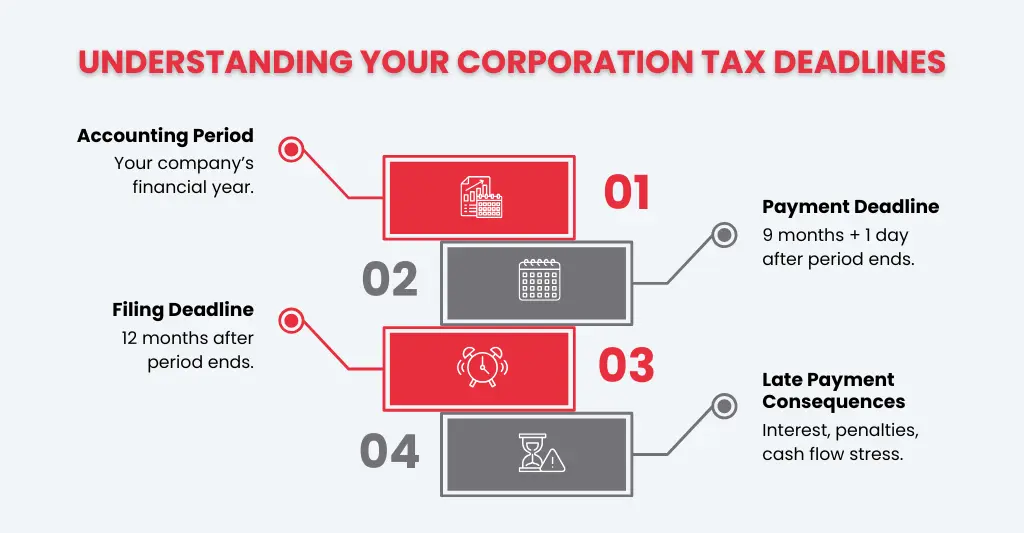
The Accounting Period Matters: The accounting period for your business, which is often your fiscal year, determines your corporation tax. The tax is calculated based on the profit your company generates during this time.
Payment Deadline: After your accounting period ends, you have nine months and one day to pay your corporation tax. For instance, your payment is due by January 1st of the following year if your company’s accounting period concludes on March 31st.
Filing vs. Payment: Filing your company tax return and paying your corporation tax are two distinct but connected procedures. While filing your company tax return (CT600) is due 12 months after the end of the accounting period, corporation tax payments are typically due 9 months and 1 day after the end of the accounting period. It’s crucial to prepare your accounts and predictions ahead of time to prevent underpayment or penalties because payment is due far in advance of filing.
Consequences of Late Payment: Paying late can result in:
- Interest charges on the unpaid tax.
- Penalties from HMRC.
- Additional stress and potential cash flow issues for your business.
You can make sure your company remains compliant and keeps out of trouble by being aware of your accounting period, properly identifying your payment date, and planning ahead.
How to Calculate Your Corporation Tax Payment Deadline
It may appear difficult to calculate your corporation tax payment deadline, but if you know the requirements, it’s actually quite simple. This is how it operates:
- Know Your Accounting Period End Date: Determining the end of your company’s accounting period is the first step. This is typically the last day of your financial year, such as March 31 or December 31.
- Add Nine Months and One Day: Corporation tax must be paid to HMRC nine months and one day following the conclusion of the accounting period.
For instance, your corporation tax is due on January 1, 2027, if your accounting period ends on March 31, 2026.
- Check for Special Cases: Businesses with high profits could be required to pay corporation tax in installments as opposed to all at once. Always calculate the deadline using the actual period end date, regardless of how long or short your accounting period is.
- Mark It in Your Calendar: Once you are aware of the corporation tax payment deadline, make sure to explicitly indicate it in your accounting software or calendar. By doing this, you can reduce last-minute stress and make sure you have enough time to prepare for the payment.
You may keep your firm compliant and penalty-free by using these procedures to precisely determine your Corporation Tax payment deadline and make advance plans.
Can You Delay Your Corporation Tax Payment?
In general, the response is no. Nine months and one day following the end of your business’s financial cycle, corporation tax is due. By this date, HMRC expects the entire payment; failure to do so will cause penalties.
Therefore, any UK business must pay corporation tax on time. If the payment deadline is missed, there will be fines, interest, and HMRC compliance problems. Generally, a lot of business owners want to know if they can postpone paying corporation taxes if their cash flow is tight.
However, there are some situations where payments can be structured differently:
Instalment Payments for Large Companies:
Large-company instalments: Companies with taxable profits of £1.5 million or more (the figure is apportioned down if you have associated companies) normally pay corporation tax in quarterly instalments starting six months and 13 days into the accounting period — see HMRC for the full schedule and how associated company rules apply.
Time-to-Pay Arrangements:
If you cannot pay, contact HMRC before the due date and explain your cashflow, proposed repayment plan and supporting documents; HMRC will assess affordability and may charge interest even if a Time-to-Pay arrangement is agreed.
Important points about TTP arrangements:
- Prior to the due date, you must get in touch with HMRC. You won’t be shielded from fines by merely making late payments without consent.
- Your request is assessed by HMRC according to your financial status and payment capacity.
- Under a TTP agreement, interest may still be applicable, and late payments may result in fines.
What Happens If You Delay Without Permission:
If you delay your Corporation Tax payment without HMRC approval:
- Interest is charged on the overdue amount from the day after the deadline.
- Penalties may be applied depending on how late the payment is.
- Up to 6 months late: 5% of the unpaid tax.
- 6–12 months late: an additional 5% of the unpaid tax.
- Over 12 months late: HMRC may impose further penalties.
How to Pay Your Corporation Tax?
Paying corporation tax might feel a tough task, but HMRC provides simple and secure ways for UK taxpayers to make the payment smoothly. Understanding your options and the process ensures you stay compliant and avoid penalties.
These are some of the ways to pay your corporation tax:
Online via HMRC’s Corporation Tax Service
Using HMRC’s online Corporation Tax service is the most popular and practical option. Paying online:
- Sign up your business for online HMRC services.
- Use your accounting records to determine your corporation tax.
- Use your company bank account to make the payment.
This process is quick, secure, and automatically entered into the HMRC system.
Direct Debit:
You can schedule a direct debit for your corporation tax payment with HMRC. This helps to prevent missed deadlines by guaranteeing that the tax is paid automatically on the due day.
BACS, CHAPS, or Faster Payments:
You can also pay via bank transfer methods:
- Bankers’ Automated Clearing Services (BACS): Usually takes 3 working days.
- Clearing House Automated Payment System (CHAPS): Same-day payment (ideal if the deadline is close).
- Faster Payments: Typically instant, depending on your bank.
In order for HMRC to match the payment to your account, you must always include your company’s Unique Taxpayer Reference (UTR) as the payment reference.
By Cheque
Doing payment via cheque is very uncommon today, but still it is acceptable and easy.
- Make the cheque payable to ‘HM Revenue and Customs only’.
- Include your company name, UTR, and accounting period on the back.
- Send it to HMRC well in advance to ensure it’s processed by the deadline.
Key Tips to Ensure Smooth Payment
- Plan before the deadline arrives and it will reduce your last minute stress.
- Make sure your calculations are accurate and cross-check it.
- After making the payment preserve the proof safely, in case HMRC asks it anytime.
- See if HMRC permits quarterly payments or a Time-to-Pay arrangement if your business is big or experiencing cash flow problems.
Consequences of Missing the Corporation Tax Deadline
Paying Corporation tax on time is not just a normal responsibility but a legal requirement too. If you miss the deadline, your company might face severe penalties and HMRC compliance problems. Here’s what can happen if you make payment late:
Interest on Late Payments: Any corporation tax that is not paid by the deadline is subject to interest charges from HMRC. The day after your payment is due is when interest begins to accumulate and it doesn’t stop until the tax is paid in full. Interest will be charged even if you are only a few days late.
Late Payment Penalties: In addition to interest, HMRC can apply penalties for late payments:
- Up to 6 months late: 5% of the unpaid tax.
- 6–12 months late: An additional 5% of the unpaid tax.
- Over 12 months late: Further penalties may be added, depending on your circumstances.
Impact on Your Company Record: Missing deadlines on a regular basis can harm your business’s reputation with HMRC. Future tax inspections or requests for payment arrangements can become stricter or challenging to set up as a result.
Cash Flow Stress: Due to penalties and interest added to the initial tax bill, late payments can put an unexpected burden on cash flow. Your capacity to pay employees, suppliers, and other costs may be impacted by this.
Risk of Enforcement Action: If tax remains unpaid for a prolonged period, HMRC can use enforcement options (e.g., distraint, statutory demands, or winding-up petitions), usually after repeated attempts to collect.
Tips for Staying Compliant and Reducing Errors
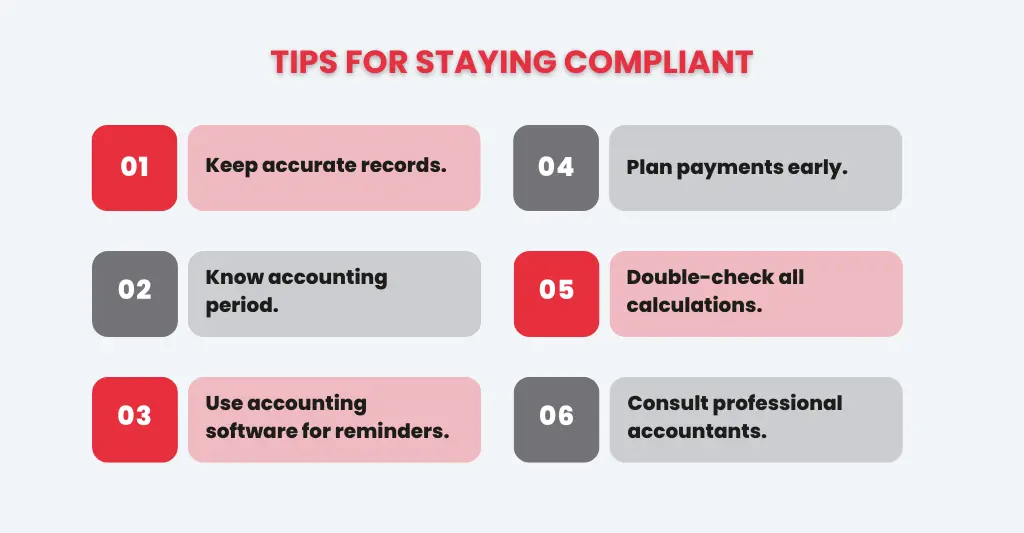
- Keep Accurate Records – Track all income, expenses, and invoices.
- Know Your Accounting Period – Helps calculate profits and deadlines correctly.
- Use Accounting Software – Automates calculations and sends payment reminders.
- Plan Payments Early – Budget ahead and set aside funds for tax.
- Double-Check Details – Verify calculations, accounting period, and payment reference.
- Get Professional Help – Accountants can ensure accuracy and identify tax reliefs.
FAQs: Frequently Asked Questions
What date does corporation tax have to be paid?
After your company’s accounting period ends, you have nine months and one day to pay the corporation tax. For example, the payment must be made by January 1st of the following year if your accounting period ended on March 31st.
What happens if I pay corporation tax late?
If you make a late payment, HMRC may impose penalties and charge interest on the amount that is past due. Repeated late payments can also harm your company’s compliance record, and penalties grow with the length of time the payment is past due.
Can I legally reduce my corporation tax bill?
Sure. By taking advantage of capital allowances, tax breaks, and approved business expenses, you can legally lower your corporation tax. You can find allowable deductions while adhering to all HMRC regulations by working with an accountant or tax advisor.
How do my accounting dates affect payment deadlines?
Your company’s accounting period, which is the beginning and conclusion of your fiscal year, determines when you must pay your corporation tax. Nine months and one day after the end of the accounting period, the tax must be paid. You can avoid penalties and accurately calculate deadlines if you are aware of your dates.
Conclusion
One of the most important duties for any UK company is corporation tax. Paying it on time helps you better manage your finances, maintains your business in compliance, and prevents fines and interest. You will be on top of your tax obligations and concentrate on expanding your business by understanding what it is, being aware of your deadlines, figuring out the suitable amount, and selecting the appropriate payment option.
The staff at Cox Hinkins can assist you with any accounting issues or corporation tax. You can relax knowing that your taxes are calculated correctly, filed on time, and fully compliant with HMRC thanks to our skilled corporation tax accountants. To begin and reduce the stress associated with corporation tax, get in touch with Cox Hinkins right now.
Disclaimer: Kindly note this blog provides general information and should not be considered financial advice. We recommend consulting a qualified financial advisor for personalised guidance. We are not responsible for any actions taken based on this content.