- What is Business Asset Disposal Relief (BADR)?
- How Business Asset Disposal Relief Works?
- Who is Eligible for Business Asset Disposal Relief?
- Qualifying Disposals for Business Asset Disposal Relief
- Business Asset Disposal Relief Rates (2025–2026 Updates)
- How to Calculate Business Asset Disposal Relief
- How to Claim Business Asset Disposal Relief
- Strategic Tax Planning Tips to Maximise BADR
- Conclusion:
- Frequently Asked Questions (FAQ)
Selling a business is more than a financial choice for many business owners. It marks the end of a chapter that has involved long hours, difficult decisions, and years of personal sacrifice. That is why every pound counts when it is time to leave.
Business Asset Disposal Relief can help with that move by lowering the tax on your earnings, allowing you to keep more of what you have worked so hard for. That support can mean a lot to people who have invested their time, energy, and ambition in building a firm.
In this blog, we will look at how the relief works, who may claim it, and why understanding it before ending could save you hundreds.
What is Business Asset Disposal Relief (BADR)?
The business Asset Disposal Relief reduces the amount of Capital Gains Tax (CGT) payable on the disposal of qualifying assets as long as certain conditions are met over a two-year qualifying period, either up to the date of disposal or the day the firm ceased operations.
Among other things, the relief is offered to persons who choose to terminate the limited business through which they have been dealing. If a limited company contractor who is also the director has decided to liquidate their firm, possibly in favour of a permanent role, or has retired and no longer needs a limited company, they should consider whether they may be eligible for this relief.
BADR cuts the CGT rate for eligible gains to 18%, down from the regular 24% rate for higher-rate taxpayers. This compensation is limited to a lifetime maximum of £1 million in eligible gains.
How Business Asset Disposal Relief Works?
Business Asset Disposal Relief (BADR), formerly known as Entrepreneurs’ Relief, allows business owners to pay a 10% Capital Gains Tax (CGT) rate on qualifying business disposals, rather than the standard rate, which can be as high as 20% for basic-rate taxpayers and 25% for higher-rate taxpayers.
To benefit, certain conditions must be met:
- Lifetime Limit: The total amount of gains eligible for BADR is limited to £1 million per individual (accumulative over a lifetime).
Who is Eligible for Business Asset Disposal Relief?
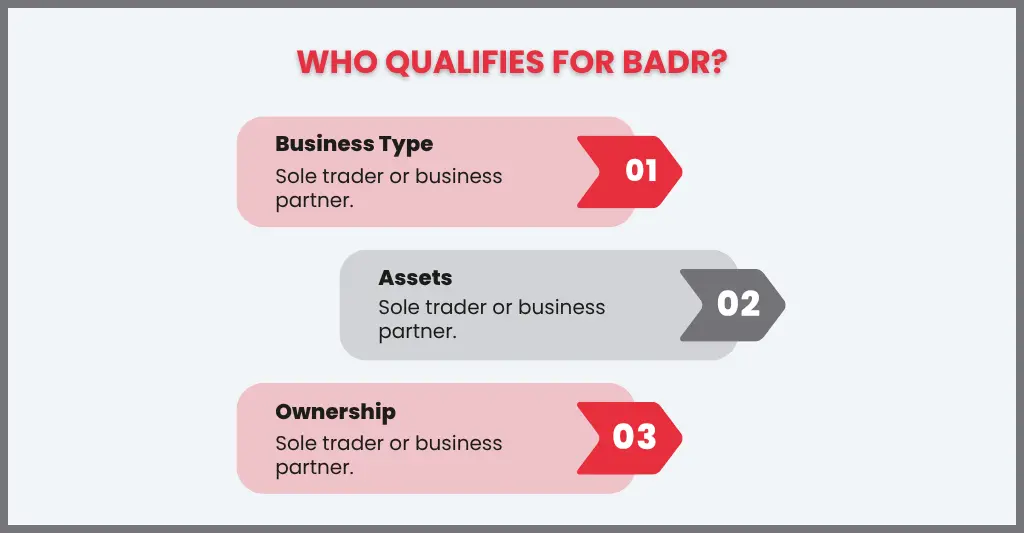
Business Asset Disposal Relief (BADR) may drastically reduce the amount of capital gains tax owed when qualifying business assets are sold or disposed of. However, not all business owners are immediately qualified. To be qualified, you must meet certain ownership, business structure, and asset disposition criteria.
To qualify for BADR, you generally must:
- Be a Sole Trader or Business Partner: As a sole trader, you conduct your firm under your own or a trading name.
- Partner in a business partnership
- Sell or Dispose of Relevant Business Assets: BADR only applies when you sell business assets. This includes:
- Tangible assets (e.g., equipment or property utilised solely for business)
Qualifying Disposals for Business Asset Disposal Relief
Not every business sale or asset disposal is automatically eligible for Business Asset Disposal Relief. BADR only applies to specific sorts of disposals that meet HMRC’s requirements. Understanding what counts can help business owners plan tax-efficient departure strategies.
Main Types of Qualifying Disposals:
- Sale of a Sole Trader Business: Selling the entire or a portion of the business may qualify if the ownership and trade standards are met.
- Sale of Business Assets:
- Tangible assets such as machinery, equipment, or office space that are used for business purposes can be qualified.
- Assets must have been used in the firm for at least two years before disposal.
- Gifts of Business Assets: In some situations, giving away business assets as a gift may be considered a disposal and subject to BADR.
Business Asset Disposal Relief Rates (2025–2026 Updates)
Business Asset Disposal Relief (BADR), formerly known as Entrepreneurs’ Relief, lowers the Capital Gains Tax (CGT) rate on eligible business disposals. It is intended to help business owners and investors by minimising the tax burden when selling or disposing of a company or its assets.
Key BADR Rate Updates (2025–2026)
- Current Rate (6 April 2025 – 5 April 2026): The BADR rate is 14%. This is an increase from the previous 10% rate.
- Future Rate (From 6 April 2026): The rate is set to increase to 18% for the 2026–27 tax year.
- Lifetime Limit: The maximum amount of qualifying gains remains capped at £1 million per individual.
How to Calculate Business Asset Disposal Relief
To calculate Business Asset Disposal Relief (BADR), first determine your eligible capital gain and then use the reduced Capital Gains Tax (CGT) rate. Proper calculation ensures that you maximise the relief while remaining completely compliant with HMRC laws.
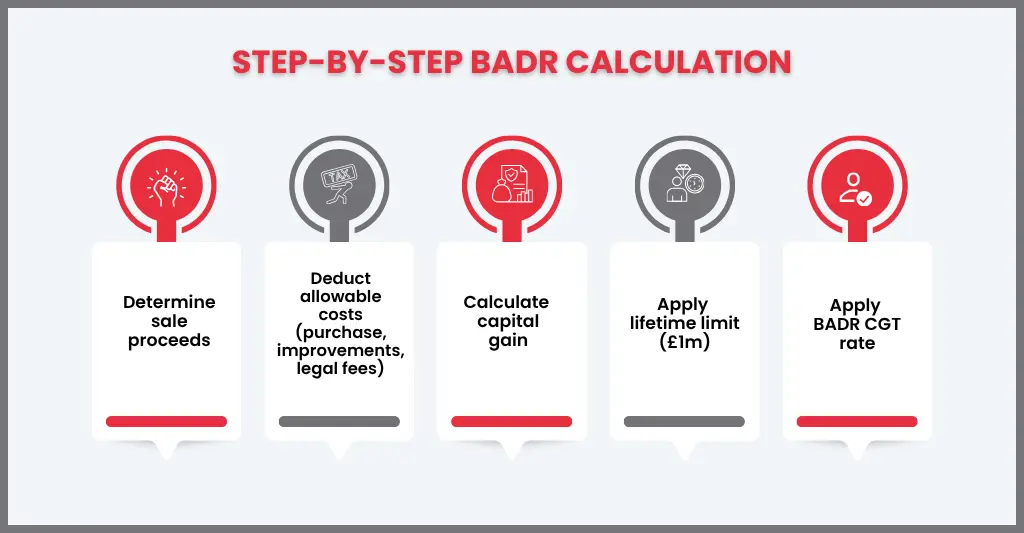
Step-by-Step Calculation
Step 1: Determine the Sale Proceeds: Begin with the whole money you earned from the sale of your firm, business assets, or trading company shares. Include any cash, property, or other compensation received.
Step 2: Deduct Allowable Costs: Subtract the asset or business’s original purchase price.
Deduct permissible expenses such as:
- Legal fees and professional advice about the selling.
- Costs of enhancing the business asset (capital improvements).
- Indirect costs directly associated to disposal
Step 3: Calculate the Capital Gain
Capital Gain=Sale Proceeds−Original Cost−Allowable Costs
This is the total gain that could potentially qualify for BADR.
Step 4: Apply the Lifetime Limit
BADR relief is only provided for gains of up to £1 million per person (lifetime maximum).
Any gain exceeding this limit is taxed at the usual CGT rates (20% for higher/additional rate taxpayers).
Step 5: Apply the BADR Rate: Multiply the qualifying gain (up to the lifetime limit) by the 10% CGT rate.
BADR Tax Payable=Qualifying Gain (up to £1m)×10%
Example: Suppose Sarah, a sole trader, sells her business for £500,000, and her original investment and allowable costs total £200,000:
- Capital Gain = £500,000 − £200,000 = £300,000
- Lifetime limit is £1 million, so full £300,000 qualifies.
- BADR applies: £300,000 × 10% = £30,000 CGT payable
If Sarah had previously claimed £800,000 of BADR, only £200,000 of this gain would qualify under the remaining lifetime limit.
How to Claim Business Asset Disposal Relief
Business Asset Disposal Relief (BADR) allows eligible business owners to pay a 10% Capital Gains Tax (CGT) on qualifying business disposals. The lifetime limit of claim is £1 million per individual. Even if you meet all of the eligibility requirements, you must actively claim the relief through HMRC to take advantage of the lower rate.
- Determine Eligibility Before Claiming: Before filing a claim, make sure you meet all BADR requirements:
- You have owned the firm or assets for at least two years before selling.
- Disposal is a qualifying event that includes:
- Selling the entire business or a portion of it.
- Selling business assets, including machinery, property, and equipment.
- Selling stock in a trading company.
- Calculate Your Qualifying Gain: Calculating your qualifying gain correctly is the foundation for claiming BADR. Steps include:
- Calculate total sale proceeds – cash, property, or other consideration received.
- Deduct allowable costs – purchase price, capital improvements, legal/professional fees.
- Apply the lifetime limit – BADR applies only to gains up to £1 million. Gains above this limit are taxed at standard CGT rates.
- Apply the BADR CGT rate – currently 10% on qualifying gains.
Example:
- Sarah sells her sole trader business for £500,000.
- Original investment + allowable costs = £200,000.
- Capital gain = £500,000 − £200,000 = £300,000.
- Lifetime limit remaining = £1 million, so full £300,000 qualifies.
- CGT payable = £300,000 × 10% = £30,000.
- Claiming BADR Through Self-Assessment: BADR claims are mostly done through the self-assessment tax return (SA100). Specifically using the Capital Gains Summary (SA108) form.
Steps:
- Register for Self-Assessment (if not already registered).
- Complete SA108 form:
- Enter asset or business details
- Date of disposal
- Total gain and qualifying gain for BADR
- Relief claimed
- Submit by the deadline – usually 31 January following the tax year of disposal.
Late claims are allowed up to four years after the end of the tax year in which the disposal occurred.
Alternative Methods for Claiming: If you don’t typically submit a self-assessment return:
- Claim BADR online or by letter to HMRC, including complete details of the disposal, gain, and relief claimed.
- Trustees and estates can claim BADR on eligible disposals under the same rules.
- Keep Detailed Records: To verify your claim HMRC may ask valid proofs for it. Make sure to keep documents safe and handy.
- Purchase and sale invoices for business assets
- Legal, accounting, and improvement costs
Strategic Tax Planning Tips to Maximise BADR
Business Asset Disposal Relief (BADR) can greatly lower your Capital Gains Tax (CGT) payment when you sell a business or qualified assets. Effective use of the £1 million lifetime cap and 10% CGT rate requires smart tax planning and timing.
- Plan the Timing of Your Disposal:
- Ownership duration matters: Any asset you are disposing should be owned at least for 2 years before selling it.
- Spread disposals across tax years: If your gains are likely to exceed the £1 million lifetime limit. Then consider selling assets in stages over different tax years to make the most of the relief,where HMRC rules are allowed.
- Coordinate with other capital gains: Plan your sale with years where you have other gains or loses, so you can offset them and reduce the overall tax payable.
- Maximise the Lifetime Limit:
- Track prior BADR claims: To avoid exceeding the £1 million lifetime limit, it’s important to keep track of previous disposals.
- Consider transferring assets to a spouse or civil partner: Each member has their own lifetime limits, which can essentially double the relief for family-owned firms.
- Focus on Qualifying Assets:
- Avoid personal or investment assets: Selling personal assets, such as real estate or non-trading investments, will not attract BADR.
- Combine BADR With Other Tax Reliefs:
- Use capital losses: To lower overall CGT, offset additional capital gains with losses from past disposals.
- Annual exempt amount: Apply your CGT yearly exemption (£6,000 for the tax year 2025/26) before applying BADR.
- Pension contributions: In some situations, making contributions prior to a disposal might decrease income tax while also supplementing CGT relief.
Conclusion:
Business Asset Disposal Relief ( BADR ) – A relief for UK business owners wanting to keep some of that cash when they sell their business, assets or shares in a trading company. You really just need to wrap your head around eligibility, what kinds of disposals qualify for the relief, the lifetime limit, and how to put in a claim before you can start thinking about making the most of the tax breaks.
You also need to keep on top of your record-keeping, not miss any deadlines for disposals, and if you are not 100% sure what you are doing then get some expert advice. Paying close attention to all these things is pretty much essential for getting the most out of BADR and staying on the right side of HMRCs rules. There are firms like Cox Hinkins who have sole trader accountants specialise in sorting out the tax rules for business owners, helping with smooth exits, getting succession planning right, and making sure their financial future is looking good.
Frequently Asked Questions (FAQ)
What is Business Asset Disposal Relief?
The Business Asset Disposal Relief (BADR) allows qualifying business owners to pay only 10% Capital Gains Tax on gains from selling a business, assets, or shares in a trading company, up to a lifetime limit of £1 million. It must be claimed via self-assessment or HMRC notification.
Is BADR still 10%?
Not always. The Business Asset Disposal Relief (BADR) CGT rate has changed in recent years:
1. Before 6 April 2025: qualifying gains were taxed at 10%.
2. 6 April 2025 to 5 April 2026: the rate increased to 14%.
3. From 6 April 2026 onwards, the BADR rate rises to 18% on qualifying disposals.
Who qualifies for Business Asset Disposal Relief?
BADR is for sole traders, business partners, or company shareholders who have possessed qualifying business assets or shares for at least two years and meet the trading and active involvement requirements.
What is the lifetime limit for BADR?
The lifetime limit for Business Asset Disposal Relief (BADR) is £1 million per person. Gains up to this amount are taxed at the lower 10% rate, while any amount above that level is taxed at Capital Gains Tax rate.
How long do you need to qualify for BADR?
To qualify Business Asset Disposal Relief, you need to own the business or assets for at least 2 years before selling. Company stockholders must also have been an employee or officer of the company for at least two of the five years before the sale of their shares.
How do I claim BADR and what is the deadline?
You claim BADR on your self-assessment tax return by completing the Capital Gains Summary (SA108) form. If you do not generally file, you can contact HMRC directly. The deadline is usually the 31st of January after the conclusion of the tax year in which the disposal occurred. Late claims can be filed up to four years after the tax year ends.